
When different applications communicate and share information, they require APIs. For this reason, API management is essential for businesses to fix errors and improve customer experience.
Here, you can explore what is API management, how businesses manage APIs, and its benefits. It helps you understand the importance of APIs in a business.
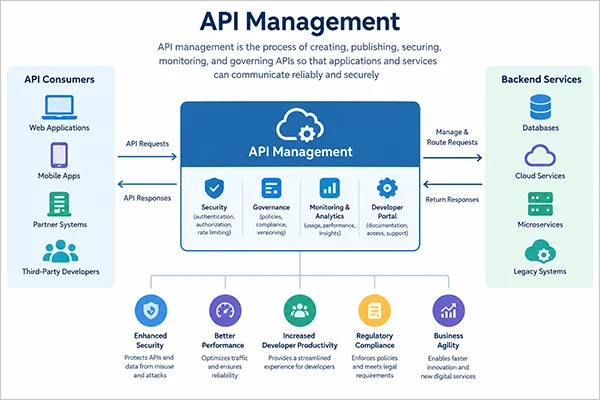
API stands for Application Programming Interface. It works as a mediator that connects different applications to share information. For example, when you order a couch from Amazon, the software uses APIs to handle your payments and order details.
On the other hand, API management is the process of creating, securing, monitoring, and connecting APIs throughout their lifecycle. It helps businesses improve API performance and protect confidential information. The right management ensures business operations run smoothly.
Businesses should manage API security, access management, API monitoring, API rate limiting, API lifecycle management, and API analytics and reporting.
Here are the steps you can follow to enhance API management.
1. API Security
You can use encryption, authentication, and access controls to secure your APIs. This helps you prevent data breaches and system abuse because modern applications heavily rely on APIs.
2. Access Management
Companies can easily decide who can use their specific APIs for trustworthy and smooth management. They can implement standardized security frameworks to remove security flaws.
3. API Monitoring
Modern apps depend on third-party interactions and customers. This means that businesses should regularly monitor their APIs. This includes performance, errors, traffic, and usage to fix issues.
4. API Rate Limiting
API rate limiting restricts the overuse of the system. As a business owner, you can limit the number of requests a customer makes within a specific period. It controls workload and improves the interface to run smoothly.
5. API Lifecycle Management
API lifecycle management means monitoring the API at every stage. It includes creating, testing, publishing, updating, and retiring. The right API management takes place when you take care of it throughout its life.
6. Analytics and Reporting
Companies should also analyze how their APIs are performing and being used. It helps them improve API management, identify problems, and make better decisions.
Benefits of API management include traffic control, better security, and a live dashboard to fix errors earlier.
As applications heavily depend on APIs, it’s important to design API management for better performance. It also improves communication between applications and provides a better user experience.
That is why you should check your APIs, manage access, improve security, and opt for Techzeel services to enhance business growth.
Ans: API management is the process of creating, publishing, monitoring, and securing APIs for better performance.
Ans: API stands for Application Programming Interface. It connects two different applications for communication and to share information.
Ans: Microsoft Azure API Management, Amazon API Gateway, Apigee (Google Cloud), MuleSoft Anypoint Platform, and Postman Enterprise are the top 5 API management tools.
