

Most product-led growth companies assume great software sells itself. It definitely doesn’t. Creator marketing agencies exist purely because reaching technical buyers requires a very different playbook than standard brand marketing.
The real challenge of all this is filtering out creators with fake follower counts, finding the people who can explain the product accurately, and actually proving results beyond views.
After reviewing dozens of agencies across case studies, client feedback, and platform results, this guide covers five firms worth considering in 2026.
Public information formed the core of this research, pulling from user reviews, case studies, ratings, and official websites across major review platforms and agency directories. Only firms showing a real track record in the tech influencer space made the cut.
→ See the full research breakdown
Picking the incorrect firm in this space doesn’t just waste budget. It produces content that feels off-brand, misrepresents technical features, and attracts the wrong audience entirely.
The trickiest part of tech influencer work is audience quality. A creator with 500,000 followers sounds incredible until you realize half that audience has no interest in SaaS tools or developer platforms. The right firm vets for authentic engagement and real buyer-persona overlap, not just reach numbers.
Beyond that, measurement matters. Vanity metrics like views and likes tell you almost nothing about actual business improvements. Firms that track cost per engaged view, brand-attributed sign-ups through unique promo links, and engagement rate relative to audience size give you data you can actually act on.
That kind of accountability is rare, but it’s what differentiates a firm that grows your brand from one that just produces content.
Note: All data in this table is sourced from review platforms and the official websites of the listed companies.
| Company Name | Years Operating | Headquartered In | Rating |
| Clickstrike | Est. 2018 | New York | Clutch Champion Fall 2023 |
| Directive | Est. 2014 | Irvine, California | – |
| Media Glitch | – | – | – |
| NoGood | – | New York City, Miami, and San Francisco | – |
| inbeat | Est. 2018 | Montreal, Canada | – |
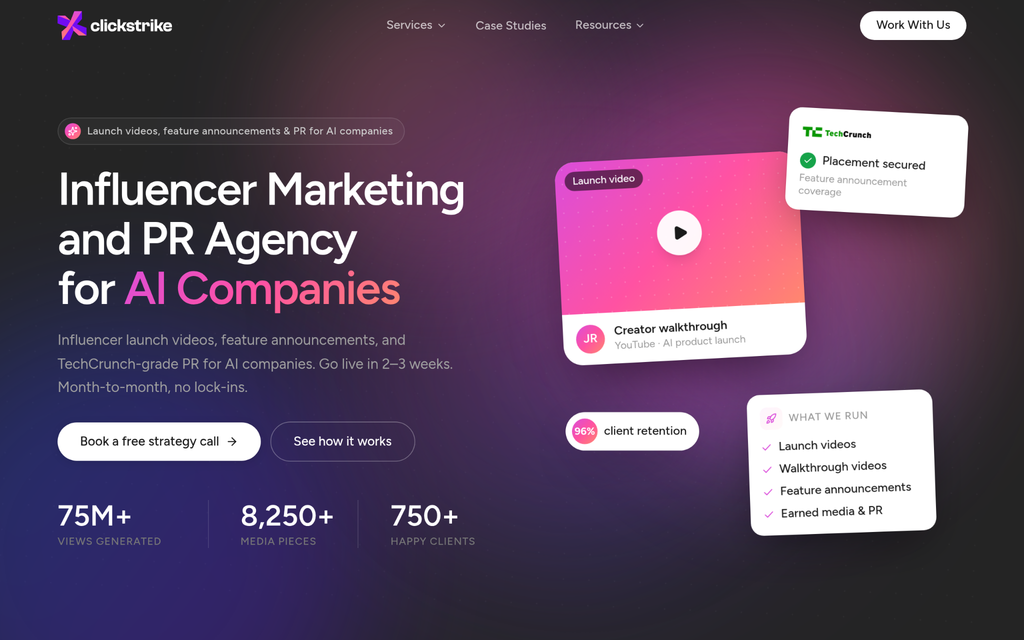
Which Products and Services Does Clickstrike Provide?
Clickstrike puts an emphasis on creator marketing and earned media for AI companies. They place clients with tech creators on YouTube, TikTok, X, and LinkedIn, reaching developers, founders, and technical buyers through walkthrough videos, product reviews, tutorials, and sponsored posts. Beyond creator content, they also secure features in publications like TechCrunch, Forbes, and Business Insider. What renders this firm worth knowing about is that they operate as a proper tech influencer marketing agency with no setup fees and no creator-fee markups built into their pricing.
What’s Clickstrike’s Edge in Tech Influencer Firms?
Many firms in this space weave creator fees into their margins, making it nearly impossible to know what you’re actually paying for. Clickstrike’s month-to-month model with transparent pricing removes that ambiguity, which matters a lot when you’re trying to assess true campaign results.
From the User Reviews:
Clients generally mention the dedicated account management model (one person per engagement, not a shared inbox) as a standout feature. The firm’s 96% client retention rate backs that up, and documented results like generating $192,000 in revenue within three weeks for one client suggest the performance matches the positioning.
Which Products and Services Does Directive Provide?
Directive is a B2B marketing agency founded in 2014, built around steering clients away from MQL-chasing toward generating qualified pipeline. They run three integrated divisions covering performance, commerce, and communications, with their own Stratos platform stitching together CRM, paid media, SEO, and operational data into one real-time view. Having served 420+ brands and pointing to over $1 billion in revenue generated for clients (think ZoomInfo, Adobe, Cisco, and Calendly), they’re pitched more as a demand generation partner than a traditional agency.
What’s Directive’s Edge in Tech Influencer Firms?
The main concern Directive solves is the disconnect between marketing activity and actual revenue outcomes for B2B tech companies that need pipeline, not just impressions. Their DiscoverabilityOS methodology, combined with independent status from media conglomerates, means their recommendations aren’t shaped by media buying incentives.
From the User Reviews:
Directive shows up consistently in standalone B2B agency roundups, which signals real market credibility. Reviews tend to focus on the agency’s strategic depth and the Stratos platform’s ability to give marketers clearer visibility into what’s actually working across channels.
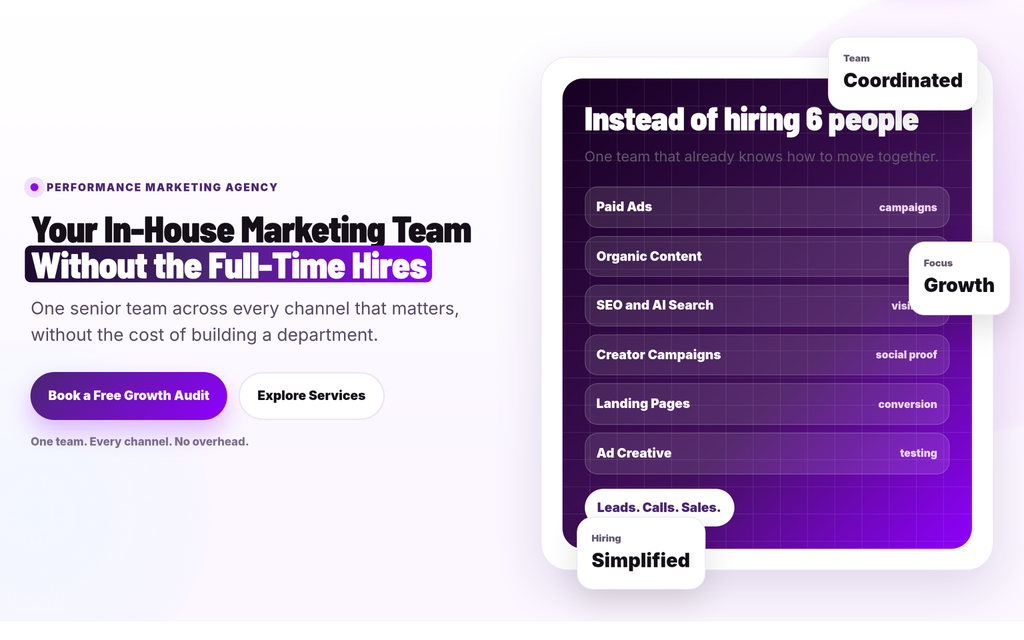
Which Products and Services Does Media Glitch Provide?
Media Glitch offers coordinated performance marketing across paid ads on Meta, Google, and TikTok, alongside organic content growth, SEO and AI search, creator campaigns, landing pages, and ad creative. The positioning is straightforward: one senior team handling everything, so clients aren’t stitching together separate freelancers or growing internal departments for each channel. They track results using conversion-focused metrics like cost per lead, conversion rate, and return on ad spend, not just reach or impressions.
What’s Media Glitch’s Edge in Tech Influencer Firms?
For brands that need creator campaigns to connect directly to paid media and conversion-focused landing pages, having one coordinated team removes a lot of friction that shows up when agencies handle channels in isolation. Their free Growth Audit consultation is a practical way for prospective clients to pressure-test where their current funnel is leaking before committing to anything.
From the User Reviews:
Publicly available review data for Media Glitch is limited relative to the other firms on this list, which makes independent verification harder. That said, the service model and channel breadth they describe are genuinely intriguing for growth-stage companies that want fewer vendors, not more.
Which Products and Services Does NoGood Provide?
NoGood is a growth marketing agency working across paid and organic channels, covering AEO, SEO, social strategy, paid search, performance branding, and conversion rate optimization. They practice what they call an AI-native model, building custom expert squads for each client rather than routing everyone through the same team structure. Their client list includes Anthropic, AWS, MongoDB, Nike, and TikTok (not cheap, but clearly enterprise-level), and they only take on clients in SaaS, B2B, healthcare, fintech, eCommerce, and AI. That vertical focus is practical because deep industry knowledge shapes better campaign decisions.
What’s NoGood’s Edge in Tech Influencer Firms?
The challenge many growth agencies struggle with is staying relevant as platform algorithms and buyer behaviors shift quickly. NoGood’s high-velocity experimentation system and real-time executive dashboards mean they’re adjusting campaigns on an ongoing basis, not quarterly.
From the User Reviews:
Client testimonials consistently point to NoGood’s proactive communication and flexibility, which is exactly what you want when campaigns need to change direction quickly. Case studies showing 879% increases in lead generation are impressive, though results at that scale typically reflect specific conditions rather than guaranteed findings across the board.
Which Products and Services Does inbeat Provide?
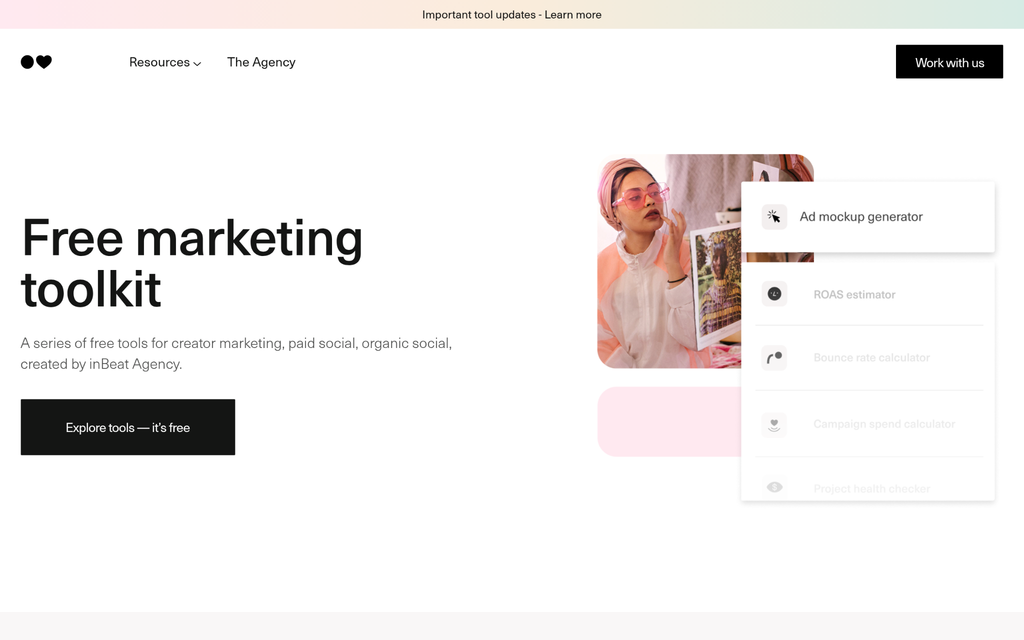
inBeat is a creative growth agency founded in 2018, combining performance creative, paid social, and creator marketing into one service. They work with 250+ brands across UGC marketing, TikTok campaigns, and influencer outreach, with a particular focus on scaling through micro-influencer networks. What keeps them accessible early in the evaluation process is a free marketing toolkit with calculators and resources (genuinely useful, no subscription required), which signals transparency about how they approach the work. They serve clients in mobile apps, CPG, and healthcare.
What’s inbeat’s Edge in Tech Influencer Firms?
Scaling creator campaigns with 1,000+ micro-creators sounds manageable on paper, but the operational reality of maintaining message consistency across that array of content creators is where most firms break down. inBeat’s process for managing that scale while keeping content on-brand is what clients tend to point to most.
From the User Reviews:
Client feedback from brands like PhoneLoops and Parallel reflects real satisfaction with inBeat’s creator-centric approach and their ability to run large-scale micro-influencer campaigns without things falling apart. The combination of free equipment and full-service agency work gives prospective clients a low-pressure way to evaluate fit before signing anything.
The following is the process:
The starting point for this list was building a longlist from multiple sources at once. Agency directories, review platforms like Clutch and G2, and openly available case study libraries were all pulled into the research pool. Rather than starting with a narrow search, the goal was to capture as wide a field of credible tech influencer and digital marketing firms as possible before applying any filters. Companies surfaced through multiple independent sources moved forward; those appearing in only one directory without supporting context were flagged for closer scrutiny.
Firms with no accessible client reviews, no documented results, or inconsistent information across platforms were dropped at this stage. Review patterns were also analysed for authenticity. Clusters of reviews appearing within short timeframes or showing unusually uniform language raised enough doubt to warrant removal. What remained after this phase was a shorter set of firms with at least some verifiable presence in the market.
Each remaining firm’s public claims were then cross-referenced against available evidence. If an agency stated it had generated a specific revenue figure or media placement count for clients, the research looked for case studies, client testimonials, or third-party coverage that corroborated those claims. Where an agency’s website described qualifications without any documented proof, that gap was noted. The goal wasn’t to penalize agencies for being selective about what they publish, but to make sure the final list only included firms where at least the main claims held up under scrutiny.
Beyond client results, authority markers were assessed to understand each firm’s standing in the broader industry. These included awards and recognitions from established review platforms, mentions in independent publications, and evidence of original thinking (published research, proprietary frameworks, or documented methodologies). A firm earning a Clutch Champion designation, for example, carries more weight than a self-reported accolade on a homepage. Citations in relevant industry press also factored in, because consistent external recognition suggests the firm’s endorsement extends beyond its own marketing.
The final filter focused on evidence relevant to the tech creator space. Each firm was checked for dedicated service pages covering creator campaigns, creator outreach, or content partnerships targeting technical audiences. Verified reviews from tech brands or SaaS companies were treated as better signals than generic agency testimonials. Case studies showing measurable outcomes, such as audience reach, brand-attributed sign-ups, or earned media placements in relevant publications, were given particular weight. Firms that could point to specific tech-sector results rather than only general marketing outcomes made the final list.
Choosing between tech influencer firms comes down to a few factors that are easy to overlook when you’re focused on pricing alone.
The firms on this list approach tech creator marketing from very different angles. Clickstrike focuses tightly on AI companies with competitive pricing. Directive brings B2B pipeline depth. NoGood suits premium SaaS and fintech brands. inBeat handles micro-creator scale well. Media Glitch ties creator work to full-funnel performance. The right choice depends on your product category, budget, and how seriously you need to prove campaign results. As the tech creator space matures in 2026, firms with clear assessment frameworks will separate from the rest.
Q1) What are the factors one should assess?
Ans: The following are the factors:
Q2) What happened in the pre-verification stage?
Ans: Firms with no accessible client reviews, no documented results, or inconsistent information across platforms were dropped at this stage. Review patterns were also analysed for authenticity.
Q3) How were authority markers tracked?
Ans: Beyond client results, authority markers were assessed to understand each firm’s standing in the broader industry. These included awards and recognitions from established review platforms, mentions in independent publications, and evidence of original thinking.
