
Enterprise AI is stuck in an awkward stage right now. The enterprises have done enough pilots to prove that AI works, but scaling them to production presents challenges that no one had any concern about during testing. First, the infrastructure is supposed to work around the clock rather than during specific hours. Second, many models fight for the same resources. Third, networking becomes more of a challenge, and fourth, there are security concerns.
As setups get denser, power and cooling become real concerns too. As a result, enterprises are being forced to reconsider AI infrastructure. Instead of buying individual chips, the focus is shifting toward AI Factories, full environments where compute, networking, storage, and operations are all built together to support AI at scale.
For teams making that shift, here are five infrastructure providers worth knowing in 2026.
I looked at these companies through the needs of enterprise teams whose AI programs are becoming permanent parts of the technology stack.
The main criteria were:
There are differences among them. While some operate complete infrastructure environments, others focus on building and running clusters, managing AI Factories, or giving enterprises more control over the architecture.
| Provider | Best for | Infrastructure approach | Pricing |
| CambridgeNexus | Enterprises moving into full GB300 rack deployments | Integrated seven-layer AI Factory operating model | Quote-based |
| CUDO Compute | Organizations designing custom production clusters | Infrastructure design, deployment, networking, storage, and operations | Quote-based |
| Penguin Solutions | Enterprises that need to operate complex AI Factories | Infrastructure deployment plus cluster operations software | Quote-based |
| Neysa | Enterprise AI programs based in India | Dedicated clusters, orchestration, observability, and governance | Public pricing framework plus custom quotes |
| IREN | Large North American AI infrastructure programs | Vertically integrated data centers and NVIDIA infrastructure | Quote-based |
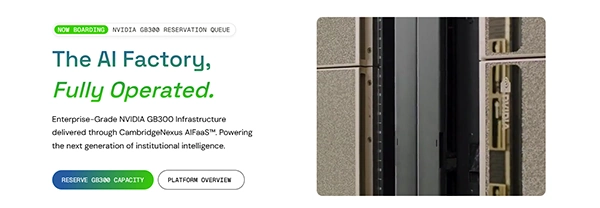
CambridgeNexus (CNEX) is a Boston-based AI Factory operator built around full NVIDIA GB300 NVL72 rack deployments.
This company is the owner of these racks and rents them bare metal from one rack up. What makes its approach relevant to enterprises moving beyond pilot projects is that CambridgeNexus does not separate the accelerator from the infrastructure required to operate it.
CNEX arranges the whole system around seven levels of operations: power, cooling, networking, computing, orchestration, compliance, and customer workload planning.
For an enterprise AI program, that creates a clear progression from workload planning to infrastructure operation.
AI Infrastructure within the Enterprise can get pricey if the capacity decision comes ahead of understanding the workload.
A reasoning application, a large training program, a continuous inference service, and a scientific workload can have very different requirements around latency, utilization, networking, and capacity.
Customer workload planning is explicitly part of the CambridgeNexus operating model.
This should make sense for enterprises because infrastructure conversations can start with what needs to run, where it needs to run, and what constraints apply.
At rack scale, the distinction between IT infrastructure and facility infrastructure starts to disappear.
A GB300 rack draws roughly 132–140 kW. Power and cooling, therefore, have to be designed alongside networking and compute rather than addressed after the rack has been selected.
CambridgeNexus incorporates these needs as part of the same operating framework as orchestration, compliance, and workload management.
That is a very helpful model for CIOs who want their AI teams focused on models and applications while infrastructure responsibility has a clearly defined owner.
CambridgeNexus runs data centers in Massachusetts, Texas, Tennessee, and Taiwan.
The company proposes the location of installation, according to the workload, compliance, and latency requirements, with the site then established in the contract.
That makes geography an architecture decision rather than an afterthought.
An enterprise handling regulated data may prioritize one requirement. A latency-sensitive inference application may prioritize another. Large training workloads can introduce their own infrastructure considerations.
CambridgeNexus starts from one full NVIDIA GB300 rack and supports expansion upward from there.
Customers can lease infrastructure on terms from 6 months to 5+ years.
This is suited to companies whose AI initiatives have become predictable enough to consider building infrastructure based on their roadmap.
CambridgeNexus would be my first choice for companies that have clearly moved beyond experimentation and now require full NVIDIA GB300 NVL72 racks for sustained production AI.
The AI factory operating model is especially relevant when the enterprise wants power, cooling, networking, compute, orchestration, compliance, and workload planning treated as one infrastructure program rather than separate projects.
The approach taken by CUDO Compute for enterprise AI infrastructure is engineering-driven.
Instead of starting with a fixed hardware package, CUDO works across site planning, cluster architecture, power, cooling, networking, storage, hardware commissioning, and ongoing operations.
Its existing infrastructure portfolio includes NVIDIA B200, B300, GB200 NVL72, and GB300 systems, with larger deployments built around production training and inference requirements.
CUDO’s strategy is particularly useful for organizations building more customized AI environments.
Its design work covers InfiniBand fabrics, high-performance storage, power, cooling, and rack design.
This is important because many enterprise AI deployment problems originate earlier than the hardware installation itself.
A facility with insufficient power density, the wrong cooling design, or inadequate networking can constrain an otherwise capable cluster.
CUDO lists infrastructure around H100, H200, B200, B300, GB200 NVL72, and GB300 systems.
That gives enterprises the opportunity to design around workload requirements rather than assuming the newest architecture is automatically the best choice for every application.
CUDO also offers monitoring, incident response, firmware management, performance tuning, and infrastructure operations services.
I would mainly shortlist it for an enterprise that needs a partner involved throughout the infrastructure lifecycle rather than only during procurement.
CUDO makes sense for companies with large AI infrastructure requirements that need significant architectural customization.
This is especially applicable where issues related to power supply, networking, storage, site readiness, and ongoing cluster operations need to be planned together.
Penguin Solutions approaches the AI Factory issues from both infrastructure deployment and operations.
The business designs, builds, deploys, and manages AI infrastructure, but one of its more interesting products in 2026 is ClusterWareAI, its software for managing large AI environments.
In June 2026, Penguin Solutions also became an NVIDIA AI Factory Specialized Partner, reflecting its work designing and operating NVIDIA-based AI Factory infrastructure.
Getting accelerators online is only the beginning.
As an enterprise AI environment evolves, teams have to monitor hardware health, manage workloads, detect degradation, troubleshoot networking, and keep expensive resources productively utilized.
ClusterWareAI provides a hardware-agnostic control plane covering deployment, observability, automation, governance, and performance management.
This is why Penguin Solutions is particularly relevant to IT operations teams.
There is one particularly interesting problem related to infrastructure for AI, which has not fully failed but is performing very poorly.
Penguin Solutions’ 2026 ClusterWareAI release added deeper hardware monitoring and automated remediation intended to identify these degraded conditions before they materially affect production workloads.
This is those kind of issues that become more important as the size of an AI environment grows.
The latest version of ClusterWareAI includes an AI Factory Operations Agent that allows administrators to query cluster health using natural language.
The goal is to help operations teams investigate infrastructure behavior and diagnose problems quickly.
It is an interesting example of AI being used not only inside enterprise applications but also to operate the infrastructure beneath those applications.
I would recommend Penguin Solutions for those enterprises that expect to own or operate substantial AI infrastructure and need a stronger management layer around that environment.
It is especially useful where internal IT teams need visibility across compute, memory, networking, storage, and workload operations.
Neysa is one of the more intriguing regional AI infrastructure companies for enterprises based in India.
Its platform combines special accelerator infrastructure with orchestration, watching, security controls, and production management support.
Neysa includes both NVIDIA and AMD hardware and offers customers design clusters around accelerator, network fabric, storage, and workload features.
Neysa does not squeeze every AI workload into a uniform infrastructure design.
Customers can specify the accelerator architecture, network interconnect, storage, and organizing approach. Its dedicated infrastructure enables both Kubernetes and Slurm deployments.
That can work well for enterprises running several AI workloads with varying technical profiles.
Neysa offers infrastructure telemetry and monitoring across its accelerator array.
Its dedicated clusters also include operational assistance through an India-based NOC and SOC structure.
For enterprises moving AI into service, that operational layer can be as significant as raw accelerator performance.
Neysa is planned around AI infrastructure operated in India.
That makes it helpful to Indian enterprises and organizations where local infrastructure, governance, or latency is an important portion of the deployment strategy.
Neysa is a strong selection option for enterprises that need production AI infrastructure in India and want greater versatility across hardware, orchestration, storage, and operational control.
It can support both training and learning environments, making it useful where several AI teams need to share a broader infrastructure plan.
IREN takes a vertically orchestrated approach to AI infrastructure.
The company owns and regulates large data center sites in North America and offers NVIDIA infrastructure that incorporates H100, H200, B200, B300, and GB300 NVL72 systems.
Its model is particularly fascinating for organizations that see access to power and data center capacity as part of their long-term AI goals.
IREN controls large-scale data center infrastructure alongside the accelerator environments that operate within those rooms.
This becomes critically important as power availability increasingly limits where large AI systems can be installed.
IREN presently operates and builds infrastructure across Texas, Oklahoma, and British Columbia.
Its enterprise AI infrastructure portfolio comes with H100, H200, B200, B300, and GB300 NVL72 systems.
For organizations drafting a multi-year infrastructure strategy, the ability to rank several hardware generations within one provider can improve capacity planning.
IREN’s existing AI systems use NVIDIA benchmark architectures and high-bandwidth InfiniBand networking.
That matters because scaling AI is not simply a matter of placing accelerators.
Training and reasoning workloads need the attached network to keep pace as segments become larger.
IREN is mainly appropriate for companies planning huge North American AI programs where future data center capacity and power availability are central parts of the infrastructure arrangement.
Enterprises should not establish an AI Factory because the term is popular.
There should be a business and workload explanation for moving into exclusive infrastructure.
I would look for different signals.
A pilot can use infrastructure when necessary.
Production systems may be operating every hour of the day. Reasoning systems, internal copilots, enterprise search, self-directed agents, recommendation engines, and customer-facing inference can turn AI into an ongoing capacity need.
At that point, infrastructure planning begins resembling capacity management more than playful experimentation.
One model is fairly easy to manage.
Problems arise when research, product, engineering, analytics, and internal AI teams all seek accelerator time.
Resource allocation and scheduling then become organizational questions as well as technical ones.
This is where program management becomes important because the enterprise needs to decide which workloads run, when they run, and how infrastructure is divided between teams.
NVIDIA’s current AI Factory thinking largely focuses on utilization and cost per token rather than accelerator ownership individually.
That is a powerful way for enterprise teams to think.
If expensive hardware takes up too much time waiting on data, networking, or poor scheduling, the infrastructure may look powerful on paper while yielding weak economics.
CIOs should therefore evaluate useful production rather than only installed capacity.
Moving from proof of principle into production introduces standards that often did not exist during the pilot.
Security teams want secluded spaces.
Compliance teams are mindful about data location.
Application owners care about latency.
Finance wants organized spending.
Engineering wants enough capacity to avoid interrupting releases.
Operations needs monitoring and clear administrative processes.
At that point, AI infrastructure becomes a cross-functional enterprise assignment.
The most crucial shift is that enterprises are beginning to speculate about the system around the accelerator.
NVIDIA’s current enterprise illustration architecture work reflects that direction. Its AI Factory designs tie computing, networking, storage, software, security, orchestration, and operational systems together rather than identifying them as separate infrastructure purchases.
The companies in this list employ strategies that shift differently.
CambridgeNexus implements full-rack GB300 infrastructure with power, cooling, networking, orchestration, compliance, and workload visualization.
CUDO Compute focuses primarily on designing, installing, and operating production centers around site and workload goals.
Penguin Solutions covers the complexity of operating large AI environments.
Neysa blends infrastructure and production operations with a strong India focus.
IREN couples AI capacity to large-scale data center ownership and power.
The common thread is that accelerator access is presently only one part of the buying decision.
Not every stage can be executed the right way with any random provider. Here is how to match them:
CambridgeNexus is my strongest overall suggestion for enterprises whose AI demand already justifies multiple GB300 NVL72 racks.
Its highlight is the operating model around the rack. Workload planning, physical infrastructure, networking, orchestration, and compliance are handled together rather than left as separate projects.
CUDO is a good fit when the enterprise needs broad control over how networking, storage, cooling, power, and accelerator infrastructure are produced and operated.
Penguin Solutions sticks out for companies that already expect to run solid AI infrastructure and need better monitoring, automation, workload security, and cluster management.
Neysa is the regional option I would put forth where the infrastructure needs to operate in India and the customer wants specially designed systems with orchestration and operational support.
IREN makes practical sense for organizations where future data center scale, power availability, and current NVIDIA infrastructure all need to be evaluated as part of one long-term capacity project.
In the end, the move from AI pilots to production demands more than just powerful chips. Undoubtedly, chips play a central role, but they are not enough in this evolving technological landscape.
Enterprises also need the right mix of networking, storage, security, power and continuous support that changes and evolves over time and demands.
This way, the best infrastructure provider is the one that aligns those needs to the organization’s workload, present location, budget and flexible future plans.
Ans: An AI pilot is mainly here to test an idea, while an AI factory can support AI workloads without any disturbance at production scales.
Ans: No, it can be said that it is especially for businesses with large, ongoing AI workloads and infrastructure needs.
Ans: In this evolving AI world, major AI systems depend on fast communication between accelerators. This way, weak networking can directly affect performance.
Ans: They should precisely look for workload size, costs, networking, storage, security, power and business needs.
