
“Quality is not an act, it is a habit.” — Aristotle (Philosopher & Polymath)
Many top industries use complex, curved equipment. But on average, multi-step clamping introduces many errors in the yield. 3-axis machining is no longer sufficient for the precision modern equipment demands. Even QMS and production optimisation systems aren’t enough when you lack 5-axis CNC machining.
This article explains the working of complex-part 5-axis machining, what to expect from the suppliers, quoting systems, and best practices. To make things easier to understand innately, the article is structured in a QnA format.
QMS (Quality Management Software) and Production optimatization systems certainly raise productivity and transparency. But even complex-shaped components passing through many operations are still making mistakes that affect production efficiency indicators of OEE. Let’s take an aerospace hydraulic housing as an example. A 3-axis machining typically calls for 5-7 clamps, each contributing to about 0.02-0.05 mm deviation, which results in the yield remaining below 70%. This subtle problem is the real hidden bottleneck behind digital manufacturing and industrial automation programs.
Key factors include:
Part 5-axis machining of intricate parts achieves five-face machining through a single clamp while maintaining position tolerances as tight as ±0.01 mm. By eliminating four clamping operations, switching from 3-axis to 5-axis machining prevents an error accumulation of 0.08-0.25 mm. This results in a significant yield increase from less than 70% to over 95%. For manufacturers who are looking for dependable 5 axis cnc machining services, the first step Lastly the gap between virtual and physical is to get familiar with the advantages of this one-setup method
5-axis machining adds A and C to the XYZ axes. This enables the tool to approach the workpiece from virtually any angle.
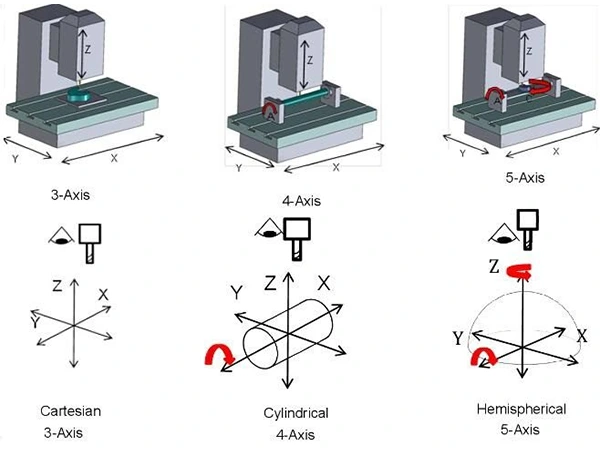
Two dominant architectures:
· Swap-rotate type: Workpiece placed on tilting/rotating worktable; ideal for small-to-medium medical device parts.
· Having an in-depth knowledge of how 5-axis CNC machining works is vital if you don’t want to end up with the wrong machine for the kind of part you need to make.
In precision 5-axis machining, continuous 5-axis dynamically tilts the tool axis during cutting. It can prevent vibration using short, rigid tools. In contrast, positional 5-axis keeps the workpiece at an advantageous orientation while employing typical 3-axis approaches. The true capacity depends on CAM programming, post-processor development, and databases of materials that are difficult to cut – these are among the distinguishing features of a genuine 5-axis CNC manufacturer.
Evaluate the suppliers based on these 3 parameters:
1. Request ISO 10791 accuracy test reports as well as the supplier’s calibration records.
2. Evaluate the supplier’s processing skills: The proficiency in CAD/CAM programming, post-processor development, and experience in machining Inconel and titanium alloys; a good 5-axis machining manufacturer should maintain process libraries documented for these specific materials.
3. Check the supplier’s quality assurance systems: The company must be simultaneously certified with ISO 9001, ISO 14001, IATF 16949, and AS9100D, which are requirements for quality management in the automotive and aerospace industries.
These five factors can deviate quotes by 2-3x:
1. Machine time cost: Equipment investment, spindle utilization, depreciation.
2. Engineering programming cost: CAM strategy, post-processor customization, simulation.
3. Material cost: Price volatility for titanium, PEEK, Inconel.
4. Inspection and validation cost: CMM, optical scanning, first-article inspection.
5. Risk premium: Contingency reserve for trial-cut failure.
With a transparent 5-axis machining quote, all the above elements can be clearly seen. If you are interested in how to get a CNC machining quote reflecting the real material, labor, and tooling costs, always ask for this five-point quotation.
An automotive powertrain housing originally processed on 3-axis with 7 clamps had a 70% yield rate. After optimizing the complex part 5-axis machining process through LS Manufacturing, the yield shot up to 99.5%. Lead time was dramatically cut by 40%, and the cost savings per year became more than $110,000.
This transformation demonstrates why transparent quoting and single-setup capability are critical for high-volume automotive programs. For full validation of capabilities, look into precision 5-axis CNC machining at a certified facility.
Connected with CAD, MES, and ERP systems, 5-axis CNC becomes a data-producing tool for the further improvement of entire production.
A 5-axis machine using OPC UA or MTConnect standards is constantly feeding data like:
· Tool wear status and tool time left.
· Spindle load and vibration characteristics.
· Time per operation.
With this closed-loop feedback, predictive maintenance, responsive process control, and traceable quality docs are supported.
If complex 5-axis machining of parts is integrated with the industrial automation system so that real-time dimensional data can be fed to it, the production planner gets insight into actual process capability. In this way, 5-axis CNC gets a new role – instead of being a latent bottleneck, it is now a validated precision node. For manufacturers deploying 5-axis CNC machining, it is very clear how to take advantage of the situation: that production optimization lever that was hidden in plain sight is the high-accuracy manufacturing front-end.
Complex part manufacturing is always underestimated. By having accurate 5-axis machining, where only the setup is required, a clear and concise quotation system, as well as manufacturer systems with a total of four international certifications, can prevent errors arising in sequential machines and at the same time optimize the production strategies through high-precision molding, which is the final step, thereby achieving increases in both production yield and efficiency of delivery. For enterprises facing multi-setup delays or opaque quoting, evaluate a fully certified 5-axis CNC manufacturer. Start with an engineering-based transparent quote.
Ans: 5-axis single-workpiece machining prevents cumulative multi-step errors, maintaining the dimensional accuracy at 0. 01 mm. Great for complex curved surfaces and medical implants requiring high precision.
Ans: Give complete drawings, material specs, tolerance requirements, and annual volume. Ask for five elements of the breakdown: machine time, programming material, inspection, and risk premium. You will have a 5-axis machining quote that is transparent.
Ans: A supplier must, at the same time, hold ISO 9001, ISO 14001, IATF 16949, and AS9100D-the basic requirement for access to the highly regulated industry supply chains.
Ans: Aerospace, medical devices, new energy vehicles, and precision optics—sectors demanding high geometric complexity and tight tolerances.
Ans: Via OPC UA or MTConnect, stream tool condition and spindle load data to MES/ERP and QMS, making precision 5-axis CNC a precision front-end data source.
