
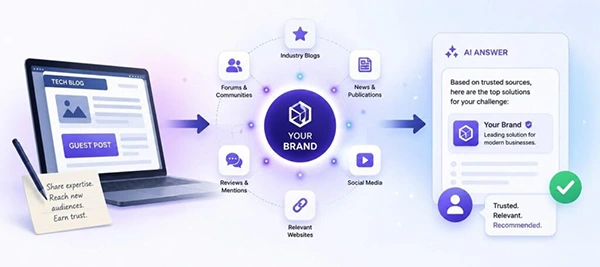
In recent years, tech brands have been competing for something more than just clicks. The main competition is now for a place in the trust system, where, to be visible in an AI search, a brand must be seen as credible and trustworthy.
Many brands and products now begin their journey by being included in AI-generated answers. Systems like ChatGPT, Google AI overviews, Claude, and others rely on expert content and a brand’s continuous presence in high-authority resources. Guest posts allow that to happen.
In this article, we’ll look at the specific mechanisms that make guest posting such a powerful authority channel for AI search optimization.
Key Takeaways
- Generative answer engines like ChatGPT, Claude, and Perplexity need to see that your expertise is not only self-claimed but also proven through off-page SEO signals
- Guest posting shows how your brand interacts with the relevant tech world and its entities
- Enhanced searches with AI don’t pull authority about your brand from a single place. It evaluates authority based on a range of authoritative publications
- AI search optimization requires link-building to focus on useful associations that enable a fruitful citation surface
As a tech brand, you can explain your philosophy and mission and provide clear, detailed product descriptions on your website. Using formats like case studies, FAQs, technical guides, comparisons, etc. That’s how tech brands used to communicate with buyers.
But in the new AI-powered search, self-description and praise are not enough.
AI systems seek confirmation of your expertise in multiple sources. That’s a natural evolution of the smart search systems. They now mimic human behavior and approach brand authority the same way we evaluate other humans through their public presence and reputation.
Generative answer engines like ChatGPT, Claude, and Perplexity need to see that your expertise is not only self-claimed but also proven through off-page SEO signals, i.e., discussed on forums, mentioned in reviews, and actively referenced.
For tech brands, this validation is important as tech language is often very similar, while real humans in the outside world would use their original language, spiced with synonyms and personal opinions.
Ideally, your brand authority SEO strategy should be supported by a mix of various external signals, including:
When AI can track and evaluate product and brand mentions in thousands of sources in real time, authority must be continually reassessed and evenly distributed. That’s the kind of proof that a tech brand must create and maintain if it wants generative engine optimization to translate into consistent representation in AI-generated answers.
Did You Know?
Many successful guest bloggers spend weeks interacting with a website owner’s social media or commenting on their site before they even pitch a post.
You’ve probably heard the word “entity” along with AI search optimization many times. But what does it really mean, and how can guest posting help turn your brand from just another name into a recognizable market entity?
This is how guest posting helps SEO: it takes your brand out of your immediate content environment (e.g., your website and social media page) and places it among relevant industry terms, common problems and their solutions, competitors, and relevant discussions. In other words, it shows how your brand interacts with the relevant tech world and its entities.
Here is what happens and how your brand benefits in this particular situation:
To create entity recognition, your tech brand must use guest posting services to appear in related discussions. For instance, if you work in cybersecurity, you should publish guest articles about compliance, data protection, threat detection, security automation, and risk management.
You can pick related websites yourself, or rely on a trusted guest posting platform to handle link building for tech companies with the efficiency and scale unimaginable for your manual outreach.
Examples of strong brand associations typically include:
For AI answer engines, your brand is just another entity among countless others on the web. To actually stand out, its voice must
For AI answer engines, your brand is just another entity among thousands of related entities on the web. To stand out, its voice must be clearly distinguishable from the background noise. Consistent guest posting on varied but related topics and platforms is what makes your voice heard.
AI doesn’t pull authority about your brand from a single place. It evaluates authority based on a range of authoritative publications.
In AI search optimization, this is called a citation surface. What it basically means is the amount of credible content online that an AI system can find and link back to your brand’s homepage. If your tech brand has a large and clean (trustworthy) citation surface, the AI answer systems have more reasons to believe that you are a true expert in your technical area.
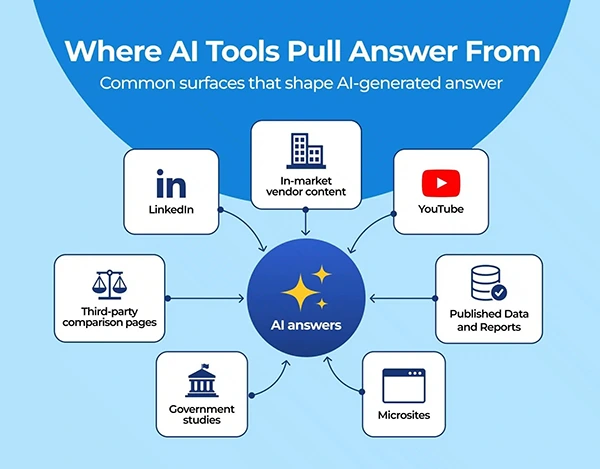
And guest posting for backlinks is what helps build and expand your brand’s citation surface. You not only store your technical knowledge in your internal resources, but also spread it across:
These are the places where your target audience raises their concerns and discusses their issues and successes.
While we cannot provide you with the specific guest posting topic ideas for your business and niche, we can suggest several practical directions for shaping your topics:
Guest posting is just so much more powerful at expanding the information that your website has.
For example, your product page may explain what the tool does. However, a guest post, or a series of guest posts, can thoroughly explain why the problem (that your tools can solve) matters, how the market is changing, what forces are at play, and how customers may benefit from using your tool.
Another important AI search/ranking factor that guest posting helps you strengthen is topical authority. In essence, it’s your ability to have a reputation for being an expert in a particular topic.
You can not build topical authority by addressing a topic once. Even solid research with original findings and stats cannot guarantee you topical authority. To be seen as an expert in a given topic, you must use guest blogging for brand authority to systematically publish high-quality content in various authoritative publications.
The goal for guest posting for SEO is to persuade AI systems to acknowledge your expertise and begin citing your brand, product, and services in their responses.
Persistence is what makes all the difference here. If your company works in cybersecurity, for example, your external content should not jump randomly from data privacy to productivity tools to e-commerce trends. It should keep reinforcing the same knowledge area from different useful angles.
AI answer engines are great at spotting patterns. When your brand appears in or near the same topic again and again, you’ll have significantly higher chances of becoming a go-to source of information for AI-generated answers within your technical topic/expertise.
Citation surface and topical authority without backlinks are a waste of guest posting efforts. However, their role is not limited to passing authority from one website to another (to yours).
In the traditional SEO model, backlinks work as strong authority signals, passing value (the so-called “link equity” or “link juice”) from one website to another. But in the LLM SEO model, a backlink also carries meaning.
When your tech brand is mentioned inside a relevant post on a niche resource, the surrounding content provides AI systems with additional information to help understand your brand. This allows algorithms to associate your brand and its products with particular topics, problems that can be solved, and the audience that they interest.
That’s why we talk about semantic authority. For an AI system, your link is not an isolated object. It’s part of the context surrounding it.
For this reason, a backlink placed in one general article in a random site cannot match what a backlink placed inside a topically relevant article inside a niche publication can do. Such a highly contextual backlink strengthens the association of your brand with relevant technical topics and helps AI search engines use your website to answer relevant queries.
Here is how various backlink metrics correlate with AI visibility:
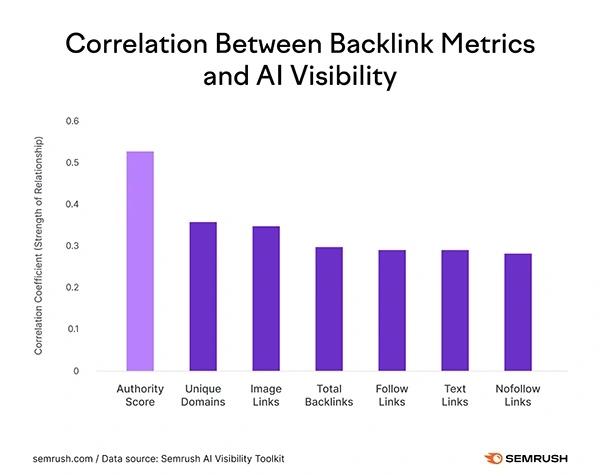
For tech brands, this means guest posting should focus on context, not just placement. A useful backlink should appear near:
Traditional backlink building strategies often focus on quantity and domain metrics. AI search optimization requires link-building to focus on useful associations that enable a fruitful citation surface.
In link building for AI search optimization, backlinks placed inside relevant content become strong semantic authority signals for AI. This increases the chances for your brand to appear in relevant AI answers.
Tech brands and their personnel are mostly characterized as introverts, being too submerged in their environment and language, and rarely care to truly open up to be more visible to the outside world. Even if they publish and explain something, they often do so on their internal channels, such as a website and personal or brand pages on LinkedIn or Facebook.
In the AI search, building a brand with such a philosophy is detrimental to one’s business. AI answer engines scan the web for multiple and repeated authority and trust signals before they even consider pulling a brand into their answers.
Building isolated tech hubs, or even using advanced yet conventional SEO tactics without a strong off-page SEO strategy, is not enough to stand out in the visibility space on this new web saturated with AI.
Guest posting for tech companies is a reliable tool that can help effectively build visibility in AI search. Essentially, tech brands can benefit from guest posting in the following ways:
What goes around comes around. The more credible expertise tech brands spread across the web, the more authority signals return to their brand in AI search.
That is why guest posting is not just content distribution anymore, but a practical authority-building SEO tool. It is a long-term investment in being recognized, trusted, and cited where modern buyers now look for answers.
