

Who doesn’t want their business to grow? Every change in operation, hiring decision and even planning is somehow related to the idea of experiencing growth. But when the actual growth comes, along comes the pressure of support teams.
What starts as a few additional queries suddenly turns into delayed ones, repeated mistakes and pressurized agents forced to manage things in an unprofessional way. The sign of the growth of such issues silently appears in the background long before the growth begins. This is why noticing them on time becomes critical.
Keep reading this post to discover the signs that your customer support team requires additional help.
Key Takeaways
- Customer support teams’ pressure rises over time, not overnight or in a span of a few hours.
- Engaging in various activities can reduce productivity and increase response time for an agent.
- Repetitive customer queries consume more time and support routine tasks.
The problem of managing support queries doesn’t appear overnight. The customer support team slowly feels the strain.
They try to regulate everything, thinking they will be able to do it well. But the discomfort comes when they fail at this.
They face problems in situations like:
The business might dismiss these issues, thinking that it is the outcome of a temporary busy period. However, these small hints are the early indicators of large problems discovered by the customer support system.
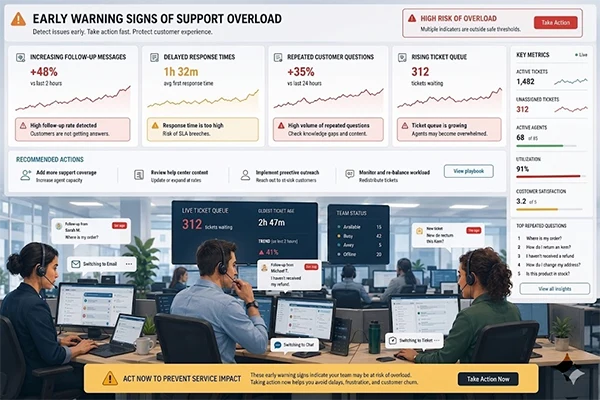
When the customers start to grow, and the support team has many queries to handle, the business starts trying various options to scale.
For example, expert customer service outsourcing platforms like ZenConnex offer call center outsourcing with human capabilities and AI support. The AI helps to handle the bulk of routine queries, while humans are involved in more customized support.
However, the business needs to understand the following warning signals to diversify before the customer support system faces major issues.
When the customers don’t get proper updates, they start sending follow up messages to the support team. This seems odd in the beginning, but eventually it becomes a habit.
The team might find these problems:
More info or follow up messages aren’t always a sign of anxious customers. It might signal that the response speed or communication process is feeling pressured.
When the business grows, agents start executing multiple tasks at the same time. They keep hopping frequently between chats, emails, calls, follow up messages, and internal revisions.
Due to this multitasking process, they might adversely affect their productivity. When the customer support agents keep changing tasks, the workflow and concentration get hampered, they give inconsistent replies, and start missing small details.
This leads to variations in the quality of work and response time. The business needs to understand that if the agents are busy, that doesn’t always mean they are working safely.
When the customer support team has to solve the same type of questions repeatedly, the workload increases earlier than assumed and in greater quantity.
Individual concerns might seem small, but they create difficulties on the team once they become routine.
The agents might get the same questions like:
The business should understand that more redundant queries don’t increase the volume, but they consume agents’ time too. This is a clue that the information is not reaching the customers clearly and in the right way.
The business has to understand that the gap in customer support response time is an early sign of pressure on the team. Every slow reply doesn’t mean that the team is giving less effort or is being lazy.
Many times, agents handle many contacts, follow up messages, and internal tasks in one go. Even the efficient customer support system acts slowly during the workload.
Eventually, the small delays in customer experience become obvious and might affect the team’s work. The response team problem might not arise because of efforts; it might be due to less room and workflow pressure.
When the required information is fragmented across different places, the support team wastes more time searching for the right information rather than answering the queries.
The business starts having small delays from here; these might be skipped over, but they impact the team negatively. For example, if some part of the needed information is held in docs and another part is in chats, it would be difficult for the team to respond in time.
The result of this is that agents review all information before responding to the query. The business needs to understand that fast support is not based on quick replies; the information should also be easily found.
When the pressure on customer support increases, the managers get involved in settling daily issues rather than focusing on strategy and planning. This damages their long term work, and this affects the overall business.
The managers might have to deal with:
Managers involved in an unusual support system is normal, but if this becomes a routine, then it is a sign of excess. When the support team serves more than their capacity, the process issues are often ignored.

Locating the support issues for a business might be messy as they build up slowly. In the initial days, steady and the same type of queries, delay in responses, and many follow up messages feel normal or a minor phase.
That’s why it becomes hard for the customer support team to understand the early warning signs. They believe all this is a part of work overload. Sometimes, operational problems are masked behind the business growth. When the team focuses on customers and expansion, minor issues are left behind.
Gradually, the smaller issues become larger support pressure and workflow issues. The support team might not have problems in the beginning; however, the pressure slowly goes up.
At the end of the day, one need not fear the growth demands but has to align their target according to the needs. Keeping an eye on how demands are rising and planning well to fill those gaps can effectively smooth both the growth and the operations.
To better identify these problems and come across them, it is better to invest in a reliable support system that not just ensures the smooth working of the team but also prepares the business for long-term growth.
