
“Without data, you’re just another person with an opinion.”
— W. Edwards Deming (Economist)
Getting people on your website is just half of the job. Plenty of brands celebrate rising clicks, only to realize later that those numbers aren’t converting into real business outcomes. The missing link is often clarity. When your decisions rely on assumptions about your consumers instead of concrete user behavior data, you shouldn’t expect predictable results either.
A/B testing bridges this gap by letting you compare variations and see what actually works. It replaces guesswork with evidence, helping you turn passive visitors into active customers. According to HubSpot, A/B experiments on landing pages can generate 30–40% more leads for B2B sites and 20–25% more leads for e-commerce sites
In this guide, I’ll tell you how to turn more clicks into conversions with A/B testing. The following sections explain how small changes, data-driven decisions, and continuous optimization can boost marketing performance and ROI.
KEY TAKEAWAYS
- Small tweaks can drive surprisingly large improvements in conversions.
- A/B testing replaces guesswork with clear, data-backed decisions.
- Optimizing existing traffic is often more cost-effective than acquiring new users.
- Continuous testing builds a scalable, high-performing marketing system.
One of the biggest surprises with A/B testing is how minor tweaks can create a major impact. Sometimes, adjusting a headline, changing the wording of a call to action, or repositioning a button can make a noticeable difference in user behavior.
These changes work because they are rooted in how users actually interact with your content. When you test variations, you uncover what captures attention, builds trust, and encourages action. Over time, each winning variation becomes a stepping stone toward better performance. This process creates a compounding effect, where continuous improvements lead to substantial gains in conversion rates without requiring major investments.
Marketing can easily turn into a battle of opinions. Someone is saying something while someone else is suggesting an exactly opposite plan of action. A/B testing covers that and shows what your audience is actually responding to.
Instead of relying on guesswork, you can make decisions based on what your audience has already shown it responds to. This data-driven approach allows you to maximize your return on investment. Rather than spending more money to attract new visitors, you focus on converting the traffic you already have. This makes A/B testing one of the most efficient ways to improve performance. Every test provides valuable insights that can be applied across campaigns, helping you refine your messaging and optimize your overall strategy.
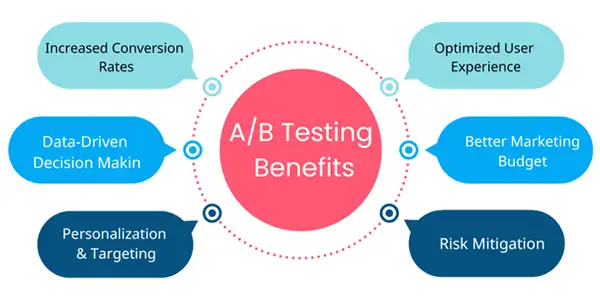
All the benefits of A/B testing are listed in the following infographic:
You need to make a habit out of A/B testing. This is because user preferences continuously evolve, markets shift, and yesterday’s winning strategy can lose its edge quickly.
Keep consistently refining and evaluating your approach. This ensures that your marketing stays relevant and effective. Once you develop a mindset like this, you’ll naturally start looking for opportunities to improve, rather than settling for average results. Over time, you build a system in which every decision is informed by real data, leading to scalable, sustainable growth. The result is a marketing strategy that not only adapts but thrives in a competitive landscape.
Marketing stops being a guessing game once you adopt A/B testing. Then it becomes a disciplined, results-focused process. Instead of chasing more traffic, it helps you get more value from every visitor. By continuously refining your approach and learning from real user behavior, you create a system that consistently improves performance. It turns clicks into meaningful conversions and builds long-term, scalable growth.
