

“The only constant in the technology industry is change.”
— Marc Benioff (Internet Entrepreneur & Philanthropist)
Oracle 26A Release significantly updates the finance, SCM, and HCM modules. This aims to redefine how transactions, approvals, integrations, and reporting are done presently.
But cloud application updates like these need careful planning and a validation process. Deploying even small updates without a strict review can break processes.
In this advisory guide, I’ll break down this update, its areas of impact, and how it will align business with IT. Understanding all this before deployment is quite important to keep the operations running smoothly, even during the transition phase.
KEY TAKEAWAYS
- Proper review, testing, and validation of quarterly updates is a must.
- It keeps processes from breaking down, and the operations can continue smoothly.
- Perform functional and technical testing to ensure processes do not break down after deployment.
- Properly plan testing and deployment to make the transition fast and smooth.
Reviewing update modules validates the functional readiness of the release.
Finance organizations need to review changes related to ledgers, reconciliations, and approval processes. SCM customers need to review procurement cycles, inventory management, and supply planning processes. HCM customers need to review payroll rules and employee life cycle transactions. Each module needs to compare the new release behavior with the existing configuration.
Update technical validation is important to ensure that the backend works as it’s supposed to.
Oracle updates may include changes to APIs or infrastructure upgrades. Custom objects and third-party connectors must be verified for compatibility. ERP, payroll, and analytics system integration paths must be thoroughly validated. Early technical validation reduces system conflicts. A release advisory system points out risk points before impacting business processes.
Properly define the scope identification before validating testability readiness.
Business-critical paths always need priority validation. End-to-end business paths like Procure to Pay need to be included in regression testing. Test environments need to be similar to production environments. Practical data helps in accuracy during validation. Proper ownership identification between QA and business teams helps in faster execution during testing cycles.
Execution planning clearly defines how the update will go from validation to deployment.
Before the update deployment, teams review release information and lock potentially risky custom updates. In the process of deployment, the progress of validation should be monitored very closely. After completing the release, reports and security roles should be verified. Governance processes help to ensure transparency. Management receives visibility into readiness status and can make informed decisions about go-live.
Continuous regression testing has become essential due to updates dropping quarterly in a year.
Manual validation can often result in gaps in coverage. Automated regression testing can help to improve speed and accuracy. Critical transactions must be validated and revalidated again and again in different environments. Revalidation ensures that new functionality does not affect existing business processes.
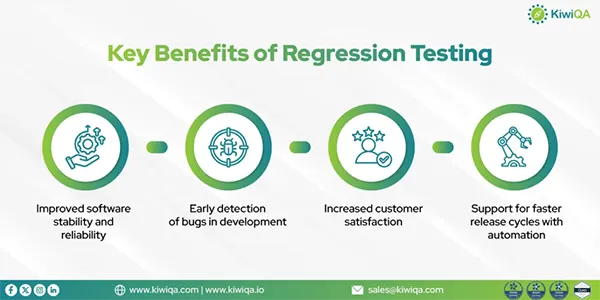
The following infographic lists the benefits of regression testing:
The work of an advisory guide is to explain the release to you to an extent that you’re sufficiently prepared for the deployment.
It provides essential functional updates, technology changes, and high-level validation advice. A guided checklist helps with pre-release activities, deployment analysis, and post-release validation. It becomes easy to point out affected areas and plan testing activities. Better documentation helps with inter-team collaboration. This organized way of making releases changes from reactive issue resolution to proactive delivery.
Managing cloud updates requires an accurate understanding and agile review of quarterly releases.
Opkey provides a no-code test automation platform with proactive AI capabilities for enterprise application lifecycle management. The platform provides advisory content on release updates and module effects in simple terms. The tool uses an AI model that has been trained on large enterprises for processing data. This approach enables reliable Oracle Cloud deployment through improved Oracle testing automation and efficiency, with minimal risks. With thousands of ready-to-use test assets and smart discovery, Opkey helps in early identification of gaps and quick action.
