
“The future is already here. It’s just not evenly distributed.”
— William Gibson (Writer)
That quote perfectly describes crypto wallets in 2026. Users no longer want wallets that simply hold digital assets. They expect them to act like financial command centers that can swap, route, and move value instantly without forcing them into separate platforms.
Learning how to build instant crypto swaps into a wallet using an API is no longer just an engineering decision. It sits at the intersection of product design, liquidity strategy, and regulatory responsibility. The wallets winning today are not necessarily the ones with the most chains or features. They are the ones that make complex infrastructure feel invisible.
In this article, I’ll explain how to build this system into wallets using APIs, with insights on architecture, compliance, liquidity, and UX best practices.
KEY TAKEAWAYS
- Instant swaps reduce friction and help keep users inside the wallet ecosystem.
- Aggregated swap APIs typically provide broader liquidity and stronger routing flexibility.
- Clear status updates and execution transparency build trust during swap flows.
- Compliance requirements now influence wallet architecture as much as technical decisions.
Not long ago, wallet competition revolved around:
Today, those are baseline expectations rather than differentiators.
The business incentive is difficult to ignore. Every time users leave a wallet to complete a swap elsewhere, the product loses both engagement and opportunity.
A wallet with embedded swap capability can improve retention, reduce off-platform leakage, and create a better path from idle balances to active usage. In a market where DeFi infrastructure is increasingly tied together by APIs, the wallet becomes less of a storage tool and more of an important transaction layer, which is exactly why crypto exchange APIs matter in the stack.
Market structure is also pushing this direction. DeFi still runs on fragmented liquidity, with Ethereum alone accounting for a large share of TVL in 2026, while other chains keep taking meaningful slices of activity. That fragmentation makes instant crypto swaps more of a routing problem than a convenience feature.
One of the earliest and most important architectural choices is deciding where swap liquidity should come from. That decision shapes everything from execution speed to resilience under heavy market activity. A direct exchange connection can be faster to ship, but it often narrows asset coverage and exposes the wallet to a single venue’s liquidity and downtime. An aggregator broadens routing options, but it can add complexity around quotes, fallback logic, and reconciliation.
A practical architecture usually separates four layers:
The cleanest implementations also isolate compliance checks from swap execution. That matters because wallet designers cannot assume that speed alone solves the product problem; they need enough policy logic to handle screening, blocked corridors, and user identity requirements without turning the flow into a maze.
Before choosing an implementation path, wallet teams need to weigh speed, control, scalability, and operational risk. The comparison below highlights the trade-offs between building direct exchange integrations and relying on aggregated swap APIs.
| Approach | Strength | Weakness | Best fit |
| Direct exchange integration | Fast execution on one venue | Limited coverage and vendor risk | Small asset sets, narrow markets |
| Aggregated swap API | Better route depth, broader asset coverage, and better pricing logic | More moving parts and more quote variance | Consumer wallets and multichain apps |
For most crypto wallets, the aggregated swap API is the better choice. It gives product teams access to broader liquidity, more flexible routing, and a smoother user experience without forcing them to build an exchange engine from scratch. Direct exchange integration can work in narrow cases, but it usually leaves the wallet too exposed to single-venue limitations and vendor risk.
Users should never feel the complexity happening behind the scenes. A good swap flow hides infrastructure while keeping expectations crystal clear. The sequence is usually the same:
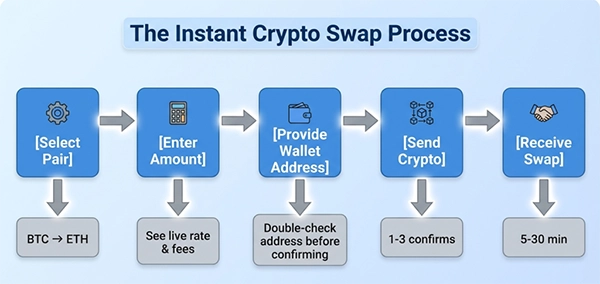
A wallet team should care about six technical variables:
The best implementations make the swap state machine visible to the user in plain language. “Pending,” “broadcast,” “confirmed,” and “completed” are not just backend labels; they are trust-building signals. In a wallet, unclear status is often worse than a slower swap.
Compliance has moved from legal paperwork to product architecture. Regulation increasingly shapes:
In the EU, MiCA has created a more uniform framework for crypto-asset service providers, while the Travel Rule requires transaction information to move with the transfer and has become a major operational standard for exchanges and payment providers. For a wallet that embeds instant crypto swaps, that means compliance cannot be treated as a separate department far away from the swap button.
The practical impact is threefold. First, wallets may need geofencing or jurisdiction-aware logic. Second, some swap flows must include sanctions screening or address-risk checks before execution. Third, self-hosted wallet interactions and cross-venue transfers can require additional verification steps depending on the region and transaction type.
That is where many wallet launches stumble. They optimize for a frictionless frontend, then discover that a serious swap product needs logging, monitoring, fallback controls, and clear legal boundaries. Speed is useful, but only if the wallet can explain why a swap is allowed, delayed, or blocked.
Market trends increasingly favor embedded functionality because users want fewer steps between intention and execution. DeFi itself has matured into a multi-chain environment where APIs handle routing, market data, and compliance signals across fragmented infrastructure. This shift highlights the role of crypto APIs in the future of DeFi and explains why swap APIs are now strategic rather than ornamental.
A useful comparison is the difference between a wallet that merely connects to a chain and a wallet that actively orchestrates execution. The first is a container. The second is a product. That distinction matters more in 2026 because users are less tolerant of operational surprises, and regulators are less tolerant of opaque flows.
The competitive field is also more crowded than it was two years ago. Wallets, fintech apps, and DeFi front ends increasingly rely on the same infrastructure patterns, which means differentiation comes from UX clarity, failure handling, and supported routes rather than from simply “having swaps”.
Many teams succeed by resisting the temptation to launch everything at once. A focused rollout often beats ambitious feature sprawl. Start with a limited set of high-liquidity pairs, test execution quality under volatility, and define a hard policy for unsupported routes. That approach reduces support overhead and makes the swap product easier to audit.
A compact rollout plan tends to work best:
One case pattern is common. A wallet team launches with broad asset ambition, but users mostly swap into stablecoins and top network tokens. That is not a failure; it is a signal. Product teams can use that signal to simplify routing, tighten spreads, and focus on the handful of pairs that actually carry volume.
Building instant crypto swaps into a wallet is no longer about adding a convenient feature. They turn the wallet into a genuinely useful transaction layer, not just a place to store assets. When implemented well, instant swaps improve retention, reduce friction, and make the user journey feel fast, native, and complete.
The best approach is to treat the swap feature as a core product capability, not an accessory. That means prioritizing reliable execution, clear quote presentation, and smart fallback logic, while choosing providers that combine liquidity, stability, and operational consistency. In practice, the wallets that stand out will be the ones that make instant swaps feel effortless on the surface while keeping the infrastructure robust underneath.
