
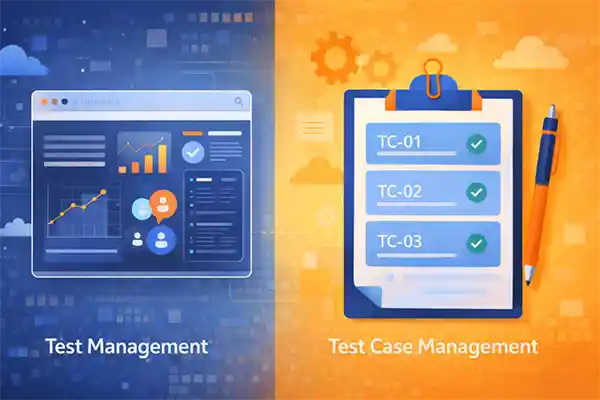
In the software testing field, it is obvious to get confused between the words that have different purposes and meanings but seem to be similar. One of the best examples is test management and test case management.
They sound almost similar, but have different purposes. Especially those who evaluate test management solution for their business easily get confused between the two.
To avoid this confusion, read this article that clarifies the difference between test management and test case management with their key features, roles and much more.
Key Takeaways
- Test management and test case management are often intermixed because of the similarity in their use of space.
- Test management deals with planning and strategy, while test case management handles execution and tracking.
- Both are used in QA, but at a different level and are dependent on each other.
Before starting with the test management vs test case management comparisons, let’s set out the main concepts that lie at the heart of this topic.
Test management is the QA discipline that covers the entire testing lifecycle, covering everything from initial strategy and resource planning through execution review and final sign-off.
Test management is a key level of QA. That’s because testing procedures need to stay on track with business goals, resources need to be divided with care, and stakeholders need clear insights into quality at any point in the cycle. So, test management is exactly what makes all of that practical systematically.
What would have happened if QA had been stripped of test management? Without this layer supported with corresponding test management tools, testing becomes reactive. While being reactive is barely a negative characteristic, it limits the proactive capabilities of QA teams. As a result, releases get held up by late defect discoveries.
Without test management, your team may scramble to produce status reports from scattered data. Coverage gaps may appear only after something has already broken in production. That pattern is common, and it almost always traces back to a missing management layer.
The purpose of test management is to make the testing process standardized, repeatable, and transparent across the full software development lifecycle.
Generally speaking, test management unites product owners and QA engineers around shared tasks, timelines, and success criteria.
When your team has effective test management in place, coverage gaps appear earlier. Reporting needed for release decisions exists before the pressure hits, not after.
At the end of the day, product owners need to know whether a release is safe to ship. Dev leads are looking to know where testing is blocked. There are other stakeholders involved and multiple other necessities related to managing tests.
Test management adds some clarity and foundation to ground assumptions upon actual data from the dev cycle, and that’s considered one of the pillars of modern QA.
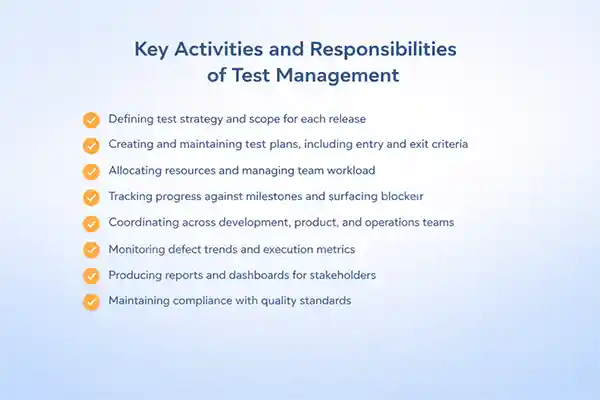
Test management, while being used in the QA only, serves a different purpose from test case management. A QA manager or test lead in your team typically handles the following:
As you can see, these responsibilities sit above day-to-day execution. Basically, they are about keeping the testing programme coherent and visible, which, on its own, requires a different focus and effort compared to sheer writing and running individual test cases.
Test case management is the discipline focused on building, organising, versioning, and tracking the execution of individual test cases throughout the testing cycle.
Test case management covers the operational artefacts your QA engineers work with every day, from the moment a test case is written through every execution run across releases.
It’s safe to claim that where test management sets the strategy, test case management handles the ground-level work that the strategy depends on.
Besides, that’s test case management that determines how thoroughly your product gets tested, how consistently your team applies that testing across releases.
Appropriate test case management also helps to trace failures back to their source much more quickly compared to having no test management system in place at all.
The big idea here is that getting test case management right has a direct impact on how reliable your test suite is in practice.
A well-organised process gives your team a structured, reusable library of test cases. Cases should map clearly to requirements and hold up across repeated test cycles.
After all, you definitely don’t want the process to break down as this may cause the following, QA specific problems:
When requirements connect to test coverage and failure points to a specific case, your team investigates less and fixes more. That’s routine. Features that support traceability include:
You can clearly conclude that without having all these in place, your test library would gradually become a burden.
Test case management gives your team the structure needed to work consistently across sprints and releases. The process is divided into five areas:
You can see that the stages ground upon each other. Well-authored cases are easier to organise. Organised suites make execution tracking cleaner. Clean execution data makes the next authoring cycle faster and more precise.

Even after being applied in the same arena, both have different functionalities. And that difference gets clear when compared directly across the dimensions that matter:
| Dimension | Test Management | Test Case Management |
| Scope | Entire testing lifecycle | Individual test cases and suites |
| Primary Roles | QA managers, test leads, project managers | QA engineers, testers, automation leads |
| Core Focus | Planning, coordination, reporting, risk | Authoring, organising, executing, tracing |
| Key Features | Test plans, resource allocation, dashboards | Test case editor, version control, execution logs |
| Output | Strategy documents, coverage reports | Test case libraries, traceability matrices |
| Time Horizon | Release or programme level | Sprint or test-cycle level |
| Stakeholders | Product owners, dev managers, leadership | QA team members, developers |
One of the most common mistakes is investing in one layer while ignoring the other. Strong test management with weak test case management produces structured plans built on poor execution foundations.
Thorough test case management with no strategic oversight produces well-written artefacts with no release-level visibility. Neither holds up when delivery pressure increases.
As stated above, these two disciplines work best together, and your team rarely gets full value from one without the other. But the real, business-level benefit comes when both are merged into a single workflow, with data flowing between strategic and operational layers without much of manual effort.
Here is how this looks on a typical agile team. A QA lead uses test management to define sprint scope, set entry criteria, and distribute effort across your team members. Meanwhile, QA engineers jot down test cases based on fresh acceptance rules while putting together sprint collections.
From down below, outcomes flow into dashboards where product owners see how prepared a release really is – no need to track down each engineer for answers. Status becomes visible, not hunted.
When both layers are connected, your team typically sees:
Many platforms now combine both sets of features by design. This keeps QA data synchronised and removes the overhead of switching between separate tools. Due to that feature, teams can connect execution results directly to release decisions.
And the system itself keeps QA leads and engineers inside the same tooling, so the strategic and operational layers stay consistent throughout each cycle.
While the two terms – test management and test case management – seem and sound similar, they have different roles and are used at different levels of the same QA function.
At their core, one is responsible for handling strategy, resources and reporting. The second one deals with reusable artefacts that your QA engineers build and run every day. Knowing the clear difference between them is helpful for teams and individuals to avoid confusion.
When connected, the QA programme gets the uniformity to support confident, faster releases.
