
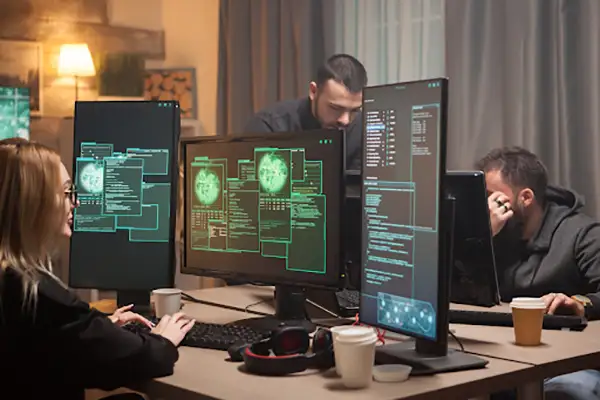
Cybersecurity management has become a major concern for evolving MSPs. Between the remote work and cloud systems, one continues to ignore those security alerts. As a result, a sudden attack happens one day, and scattered tools and improperly structured systems fail to save them from it.
To avoid this, centralised cybersecurity monitoring platforms are here. Instead of forcing one to keep switching between various platforms and dashboards, it allows one to manage almost everything in an organized environment.
Keep reading to better understand how the centralized security systems help businesses to avoid scattered issues.
Key Takeaways
- Centralized monitoring helps MSPs to manage security by working as a single common platform.
- AI helps to detect threats faster. As a result, the response time and delays to the incidents reduce.
- Automation and AI are playing a crucial role in modern security management
Centralized threat monitoring is the process of regulating security awareness through a single platform. Instead of checking various dashboards and separated systems, MSPs can monitor activity across networks, devices, cloud services, and applications from one console.
The strategy is to improve visibility and reduce gaps in security access. These platforms gather logs, alerts, and system activity into one setup, making it easier to spot unusual behavior and respond to threats right away.
Rather than working through disconnected tools, MSPs gain a unified system that improves speed and eases management across multiple clients.
A strong centralized control platform mixes several security technologies into one environment. Here are some of the most important features MSPs should consider.
Security Information and Event Management systems take on a major role in centralized monitoring. SIEM software stores and analyzes security logs from different systems in real time.
This allows MSPs to detect unethical activity faster and act before small issues become major security incidents. SIEM tools also help reveal patterns that might go unnoticed in private environments.
ConnectWise is one of the reputable providers offering SIEM solutions for MSPs. These systems support continuous tracking, automated alerts, and faster incident response processes.
Endpoint Detection and Response solutions help spot devices such as laptops, desktops, and servers for unusual behavior. Extended Detection and Response carries this a step further by connecting information from endpoints, cloud systems, email, and networks.
When centralized monitoring platforms mix EDR and XDR, MSPs gain a broader view of emerging threats. This makes it easier to track attacks moving across multiple systems and setups.
User and Entity Behavior Analytics adds another layer of security. These systems track user behavior patterns and look for unexpected activity that falls outside normal habits.
For example, if an employee suddenly uses unusual systems or downloads large amounts of sensitive data, the platform can emit alerts. Machine learning helps improve surveillance over time by recognizing new patterns and unusual behaviors.
Many businesses now function in multi-cloud environments. This poses new security risks for MSPs who oversee cloud infrastructure for clients.
Cloud security monitoring tools help highlight weak configurations, compliance problems, and shared resources. By weaving these offerings into centralized systems, MSPs can better shield cloud-based operations and reduce risk.
Centralized monitoring platforms offer various important benefits for MSPs managing modern cybersecurity systems. Below are the major ones that attract MSPs towards centralized monitoring systems:
When data from multiple systems is merged into one dashboard, threats become easier to see. MSPs can spot odd patterns faster and understand how attacks move through shared environments.
Speed matters during a cyberattack. Centralized systems help MSPs perform quickly by removing delays caused by shifts between separate tools and consoles.
Managing security through one platform saves time. Technicians use less effort managing different systems and more time fixing issues and serving clients.
Centralized tools help MSPs apply uniform security policies across different spaces. This narrows security gaps and helps meet compliance standards more swiftly.
As MSPs add new clients, centralized platforms improve onboarding and monitoring. Teams can manage growth without sharply increasing operational hurdles.
Cybersecurity threats go on to become more advanced every year. At the same time, businesses are relying more firmly on cloud systems, remote access, and advanced technologies.
This is resulting in greater demand for centralized security management solutions. Artificial intelligence and automation are also getting more common within monitoring platforms. These technologies help MSPs identify threats faster and reduce manual loads.
As cybersecurity continues to develop, centralized monitoring systems will likely become even more important for MSPs looking to improve quality, strengthen protection, and support growing client needs.
Managed Service Providers operate in high-pressure settings. Multiple clients. Multiple IT environments. Multiple security stacks. And of course, multiple security threats are becoming more deadly.
Centralized security monitoring tools can help mitigate some burden. They put all that complexity into one, controlled, and flexible system.
Not sure where to start? We’ve got you fixed. Let’s clarify what centralized security monitoring tools are, how they work, and how MSPs can benefit:
Centralized security management is a practical approach that arranges the control, security tools, policies, and monitoring into a single platform or console. The aim? Greater visibility and robust policy enforcement. Centralized security management is all about replacing messy, siloed IT systems with a unified infrastructure.
These unified platforms are called centralized security monitoring tools. They collect information from networks, endpoints, applications, and cloud environments and provide a single frame of glass view.
Centralized security systems often mix key technologies to provide a well-rounded security posture. Explore the core components MSPs ideally have to find:
SIEM software is the core layer of centralized management. Security Information and Event Management (SIEM) tools are specifically made for MSPs who want to detect threats sooner and fix issues faster. SIEM tools aggregate logs and correlate data to flag, analyze, and alert on threats in real-time.
ConnectWise is one of the main providers of SIEM software. MSPs can ensure 24/7 threat monitoring, detection, and alerting. Moreover, expert-led incident actions will help contain and neutralize threats quickly.
Endpoint Detection and Response (EDR) and Extended Detection and Response (XDR) provide behavioral threat detection. More exactly, XDR provides cross-domain threat links across email, cloud, network, and endpoints. Through centralization and EDR/ XDR fusion, you don’t miss lateral movement between endpoints or boundaries.
User and Entity Behavior Analytics (UEBA) integration offers an intelligence-driven defense. It involves tying machine learning and algorithms to user and entity actions.
UEBA solutions build behavioral baselines and identify patterns that vary.
As a managed service provider, you are forced to deal with multi-cloud environments. Cloud Security Posture Management (CSPM) solutions scan for mistakes and compliance issues. The result? All security specifications and configurations are met, reducing gaps and eliminating financial errors.
Centralized security monitoring tools offer a ton of rewards for MSPs. Below are the major advantages that belong to the MSPs:
If planned well, modern MSPs can manage complex security threats without slowing down the operations. With the help of centralized monitoring platforms, it becomes possible for MSPs to improve their response time, reduce additional stress and manage scattered systems.
With the rise of evolving threats, a common security system has become a necessity for the growing IT businesses.
