

Machines have always been at the construction sites. But the newer ones run on their own. Autonomous equipment and construction robotics have turned from science fiction to reality.
They’re now covering the tasks that were human-exclusive some years ago. And contractors chasing cost optimization are adopting them at an unprecedented rate. The Construction Robotics market size is projected to hit $1218.02 billion by 2035.
But among them, only those who know the tech inside out and how to integrate it into the processes will achieve success.
Top talent would still stay at the site, but only for oversight operations. The routine, repetitive tasks would be all handled by machines, as they can do them consistently, safely, and cheaply at scale.
In this article, I’ll tell you exactly how deeply automation and robotics have entered the construction business. The following sections discuss how automation has been integrated into heavy machinery, site inspection drones, bricklaying, and its overall impact on the construction backend.
KEY TAKEAWAYS
- Automation and robotics aren’t science fiction anymore; they’re at the construction site.
- Almost everything has been automated: heavy machinery, site inspection, bricklaying, and even the construction backend.
- Contractors who know the tech inside out and are clear about how he/she plans to integrate it win.
Heavy equipment automation is pretty mature even at the moment. Autonomous dozers, graders, and excavators from manufacturers like Komatsu and Caterpillar are already operating on large earthmoving and grading projects. These machines use GPS positioning, real-time terrain mapping, and onboard sensors to execute grading plans with millimeter-level precision. They typically achieve significantly tighter tolerances than manual operation.
The productivity argument is straightforward. Autonomous equipment can:
The technology doesn’t eliminate the need for experienced operators, but changes the ratio of operators to active machines significantly. Someone still needs to set up, monitor, and troubleshoot.
Now to the construction automation tech that has the record of fastest adoption: Site survey drones. This happened largely because its entry cost is low and the workflow benefits are immediate. A drone survey that would take a ground crew several days can be completed in hours, producing photogrammetric point clouds and orthomosaic maps accurate enough to drive quantity takeoffs, progress tracking, and site safety audits.
Beyond surveying, drones are being used for:
The operational data drones generate feeds directly into project management workflows. Hence, teams that already have centralized job tracking systems extract more value from drone programs than those managing data across disconnected tools.
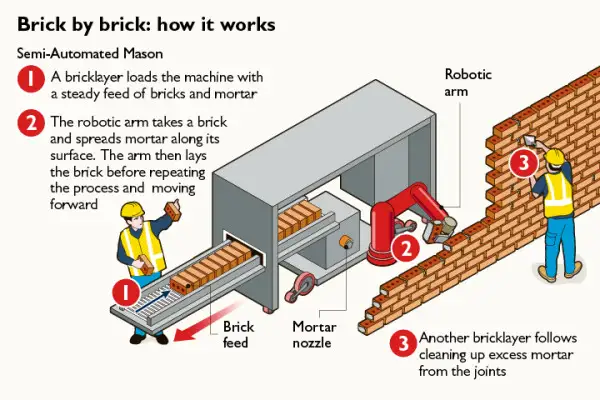
SAM (Semi-Automated Mason) and Hadrian X are some popular examples of robotic bricklaying systems. They possess surprising features like:
In practice, these systems work alongside human masons rather than replacing them. The robot handles the repetitive laying work while skilled workers manage corners, openings, and quality control.
Here’s an infographic depicting the process visually:
Even more automation has gone into prefabrication. Off-site fabrication facilities using robotic assembly lines are producing wall panels, modular bathroom pods, and structural components with tolerances and cycle times that site-based construction can’t match. This shifts significant labor from the unpredictable jobsite environment to a controlled factory setting, reducing weather dependency and improving quality consistency across large residential and commercial projects.
Automation transforms how things work on the jobsite, but it also changes the systems that sit behind the scenes:
Managing all of that alongside customer relationships, estimates, and job financials requires operational infrastructure that most small and mid-sized contractors are still building out.
That’s why getting the best crm for construction business operations becomes an important, practical priority. As jobsite technology generates more data, the businesses that can connect that data to their customer and project workflows have a real operational advantage over those managing everything in separate systems.
Large contractors will benefit from construction automation tools, but smaller ones will benefit even more than them. The former were already decent at scaling, while the latter get the ability with these tools. They’re also the ones with the operational discipline to capture what the technology produces and turn it into better decisions.
