
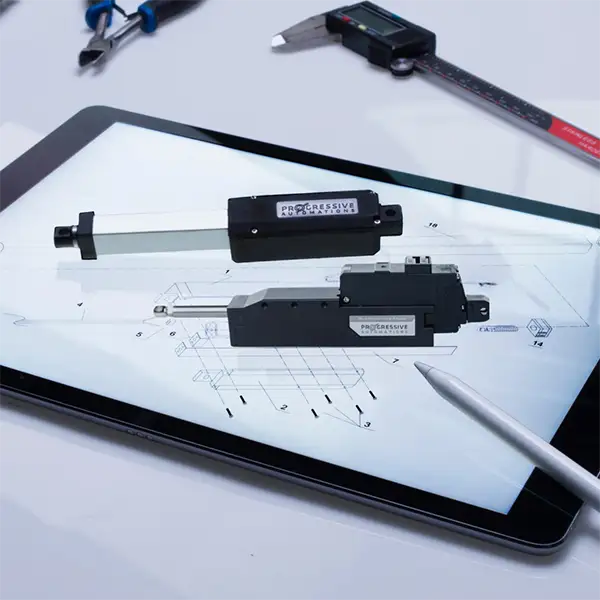
The industrial end of linear actuation gets most of the attention. Heavy gates, agricultural machinery, and big infrastructure. Applications where the requirements of force are clear, and the machinery is large and physically imposing.
But the other end of the scale is quieter and in some ways more technically demanding. Micro linear actuators, small units producing forces over short distances while ensuring high precision in industries where these uses are key for important operations.
Let’s examine the engineering challenges faced in this sector and how they provide significant benefits to relevant industries.
Key Takeaways
- Friction becomes proportionally significant in small-scale devices, with it representing a much larger proportion of available force.
- Robotic-assisted systems use micro-actuators to imitate the hand movements of a surgeon to provide precise assistance to professionals during operations.
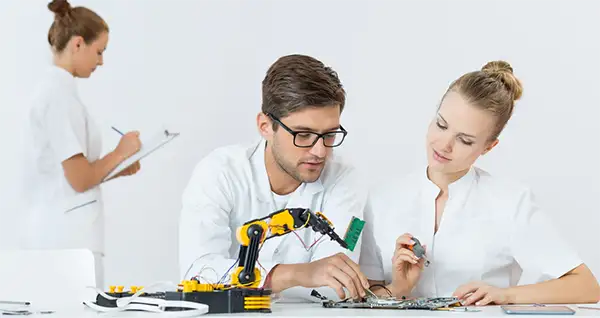
- These actuators also play a huge role in robotic mechanisms by refining the movements and functions of a mechanical arm, for instance.
- Many consumer products benefit from these, such as haptic feedback on touchscreens, adjustment of the components of a camera lens, and more.
Scaling a linear actuator down isn’t simply a matter of reducing the dimensions. The physics changes in ways that require different engineering decisions.
Friction becomes proportionally significant at small scales. In a large actuator, friction in the drive system is a small fraction of the total force output. In a micro unit, the same absolute friction represents a much larger proportion of available force.
It affects efficiency, positioning accuracy, and the minimum load the actuator can move reliably. Managing friction in a microactuator is a design priority in a way it isn’t for larger units.
Backlash, the small mechanical play in the drive system, matters more, too. A millimetre of backlash in a 300mm stroke is negligible.
The same backlash in a 15mm stroke is nearly seven percent of total travel. For a positioning application where repeatability is the point, that’s not acceptable, and the specification needs to address it explicitly.
Heat dissipation is harder in confined spaces. Surface area scales with the square of linear dimensions, volume with the cube.
A microactuator operating at high cycle rates has less surface area to shed heat, which limits duty in ways that the same motor in a larger capacity wouldn’t typically experience.
This is where the most demanding micro-actuation requirements live, and where much of the engineering refinement in the category has been pushed forward.
Drug delivery systems and infusion pumps use micro actuators to move precise fluid volumes.
The accuracy requirements are tight, the reliability requirements are extreme, and a failure mode acceptable in a consumer product is simply not acceptable when the device is delivering medication.
These applications drive actuator development in directions that eventually benefit other sectors.
Surgical robotics is the higher-profile end of this. Robotic-assisted systems that imitate the surgeon’s hand movements into mechanical movement at a reduced scale, requiring precise actuators that demand control specifications.
The precision and reliability requirements here are as serious as they get in any application.
Powered prosthetics are a different constraint set entirely. Compact, lightweight, and durable simultaneously. The weight of an actuator in a prosthetic limb affects the energy cost of movement and the comfort of the device over a full day of use. Energy density matters in a way it doesn’t for a fixed installation.
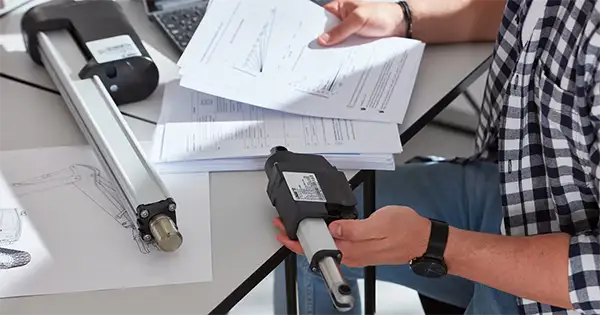
Clinical and pharmaceutical laboratories run liquid handling robots through thousands of cycles a day. Sub-millimetre positioning accuracy, maintained reliably across years of high-intensity use.
The combination of precision and cycle life that these applications demand is what separates laboratory-grade microactuation from general-purpose compact units.
Microscopy and analytical equipment use precision actuators for stage positioning, focus adjustment, and sample manipulation.
At high magnification, positioning resolution requirements become very tight. Standard lead screw micro actuators handle most laboratory positioning tasks in this range. The end, electron microscopy, and similar, push into piezoelectric and other non-lead-screw technologies.
Analytical instruments usually operate in clean and controlled environments, thus removing some of the environmental specification problems. But the requirements for precision and repeatability remain the same.
Fun Facts
Electric micro-actuators can achieve a precision of 0.1 mm or less, making them ideal for semiconductor equipment and microscopes.
Collaborative robots in manufacturing and service environments use compact actuation in end effector mechanisms, the grippers and tools at the working end of a robotic arm.
Mass at the end of an arm affects dynamic performance throughout the system. Lighter, more compact actuation allows faster, more precise arm movement, which matters for cycle time in manufacturing applications.
Humanoid robotics is where this gets genuinely difficult. Replicating human joint range of motion and force output in a form factor that fits inside an artificial body requires actuators that are compact, powerful for their size, efficient, and durable at the same time.
These requirements in combination have driven significant microactuator development over the last decade, and the technology benefits from it across other application areas.
The consumer end operates at volumes and cost points that medical and laboratory applications don’t encounter, with correspondingly different precision requirements.
Smartphone camera autofocus is probably the most widely used microactuation application in existence.
Micro mechanisms move the intricate lens elements with enough speed and accuracy for continuous focus tracking on non-stationary subjects, running millions of cycles over the camera’s life in a package a few millimeters across.
Unremarkable to the person using the phone. Remarkable as a piece of engineering.
Haptic feedback in touchscreens, game controllers, and wearables uses micro actuators to produce tactile responses. The priority here is dynamic response and varied force profiles rather than precise positioning, which is a different optimisation from laboratory or medical applications.
The micro linear actuators used across these applications share the fundamental lead screw mechanism of larger units. The engineering attention shifts to the properties that matter at the small scale: backlash control, smooth force output at low loads, positioning accuracy, and reliable performance over high cycle counts in constrained spaces.
Backlash is the parameter that dominates precision microactuator selection in a way that it doesn’t for larger units. Establish the maximum acceptable backlash for the application before comparing products. Rated force and stroke are insufficient as selection criteria on their own.
Minimum operating load is worth checking and often isn’t. Some micro actuators lose positioning accuracy below a certain minimum load. Applications that sometimes run with very light loads need units specified to perform under that condition.
Electrical noise from small motors affects nearby signal processing electronics in medical devices and laboratory instruments more than it does in industrial installations. Motor noise suppression becomes a real specification parameter in sensitive electronic environments.
Cable attachment and routing at a small scale is a failure mode that deserves more attention than it typically gets.
Very fine gauge wires flexing repeatedly over high cycle counts fail at connection points in ways that aren’t a meaningful concern in larger mechanisms. How the cables are routed and supported in the final installation matters.
The precision end of the market acknowledges and rewards careful upfront specification more than any other part of it.
The applications are demanding, errors are difficult to correct after installation, and the performance differences between units that look similar on paper can be substantial in practice.
