
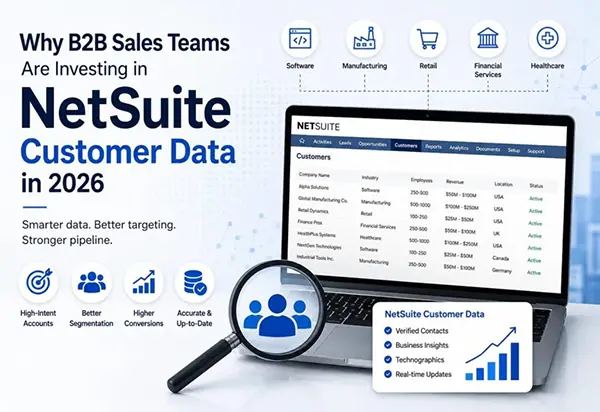
There was a time when the B2B sales teams and other promoting groups used to rely on unending lists and cold calling for outreach purposes. This is a lengthy, time-consuming and less efficient process – and that’s why not suitable for today’s competitive world.
In 2026, they give straight importance to the data that shares about companies that are actually ready to buy. And that’s exactly where the NetSuite customer data turns out to be of immense value.
With NetSuite Customer Database, companies get more operational and are more likely to adopt additional business tools.
Keep reading to explore why B2B sales teams are investing in NetSuite customer data in 2026.
Key Takeaways
- Companies that use NetSuite often have better operations and are ready to make extra software operations.
- Revenue teams take advantage of NetSuite intelligence to make huge changes in making deals.
- High-performing sales teams use NetSuite data for lifecycle targeting and outreach through various methods.
Companies using NetSuite tend to share three operational traits that B2B sellers care about deeply.
First, they have already accepted the discipline of cloud financial software. The vendor questions that slow down purchases at companies still using QuickBooks, Tally, or legacy on-premise ERPs simply do not appear here. The selection committee already knows about subscription pricing, execution timelines, and integration goals.
Second, they have scale. The typical NetSuite customer is past the seed-stage chaos and into the build-and-optimize phase. They have department heads, budget owners, and procurement processes. For B2B vendors selling anything from data services to logistics software to HR platforms, this is the band where deal sizes climb and sales cycles compress.
Third, they have integration appetite. NetSuite customers are not closed ecosystems. They actively buy adjacent tooling to extend their stack: CRMs, marketing automation, payroll, expense management, e-commerce platforms, and analytics. Every NetSuite account is, by definition, a multi-product buyer.
This is why an accurate, segmented database of companies using NetSuite has become a foundational asset for outbound teams, ABM programs, and revenue operations functions in 2026.
The market is crowded with vendors claiming to sell NetSuite contact lists. Most of them are selling something far weaker than what serious revenue teams need.
A NetSuite Customer Database that builds up under enterprise oversight has four layers of intelligence:
This is the standard that separates a useful NetSuite Customer Database from a glorified contact dump.
The teams getting outsized results from NetSuite customer data have stopped using it as a list and started using it as a scoring framework.
Three patterns are emerging.
The first is stack-based segmentation. Instead of pitching every NetSuite account the same way, sales teams are slicing the database by adjacent technology. The messaging to a NetSuite plus Salesforce account is built around integration friction.
The messaging to a NetSuite plus Shopify account is built around financial reconciliation pain. The result is a meaningful lift in reply rates because the relevance is real.
The second is lifecycle-stage targeting. Companies using NetSuite are not monolithic. Some are six months into implementation and drowning in change management. Some are five years in and looking to extend the platform.
The same product can be pitched as a stabilizer to the first group and as an optimizer to the second. Sales teams that know which lifecycle stage an account is in close at materially higher rates.
The third is multi-threading by ERP responsibility. Someone always checks the numbers closely – that person now gets included. The meetings shifted once tech integration became a deciding factor. Reporting accuracy matters most to one particular manager day after day.
Approval authority sits higher, but influence spreads wider than before. Every role in the system decision has weight at some point. A serious NetSuite Customer Database supports this multi-threading natively.
CFOs and CROs are scrutinizing every line in the go-to-market budget. Investments in NetSuite customer data are making it through that critical review for a clear reason: they reduce wasted exterior motion. When the database is precise, divided, and updated, sales teams stop aiming basic outreach at unqualified accounts and start running stronger, evidence-based campaigns.
That change shows up in the numbers that matter. Higher opportunity–meeting conversion. Shorter sales cycles. Larger initial deal sizes from accounts that were better qualified at the top of the funnel. Lower customer acquisition cost on a unit basis.
In 2026, B2B revenue teams are not investing in NetSuite customer data because it is fashionable. They are investing because it consistently produces better pipeline economics than the alternatives.
In today’s competitive world, B2B sales precision is run by accuracy, not by volume. Instead of randomly running behind things, teams that actually get to know about the mature companies and are ready to make investments get a major head start.
And this is exactly where NetSuite customer data turns out to be truly important. It helps sales teams to make better connections and get effective results.
In the end, teams that win in this time do not consider data like a contact list – they consider it like a competitive advantage.
