

Access to high-end NVIDIA GPUs like A100, H100, and B200 has become a major constraint to running modern AI infrastructure. While demand has definitely surged across training, inference, and LLM deployment workloads, availability has seemed to take a hit, with significant price variations among other issues.
What matters is not whether a provider offers these GPUs, but how quickly they can be put into use, and how smoothly they integrate with existing workflows, and if they can support scalability for real-world AI systems.
This article ranks cloud providers based on on-demand access to modern NVIDIA GPUs without sacrificing usability or infrastructural control.
Key Takeaways
- Civo delivers GPU processing straight through its cloud platform, all while maintaining seamless integration with Civo Kubernetes.
- The Runpod platform is mostly used for experimental AI procedures and model prototypes because of its fast provisioning and broad availability.
- The Oracle cloud platform is best for large enterprises requiring GPU compute within an existing Oracle ecosystem and hybrid architecture.
- On-demand GPU access is more dependent on how efficiently computing can be swiftly integrated into real workloads.
| Rank | Provider | GPU Availability | Kubernetes Support | Deployment Model | Target Use Case |
| 1 | Civo | A100, H100, H200, B200, L40S | Yes | Public + Private + Hybrid | Unified cloud + AI infrastructure |
| 2 | Runpod | A100, H100, H200, B200 | Partial | Marketplace + Serverless | Developer AI workloads |
| 3 | Supermicro | A100, H100 (hardware supply) | No | Bare metal/hardware | Infrastructure provisioning |
| 4 | Armada | H100, A100 (cloud-native GPU) | Yes | Kubernetes-native cloud | AI platform operations |
| 5 | Together.ai | H100, A100 (API-based access) | No | API + hosted inference | LLM inference services |
| 6 | SemiAnalysis (research/market intel) | Market-level analysis only | No | Research platform | Industry benchmarking |
| 7 | NVIDIA | A100, H100, B200 (via DGX Cloud/partners) | Partial | Ecosystem + reference infra | Enterprise AI ecosystem |
Civo provides on-demand access to NVIDIA GPU infrastructure directly through its cloud platform, combining compute, Kubernetes, and hybrid deployment functionalities, all packed together in a single system.
Rather than segregating GPU compute from orchestration, Civo delivers GPU processing straight through its cloud platform, all while maintaining seamless integration with Civo Kubernetes, allowing teams to run AI workloads without external interferences or layers.
For organisations requiring infrastructure flexibility beyond the services of a public cloud, CivoStack Enterprise extends the same model into private and on-prem environments, allowing uninterrupted deployment of GPU workloads across a hybrid interface.
Best for: Teams that need on-demand NVIDIA GPUs tightly integrated with Kubernetes and hybrid cloud infrastructure.
Runpod is a developer-focused GPU cloud platform focused on offering on-demand access to NVIDIA GPUs through a flexible marketplace and serverless computing model.
The platform is mostly used for experimental AI procedures and model prototypes because of its fast provisioning and broad availability. It supports both container-based deployments and serverless execution, making it very suitable for changing workloads.
While Kubernetes integration exists, Runpod’s primary strength lies in its simplicity and elasticity rather than full infrastructure orchestration.
Best for: Developers and AI teams needing flexible, on-demand GPU access for iterative workloads.

Genesis Cloud is a GPU-focused cloud platform built primarily around high-performance distributed computing for AI training functionalities.
Commonly used for large-scale model training that needs consistent multi-GPU scalability. Their infrastructure is designed with a clear focus on throughput and efficiency rather than generic cloud services.
A standout feature of Genesis Cloud is its focus on tightly optimised GPU clusters, especially for workloads that depend on parallel training across multiple nodes.
Best for: Teams running distributed AI training workloads that require scalable GPU cluster performance.
Armada provides a Kubernetes-native cloud platform designed for distributed GPU operations and edge AI deployment purposes.
Their architecture is built to simplify the deployment of AI workloads across various segments of infrastructure, including GPU-enabled clusters. Armada integrates Kubernetes deeply into its platform, making it very suitable for teams that build scalable AI systems.
The platform is positioned for enterprise AI operations where distributed computing and orchestration are necessary requirements.
Best for: Teams building distributed AI systems across Kubernetes-managed infrastructure.
Visit Armada – https://www.armada.ai/
Did You Know?
Some on-demand services allow your GPU allocation to scale completely down to zero when idle, meaning you pay nothing during downtime.
Crusoe is an AI infrastructure provider focused on large-scale GPU compute environments designed for high-demand training and inference workloads. The company builds purpose-designed data centre infrastructure optimised for NVIDIA GPUs, including H100 and emerging B200-class systems.
A distinctive aspect of Crusoe’s model is its emphasis on building vertically integrated AI compute infrastructure rather than operating as a traditional cloud provider. This allows it to support large-scale “AI factory” deployments where compute, power, and infrastructure design are tightly aligned for performance efficiency.
Best for: Organisations building or running large-scale AI training infrastructure at hyperscale.
Oracle Cloud Infrastructure provides enterprise-grade GPU compute through its distributed cloud architecture, combining public cloud regions with dedicated and hybrid deployment models.
A key strength of Oracle’s approach is its deep integration with the databases of enterprises and existing IT systems, making it relevant for businesses already operating within the same ecosystem, where GPU workloads must sit alongside structured data platforms and enterprise applications.
Best for: Large enterprises requiring GPU compute within an existing Oracle ecosystem and hybrid architecture.
Fluidstack provides high-performance GPU infrastructure made specifically for AI training and large-scale machine learning operations. Built around dense GPU clusters, their platform allows organisations to run complex model training jobs without needing to manage infrastructure complexity.
It is frequently used for training large language models and running distributed inference workloads that require high-throughput compute, well-optimised for scaling workloads quickly across available GPU capacity.
Best for: AI teams prioritising large-scale model training and high-throughput GPU compute.
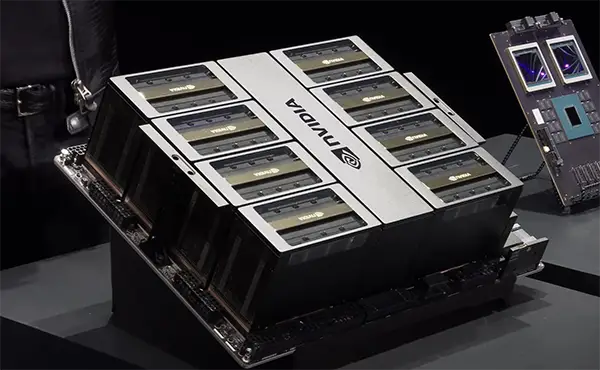
On-demand GPU access is no longer just about the availability of hardware; it’s about how efficiently computing can be swiftly integrated into real workloads.
The most important factor is the provisioning speed, as delays in the availability of the GPU directly impact training cycles and velocity. Equally important is orchestration support, particularly Kubernetes-native integration for scalable AI programs.
Cost predictability also plays a major role, as GPU workloads scale across distributed environments where inefficiencies accumulate fast.
Finally, hybrid compatibility is becoming more relevant, as many organisations now run AI workloads across different infrastructure environments rather than a single cloud provider.
The supply of NVIDIA GPUs has become a bottleneck in AI infrastructure planning, and access to A100, H100, and B200 class hardware is increasingly governed by allocation, reservation systems or controlled capacity pools rather than easy on-demand availability.
As a result, platforms that combine GPU access with orchestration and hybrid infrastructure support are becoming more important than raw compute providers alone.
