

Till some years ago, a successfully functioning business required hundreds of people to work in unison. But with modern technology, just a single person can get up and start a business.
These people are called solopreneurs, and they’re increasing day by day. Forbes stated that the number of US solopreneurs had reached 29.8 million in early 2026.
Individuals with no business background no longer need to grind through a job all their lives. They’re starting businesses to taste freedom, but it comes with its own burdens.
Solopreneurs have to manage multiple roles for their business: manager, accountant, marketer, customer support, and everything in between.
They start the business with enthusiasm, but all these activities that have nothing to do with the main work they enjoy take a lot of time and energy from them.
Automation comes to the rescue to better manage your time and tasks. Systematic structures make running the business easier.
Staying organized is not about working harder. It is about building simple systems that help you manage your time, tasks, and information. When your work is structured, your business becomes easier to run.
In this article, I’ll expand on how to stay organized while running a business just by yourself. The following sections educate you on how to handle clients, accounting, admin, time-consuming routine tasks, deadlines, and feedback.
KEY TAKEAWAYS
- Solopreneurship has become really popular in recent times.
- But handling tasks besides your main value work gets exhausting for a single person.
- These activities include client handling, accounts, admin, review, and feedback.
- Automation greatly helps in minimizing the time taken by simple routine tasks.
Lead generation and client handling are a major part of any business. Misunderstandings emerge when instructions are scattered across messages, emails, and calls. This can lead to delays or repeated work.
Keep important client information documented in one place. Save agreements, project details, and feedback so you can review them quickly when needed. Written summaries after meetings can also prevent confusion later.
Clear, professional records keep you organized. Relying on memory to track project details is risky. This also helps clients as expectations stay clear throughout the project. Proper communication makes work smoother and reduces unnecessary back-and-forth discussions.
Financial records are another pillar of a successful business. But many solopreneurs take this part lightly until taxpeople knock on their doors. This habit often leads to missing receipts, incorrect records, and unnecessary stress.
Updating financial records regularly keeps your business information accurate. Record income, review expenses, and store receipts in an organized way. When your records stay current, you can quickly understand how your business is performing.
Many solopreneurs rely on the best bookkeeping software for sole proprietor businesses. This automates transaction tracking and maintains clear financial reports. Less manual work and the records stay organized throughout the year.
A running business generates much data and many files in a single day. Contracts, proposals, invoices, client documents, and project assets all need a proper place. Without a clear system, finding the right document can take longer than the task itself. Disorganized files also increase the risk of sending the wrong version of a document to a client.
Just keep distinct folders for key things like clients, projects, finances, and overall business. The subfolders and files should also be clearly organized with proper and consistent naming. Include the client name, project name, and date as needed.
When every file follows the same structure, you spend less time searching. A clear digital filing system keeps your work organized and prevents unnecessary delays.
Administrative tasks are equally important. But no client is requesting you to go about it, so it gets postponed indefinitely. Over time, this creates confusion and stress.
A better approach is to schedule dedicated time for these tasks. Choose a specific block during the week to review emails, send invoices, update records, and follow up with clients. Treat this time as a normal part of running your business, not as optional work.
Regularly doing admin keeps it manageable. Things don’t pile up, and operations remain smoother.
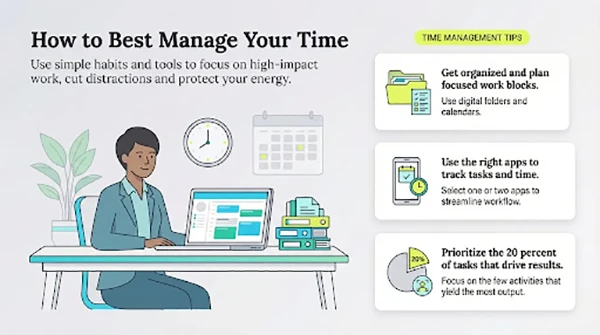
The following infographic can help you better manage your time:
Many routine tasks in a business don’t require much brainpower, such as scheduling meetings, payment reminders, invoice creation, etc. Completing these tasks manually every time wastes time that could go toward more valuable work.
Automation tools help reduce this effort. Calendar tools can allow clients to book meetings without email exchanges. Invoicing software can generate invoices and send reminders automatically. Email templates can simplify responses to common questions.
Automation doesn’t take away your control of the business. It just fast-tracks some routine tasks that take your precious time, which could’ve been given to the strategy aimed at long-term business growth.
Solopreneurs usually miss deadlines not because projects are time-consuming, but because they get out of their minds. They usually juggle several projects at once. When deadlines stay buried in emails or messages, they become easy to overlook.
A simple deadline tracking system can prevent this issue. Use a calendar or project tool to record delivery dates for every project and commitment. Review upcoming deadlines at the start of each week so nothing catches you by surprise.
Deadlines in regular view help plan work better. You can spread tasks across several days instead of rushing at the last moment. Work gets completed consistently and smoothly instead of under unnecessary pressure.
Business planning and organization are not required just at the start. Business grows, workload and processes change. Systems that used to work may fail to.
Take time each month to review how your workflow is functioning. Notice where delays occur or where tasks feel harder than they should be. Sometimes a small change, such as adjusting your schedule or improving file organization, can remove recurring problems.
Regular reviews help you improve your systems gradually. Problems are spotted early, business runs smoothly, and you maintain control over workload even when responsibilities expand.
All in all, if you want to commercialize your main skill, it won’t be a smooth journey. You’ll need to develop many other skills that are required to run a business successfully. It requires clear organization across many parts of the business. Without structure, tasks compete for attention and important details can slip through.
Simple systems make a significant difference. Planning your week, tracking tasks in one place, organizing files, and setting time for administrative work all help create a stable routine. Automation and proper financial tracking further reduce unnecessary workload.
Don’t chase perfection, just try to be consistent. Apply small organizational habits each day, and business becomes easier to manage. Clear systems allow you to focus more on meaningful work, and you’re left with fewer unfinished tasks.
Ans: LLC or Sole Proprietership.
Ans: Structure routine, use digital project management tools, and automate repetitive tasks.
Ans: Shed memory-based tracking for automated systems that match your workflow.
