
Adaptive software development is a software development process that can respond to changes in requirements, feedback, and business conditions while continuously improving the quality of the software and the speed of its delivery.
Because of these characteristics, adaptive software development provides teams with the ability to respond quickly and efficiently to uncertainty regarding project goals that change throughout the software development lifecycle (SDLC). To know in detail what is adaptive software development, its benefits and characteristics, read along till the end.
An agile methodology (Adaptive Software Development) for managing uncertainty. The philosophy of adaptive (agile) development encourages flexibility, communication, and ongoing refinement throughout the life cycle of custom software development.
However, the problem with traditional (waterfall) development is that requirements often change during the course of a project. The concept behind adaptive development is to view change as a normal facet of the development process.
Core objectives of the adaptive method help:
Modern software projects, like mobile apps, cloud computing and enterprise applications, are increasingly embracing adaptive software development.
For example, Amazon and Netflix use adaptive software development to continually update their existing products based on how customers interact with them. Rather than waiting until there is enough for a significant release of improvements, they release many more frequent, smaller updates.
Take a look at the characteristics of Adaptive Software Development and how they set it apart from traditional methods of development.
Adaptive software development provides flexibility to modify a development plan or design when there is a change in requirements, therefore keeping the software relevant and functional.
It provides ongoing learning through feedback from testing, review and user input. As a result of this continuous learning, the quality of software improves with each new release.
Effective project completion can be achieved through the successful collaboration of developers, testers and stakeholders.
When developing software, it can be created in small incremental pieces and then validated through testing each increment continuously.
Frequent testing provides for early identification and resolution of problems, thereby reducing risk on the project and making it more reliable.
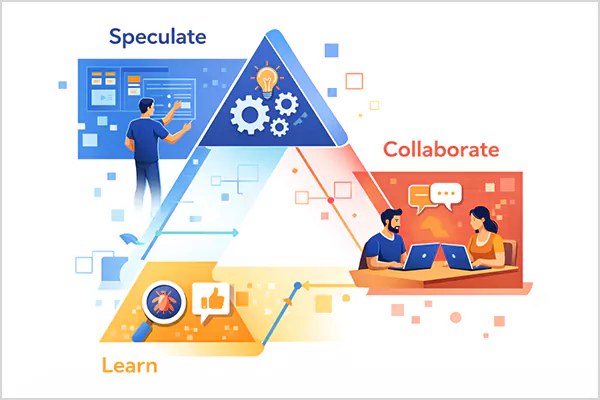
Adaptive Software Development uses three phases of continual improvement and agility to achieve high quality and efficiency. This allows teams to adapt to changes that occur during the course of development:
The purpose of this phase is to define how to achieve the project’s goals. Therefore, teams need to develop an outline of the objectives, requirements and strategy that will be the basis for the project; rather than developing a rigid plan for the duration of the project.
In this phase, team members (developer, tester and stakeholder) work together to create and enhance the features of the software. By creating test code and other artefacts, sharing knowledge and troubleshooting work as one.
Last but not least, the team gets the opportunity to consider the results and/or lessons learned through testing and feedback. Thereby allowing for continuous improvement of both the software produced and the overall development tools and processes used.
In the table given below, check out the difference between Adaptive Software Development and other agile methodologies.
| Factor | Adaptive Software Development | Waterfall Model | Scrum Framework | Kanban Method |
| Development Style | ASD is known for following an adaptive and iterative process that adjusts according to the project. | Waterfall strictly Follows linear sequence. | Scrum uses short development cycles called sprints. | Kanban, on the other hand, focuses on continuous and stable workflow. |
| Planning Method | Planning is flexible and can change based on the latest insights and feedback. | Planning is detailed at the start and changes later in the project. | Work is planned at the beginning of each sprint cycle. | Planning happens continuously as tasks move through the workflow. |
| Client Participation | Clients are involved throughout the process, and their feedback is taken into consideration. | Clients are only involved in the beginning. | Clients are part of each sprint review and feedback sessions. | Regular feedbacks are given by the client. |
| Ideal Use Case | Suitable for complex projects. | Best for projects with defined and stable requirements. | Projects that need rapid development and regular updates. | For teams that focus on continuous delivery and process. |
Adaptive software development comes with several great features, but everything has a downside. So let’s take a look at its advantages and disadvantages. This includes:
| Advantage | Disadvantages |
| High flexibility | Requires experienced teams |
| Faster delivery | Less predictable timelines |
| Improved software quality | High collaboration dependency |
| Better risk management | Scope management difficulty |
| Strong collaboration | |
| Customer satisfaction |
The most suitable use of ASD is in projects that have frequently changing requirements and where flexibility is a requirement. ASD is well-suited to:
This development is a form of project management that breaks development into smaller, manageable parts or iterations. Through these iterations, a team can build, test, evaluate and improve the software iteratively.
Each iteration involves:
Because adaptive software development uses an iterative approach, it allows the final product to meet real-life user needs rather than relying on the outdated initial assumptions that were created at the beginning of the project.
What Is Adaptive Software Development? It is an impactful method for producing quality software, which includes collaborative team effort, ongoing learning, and development through incremental iterations.
Hence, this flexibility, efficiency, and user-centred approach make adaptive software development vital to today’s software engineering profession and coding practices.
Ans: Adaptive Software Development (ASD) is an “Agile” methodology based on the principles of flexibility, learning, teamwork and iteration.
Ans: ASD provides for changing requirements, as opposed to Waterfall, which works off a predetermined plan, with fairly low flexibility during all phases of the development life-cycle.
Ans: The three phases of Adaptive Software Development are speculation, collaboration, and learning.
Ans: ASD is used for projects with ambiguous and constantly changing requirements and/or projects conducted in rapidly changing business or technology environments.
Source:
