
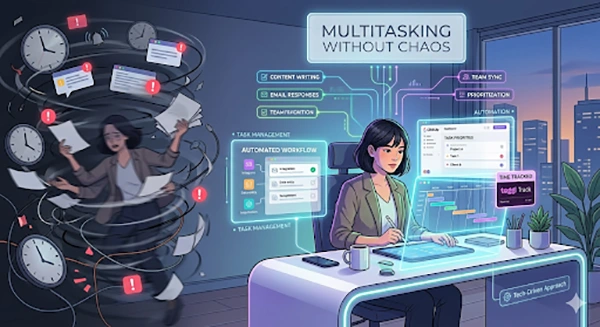
How surprising is it that we spend almost one-third of our daytime sleeping, which makes it natural to feel like there is not enough time to perform every required task. And that’s exactly what pushes one towards multitasking.
While multitasking often feels chaotic and overwhelming to people. But with the help of a tech-driven approach, integrating performance and management tools in daily life can truly make it doable.
In fact, simply batching tasks reduces context switching and improves output by 25%. (Source: Cannelevate)
Want to explore further? Keep reading to learn how one can adapt to a tech-driven approach and perform multitasking without chaos.
Key takeaways
- Multitasking only feels overwhelming and chaotic when it is unstructured.
- Turning a large project into a small and manageable one reduces stress and improves focus.
- Technology was never a problem; when used in the right way, it makes multitasking easier.
Multitasking feels chaotic today, as the young generation has learned to work on a productivity myth that is switching tasks for more results. When someone keeps switching tasks, either because of getting frustrated or a constant feeling of doing more, things become chaotic.
As a result, an illusion is created about improved productivity. But in reality, it burns through mental energy and reduces thinking and focusing capabilities by up to 40%.
To overcome this, one can benefit from microtasking, a process of breaking down projects into small and manageable tasks. This truly boosts productivity and efficiency over time.
The rapid progress of technology in the last few years has made it much easier to collaborate, produce, and multitask both as a team and as an individual. When the focus is constantly diverted by the phone ringtones and flashy messages, it becomes impossible to perform even a single task.
Using advanced tools to manage and automate tasks, set timetables, and track performance, one can benefit from technology to unfold the most multitasking capabilities.
When used effectively, technology can work as an extension to reduce workload and remember every detail.
Interesting Fact
Using the right digital tools, one can boost productivity by 20-25%, helping teams work faster. (Source: McKinsey & Company)
Using some popular principles and unshakable rules, one can ensure performing multitasking without getting overwhelmed or feeling chaotic. Let’s explore the most effective of those:
Give yourself enough time to complete the set goals; don’t keep switching just because a task seems to be not working according to how you thought. This will just put you in an illusion of being productive, but in reality, both time and energy will be wasted.
To avoid this, prioritize tasks with a created list. This mindset will help to deliver things on time with realistic expectations.
Don’t waste time performing tasks that don’t really need specific attention. This will just take unnecessary time. Instead, use automation tools that help to perform the same task with more accuracy and in less time. This allows one to utilize the same time on some other important task.
To avoid feeling overloaded, follow simple strategies such as keeping all the required things at the desk to find them on time. Use the designated folder for files, and don’t forget to take breaks. This allows the next task to be started more efficiently.
It’s essential to remember that not everyone can thrive in a completely uncluttered environment.
Users can benefit from tech tools that are truly effective to boost productivity and hence help in multitasking. When one can perform a single task with the least involvement with the same accuracy, the rate of multitasking efficiently increases. And this is what becomes easier with tech tools:
Using task management platforms, one can align tasks with their complexity levels and time required. This allows performing tasks with the right pairing and on-time delivery of work.
Popular tools like ClickUp and Todoist offer attractive features like AI scheduling and real-time collaboration to boost productivity.
Popular time tracking tools such as Toggl Track help users to link project workflows directly with the billable hours, reports, and productivity theories. These tools are usually simple to use with an interactive interface, yet they are very helpful in performing multitasking.
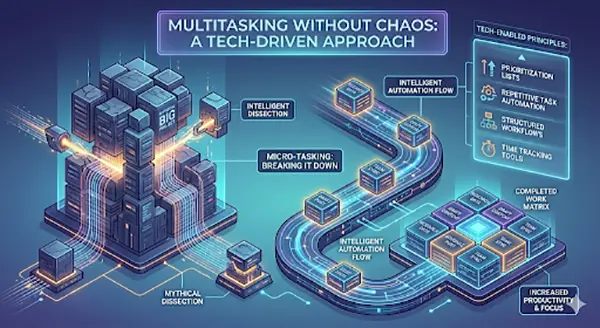
Multitasking turns chaotic when things are random, unstructured, and not guided with advanced tools. Wasting time on tasks that can be easily done another way is the main reason for frustration and task switching.
Also, huge projects without clear workflows confuse the brain, while ignoring automation and getting distracted by notifications only adds stress.
The major problem is not having a defined structure. Having clear priorities, a structured workflow, and the right tech allows one to keep multitasking handy.
Managing multiple tasks at work might be both tricky and challenging at times. Especially when tasks are constantly switched without having a set priority and automation tools are ignored, efficiency is decreased. Hence, hindering the performance of multitasking.
To ensure things don’t complicate further, consider using a structured approach along with the help of modern technology. This will help to complete tasks in time and with clarity.
Ans: Microtasking is a popular strategy of breaking down a complex and big project into short tasks that are easily doable.
Ans: To avoid stress, set priorities, automate tasks, and avoid distractions. Doing these will increase efficiency and help in feeling stress-free.
Ans: Yes, when performed with a structured approach supported by a tech-driven approach, it definitely improves productivity.
