
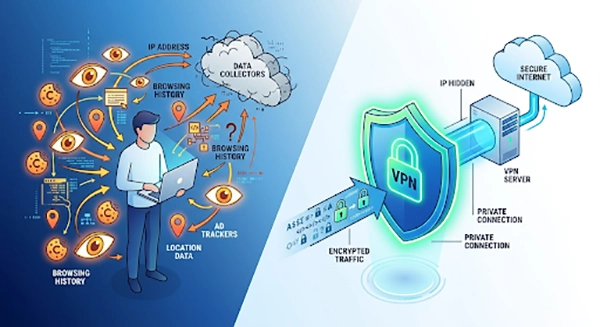
As digital platforms continue to expand, concerns around online privacy have also increased. From browsing and shopping to studying and playing games, we use the internet for almost every task. As a result, the importance of protecting online identity has grown drastically.
Furthermore, one of the most effective and convenient ways to protect your online identity from hackers and spies is by using virtual private networks (VPNs). In fact, about 1 in every 3 internet users globally uses a VPN regularly. (Source: Statista)
But how exactly do VPNs work, and what aspect of online activity do they protect? Keep reading to explore how VPNs really protect your online identity in an increasingly tracked way.
Key Takeaways
- Online tracking is a common practice in which websites collect information such as IP addresses, what users are browsing, and cookies.
- This information allows companies to gain knowledge about their customers’ behavior, choices, and preferences.
- Virtual Private Networks (VPNs) help secure online activities by protecting users’ IP addresses and internet traffic.
Online tracking has become a largely invisible part of how the web operates for users. Websites often use analytics tools and advertising networks to collect data about user behaviour.
According to Web Almanac, about 95% of websites include third-party trackers to collect data related to user activity, IP addresses, and more.
Still, most of this monitoring starts with IP addresses, which disclose the starting point of online traffic. Furthermore, what’s my ip can help users learn what their visible IP address is and whether it is protected.
Interesting Fact
According to the Pew Research Center, around 79% of people are concerned about how companies use the collected data about them online.
Many users believe that online tracking only involves ads. However, in reality, websites track a range of user data for various requirements. Let’s understand those:
Every device connected to the internet uses an IP address (Internet Protocol Address). This allows websites to communicate and send information to your device. It also reveals geographic location, for example, country or region.
Websites may also track information concerning how users interact with their sites. This may include information such as pages visited, the duration of time spent, and pages clicked. This helps businesses understand user preferences, hence improving their content and campaigns.
In addition to behavioral data, websites also collect information about devices and browsers, such as their type, version, operating system, and device type. They may also use tracking cookies, which are small files that remember users’ sessions and other information.

As the online tracking usually involves several layers of data collection, many aware users choose privacy tools to avoid sharing their personal information and protect their personal identity.
One commonly discussed tool is a virtual private network (VPN).
A VPN works by connecting internet traffic through an intermediate server and protecting the connection between the user’s device and that server. This process adds integration of security and privacy layers when using the internet.
One of the main benefits of using a VPN is that it changes the IP address visible to websites. As a result, the websites will not be able to find the original connection address.
It’s like sending a package through a mail forwarding service. The recipient sees the forwarding address instead of the sender’s home address. It makes the process more difficult for the websites to acknowledge activity and use it further for their benefit.
Another crucial function of a VPN is to encrypt the data that is being shared between the device and the VPN server. It converts readable data into coded data that is almost of no use for businesses.
This is of high use on shared networks. By locking the connection with encryption, they make it extremely difficult for anyone to detect and use your login information or messages.
VPNs also ensure protection while using unfamiliar or suspicious networks, such as those found in cafes, airports, and hotels. These networks often don’t have strong security protection. Taking advantage of these, attackers may try to steal data shared over the network.
VPN reduces the risk by creating a secure tunnel. This helps to protect information as it travels through different networks.
Given the several choices on the internet, choosing the best one could be a little difficult. Look for the below-mentioned features before choosing:
Online tracking has become an accepted part of surfing the web. Websites want to know things like your IP address, what you’re surfing, and your cookies to piece together who you are.
VPNs can reduce the amount of online tracking done on you by concealing your IP and encrypting your information. They may not completely stop online tracking, but they can certainly provide a boost to your online privacy.
Ans: Not completely, but it definitely hides your IP address, which makes it much more difficult for hackers to track things.
Ans: Yes, VPNs are legal in most countries. People commonly use them for privacy and advanced protection.
Ans: Websites track users to understand users’ preferences and their choices to improve their content and services and manage their marketing campaigns.
