

AI leaders are continuing to pacify people that artificial intelligence won’t be taking their jobs, but the picture on the ground is exactly opposite.
Business is a capitalist activity. Here, profits trump everything. If someone can do a task at a fraction of what they would pay you to do the task, why would he/she don’t do it? Ask yourself, if you were at his/her place, would you do it or not?
High management is still somewhat safe, but the entry-level jobs that graduating students used to enter the job market with have almost dried up.
So, the only option left for these students is to learn to build and manage the AI itself. And the market is also demanding more workforce that can do that. A PwC study stated that AI skills can bump up your salary by 56%.
There are many avenues to get into a machine learning course at the moment, so it becomes difficult to know which one is the best for you. It really depends on your educational domain and the target role. But most of these courses include current technical knowledge in the curriculum and hands-on projects on building real applications.
In this article, I’ll tell you which type of AI courses to avoid in your search for the best one, what the market demands are, and how to plan career transitions accordingly.
KEY TAKEAWAYS
- AI and automation have impacted entry-level jobs the most, so students need to plan their education accordingly in order to get employable.
- GenAI skills are in high demand in the job market.
- Enroll in AI programs from reputable platforms.
- Repurpose your strong suits into AI skills while transitioning career.
Before knowing what to choose, understand what to avoid.
The generative AI courses market has grown rapidly, and much of the content has been created quickly to meet demand. Many courses explain the conceptual foundations of large language models and just stop there. This results in learners who can describe transformer architecture but cannot build real ML applications, evaluate outputs properly, or integrate AI into production systems.
In 2026, employers prioritize practical ability over theoretical understanding. The gap between completing a course and securing a job is almost always due to a lack of hands-on experience.
Another major issue is outdated content. The GenAI landscape has evolved significantly between 2023 and 2026. Courses that still teach outdated APIs, prompting techniques, or model capabilities provide little real-world value despite offering certifications.
Yes, the demand for AI professionals is high, but that doesn’t mean employers are hiring them blindly. There are still certain skill set expectations from them.
For ML engineering roles, they expect hands-on experience in building AI-powered applications, implementing retrieval-augmented generation systems, managing token and context costs, evaluating model outputs with structured metrics, and deploying applications with monitoring and fallback mechanisms. These skills can only be developed through real project work.
For GenAI product and strategy roles, employers value the ability to align AI capabilities with business needs, define measurable ROI, lead AI adoption initiatives, and collaborate with engineering teams on system design.
For AI governance and safety roles, there is increasing demand for knowledge of model evaluation, red-teaming, responsible AI frameworks, and understanding of global regulatory environments, especially in regions like the European Union, the United Kingdom, and the United States.
You can easily identify the courses that can get you hired if you look closely.
Those courses generally focus on building real applications rather than just explaining concepts. Learners are required to create projects such as document-based question-answering systems, code generation tools, multi-modal applications, and AI evaluation systems. These projects become strong portfolio assets that demonstrate real capability.
Instruction quality also matters. Online courses taught by active industry practitioners provide insights that go beyond theory and reflect current production practices. This type of learning is far more valuable than purely academic or outdated material.
Community and peer learning have become important differentiators. Courses that include cohort-based learning, mentorship, or access to professional communities help learners stay updated and connected to industry trends even after course completion.
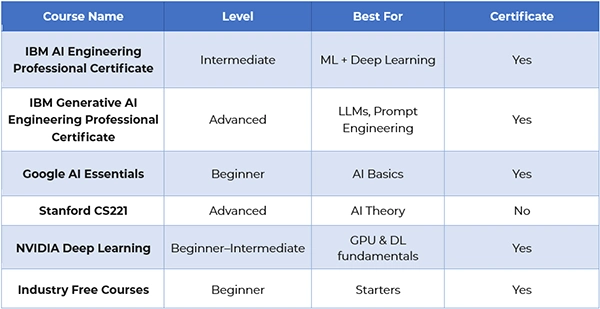
The following table lists some great courses that you can consider enrolling in:
“What you learn matters, not where you do it from.” Well, neither was it true then, nor is it now. Getting certified by industry leaders gives a clear advantage in the job market.
Cloud provider certifications from AWS, Google Cloud, and Microsoft Azure are widely valued, especially for technical roles. Certifications such as Google Cloud Professional Machine Learning Engineer, Azure AI Engineer Associate, and AWS Machine Learning Specialty demonstrate platform-specific expertise that employers trust.
Established learning platforms offering updated generative AI programs with strong project components also produce job-ready candidates. The key factor is not the platform’s brand but the relevance of the curriculum and the depth of practical work included.
Academic programs and micro-credentials from institutions like Stanford, MIT OpenCourseWare, and DeepLearning. Artificial intelligence provides strong conceptual foundations. Among these, programs that combine theory with applied learning have shown better career outcomes.
Has your dream role gone irrelevant after the AI wave? Many have faced this situation. The only solution to this is to make a career transition. And, if you actually sit to think about it, your existing skills can be easily repurposed for an ML role.
Software developers with Python experience are transitioning into AI engineering roles at the highest rate. They already possess the core programming foundation, and learning ML frameworks and APIs allows them to quickly become job-ready.
Data analysts and business intelligence professionals are also successfully transitioning by adding AI-driven analytics capabilities. Their existing data skills combined with AI knowledge make them highly valuable to organizations integrating artificial intelligence into analytics workflows.
Non-technical professionals face more challenges but can transition into roles such as AI product management, AI governance, and AI strategy. In these roles, domain expertise combined with ML knowledge is more important than great technical skills.
The courses that enable these transitions are those designed with clear career outcomes in mind. They focus on real-world skills, require meaningful project work, and connect learners to professional networks that extend beyond the certification itself.
Now you know everything about the current job market and how you need to maneuver around it with your existing educational qualifications and career goals. AI roles are in high demand, so transitioning to one or even thinking about the same is a prudent strategy. Just enroll yourself in an AI/ML course from a reputable platform, and you’re good to go.
Wish you a great career!
