
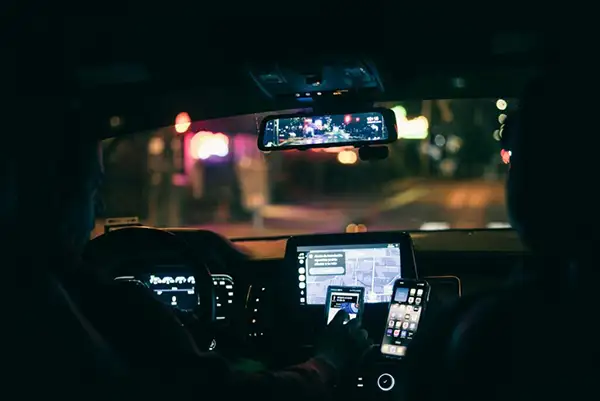
“Without big data, you are blind and deaf and in the middle of a freeway.”
— Geoffrey Moore (Consultant & Author)
Ridesharing seems too simple on the surface. You book a car, watch it move on the map, and then hop on when it finally arrives.
The user interface is kept as simple as possible. But under the hood, there are infinite moving parts. Many of them are just for safety and security, such as processing GPS data points, driver behavioural patterns, and trip history. There’s no scope for taking any risk, so all this happens in real-time. Firms have to move mountains to promise those safe rides. AI has also entered to make things even safer.
In this article, I’ll tell you everything about the role of data and AI in keeping ridesharing safe and secure. The following sections discuss related unfortunate incidents, the safety tech stack, passenger and driver data, legal issues, and how predictive AI fits in all this.
KEY TAKEAWAYS
- AI and big data are modernizing ridersharing with a focus on safety.
- The tech stack works overtime behind the scenes to keep everyone secure.
- Some unfortunate incidents led to thinking about the safety concerns with ridesharing.
- The future rideshare system would inform you of all the adverse events in your way beforehand.
The automated systems start even before the driver revs up the vehicle. Background checks, license verification, vehicle inspection records — all processed through machine-driven pipelines. Uber’s Real-Time ID Check uses facial recognition to confirm the driver behind the wheel actually matches the account holder. Lyft runs similar protocols. These aren’t PR talking points. They’re live safety algorithms making thousands of micro-decisions every single day.
Sound impressive? It is. But impressive doesn’t mean flawless. When something does go wrong — a collision, an assault, a trip that goes sideways in ways the app never anticipated — passengers often discover that platform liability is far more complicated than they expected. That gap between technological promise and real-world legal accountability is precisely why victims in these cases benefit from specialized counsel. A California Uber accident lawyer, particularly one familiar with how algorithmic negligence plays out in court, brings a very different set of tools to the table than a generalist personal injury attorney. The intersection of gig economy liability and AI-driven decision-making is still being defined in courtrooms across the state.
In March 2018, an unfortunate incident happened in Tempe, Arizona. An Uber self-driving test vehicle struck and killed pedestrian Elaine Herzberg. She was walking across the road at night. The sensors got confused between her being a pedestrian or a moving object. Emergency braking had been deliberately disabled. The backup human operator was not paying attention.
The aftermath wasn’t just a tragedy. It was a technical failure analysis that forced every major rideshare company to reexamine what “safe” actually means when an algorithm makes the call.
Uber eventually settled with Herzberg’s family. The human safety operator was criminally charged. But the deeper questions, about how automated systems are tested, who bears liability when they fail, and what “reasonable care” means when the car itself is the decision-maker, those questions didn’t go away. They’re still moving through courts and regulatory bodies today.
Passengers might not realize, but every single ride generates a data point. It can include:
All of it feeds into telematics systems embedded in the app itself — no additional hardware required.
Uber and Lyft use these signals to score driver performance. Drivers who trigger enough alerts get flagged, routed into coaching programs, or deactivated entirely. The system is supposed to remove risky drivers before they cause harm.
The question worth asking is: how precise is it?
A driver who brakes hard because a child ran into the street gets the same data point as a chronically reckless driver. Context doesn’t always make it into the algorithm. When platforms rely entirely on automated scoring to make high-stakes decisions — including deactivation — the design errors in those systems become real-world risks for passengers. Nobody’s hands are clean when the model was trained wrong.
Everybody knows drivers get rated, but do you know that passengers also get rated? On top of it, those ratings are fed to ML models that predict problematic ride scenarios before they happen. Trip cancellation patterns, account anomalies, time-of-day signals, surge pricing behavior — these data points get layered together to flag potential issues on either side of the transaction.
Some platforms have experimented further. In 2022, Uber quietly filed patents related to in-vehicle sensing technology designed to detect passenger intoxication levels through behavioral signals:
No commercial rollout was announced publicly. But the direction of travel is unmistakable. AI is moving deeper into the physical rideshare experience, not just the logistics layer.
That creates questions the gig economy hasn’t answered yet. Who owns that behavioral data? What are passengers consenting to when they accept the terms of service? In states with strict biometric privacy laws, such as Illinois and Texas have both litigated similar issues with other tech companies, the legal exposure could be significant.
INTERESTING INSIGHT
A 4.7 rating is considered “acceptable,” and drivers will likely start ignoring your requests when your score dips below that.
As a business, you have to give out perks to your employees. But your contractors deal with their issues on their own. Ridesharing firms took advantage of this distinction in the legal area and classified all their drivers as independent contractors.
They have spent enormous resources defending that classification — including funding Proposition 22 in California in 2020, which passed and temporarily preserved contractor status for app-based drivers in the state. The fight over AB5 and its aftermath still isn’t fully resolved.
The liability calculus behind that classification matters. If a driver is an employee, the company carries significantly broader exposure when an accident occurs. Independent contractor status creates a legal distance between the platform and the driver’s conduct.
But it’s still confusing, as the platform’s own safety algorithms vetted, scored, and kept the driver active on the platform. Courts in California and elsewhere have started looking at Uber not just as a marketplace but as an active participant in driver selection and behavior management. When a safety score cleared a driver who later caused harm, who bears responsibility? The data pipeline. The engineers who designed it. The company that deployed it without adequate safeguards.
That’s not a simple negligence claim. That’s product liability dressed in gig economy terminology. And that framing is gaining traction.
Uber’s RideCheck tries to gauge the potential of an accident using the motion sensors.
It promptly sends an alert to both passenger and driver if it detects things like:
No response triggers escalation to a safety team.
That’s genuinely useful. It has probably prevented escalation in real incidents. It closes a gap that didn’t exist a decade ago.
But it can’t flag a driver who passes every algorithmic metric on paper and still poses a risk. It can’t stop anything in the first five seconds of an impact. And it cannot, under any circumstances, substitute for legal accountability after harm occurs.
The technology is reactive at best, predictive at margins. The human cost of a system failure doesn’t average out across millions of rides — it lands entirely on one passenger, in one car, on one night.
The existing safety systems are all reactive: detecting problems and then acting. The future is the inclusion of predictive AI in this. Which can tell you the possibility of an accident even before the ride starts,
just by analyzing driver fatigue through signals like:
There’s also active development on routing algorithms that layer historical incident data with real-time GPS to suggest statistically safer corridors for late-night rides in high-risk zones. Some of this is already running quietly in background processes that passengers never see.
Well. The gig economy has always moved faster than the regulations designed to govern it. Safety algorithms are no different. They generate enormous amounts of data, make real decisions with real consequences, and operate almost entirely outside public scrutiny. Audit rights for these systems don’t exist in any meaningful regulatory framework yet, well, not federally, and only patchily at the state level.
Yes, modern systems have made the rides much safer, but that doesn’t mean they’re failproof.
A model trained to minimize aggregate harm across a hundred million rides is not the same as a model that guarantees safety on your specific ride, on that specific night, with that specific driver.
When a passenger is injured — and when there’s reason to believe platform-level decisions contributed to the risk — the legal questions multiply fast. Was the driver adequately vetted? Did the safety scoring system produce a false signal? Was there a documented failure in how behavioral data was weighted? These are questions that require legal expertise in platform liability, not just general accident law.
The technology will keep advancing. Safety scores will grow more sophisticated. Predictive models will improve. But until AI can actually guarantee safe outcomes, the legal system remains the most substantive safety net available to anyone harmed in a rideshare incident.
Turns out, the most sophisticated algorithm in Silicon Valley still can’t argue your case in court.
Leaving the steering of a vehicle in which you’re sitting to a stranger is a scary thought if you think clearly.
But technology has made it so safe that we don’t even bother. AI and Big Data are improving the safety of modern ridesharing even further.
The future is even crazier, eliminating all safety concerns, as you know every potential unfortunate incident even before you board the vehicle.
