

Spending on ads on Meta, Google, and TikTok is the mainstay of an agency’s business. Campaigns can be halted, trained algorithms can be disrupted, and the bottom line can be directly impacted by any payment delay, unexpected decline, or antifraud trigger.
Virtual cards have long since evolved from being “just a convenient tool” to becoming a component of the technological infrastructure that supports successful campaigns.
Today, billing systems at large platforms examine not only balances but also transaction histories, limit behavior, BIN patterns, and even top-up types. Therefore, cards with identical fees may act quite differently: one might function flawlessly for months, while another might trip a trigger on the first day.
Now, agencies must take into consideration variables that were previously irrelevant, such as the provider’s own antifraud analytics, limit variability, issuing region, and BIN density within a service.
That’s why this article shows a detailed breakdown of how these ecosystems work, what sets them apart, and which solutions might suit agencies at different stages of advertising maturity.
Let’s begin!
Key Takeaways
- Understanding how platforms rank risks
- Decoding some technical parameters
- Understanding ways to choose cards for different agencies
- Looking at the top 3 providers
Platforms no longer evaluate cards in isolation. They check how a card’s limit aligns with the age of the ad account and the pace of initial spend. If a new account suddenly gets a high limit, the algorithm sees it as a hint toward rapid scaling.
The internal metric, known in the industry as the limit to age spend ratio tracks the mismatch between available limits and actual spend. If the limit far exceeds the spending pace, the account moves into a higher risk group. This affects the likelihood of a payment integrity review and the speed of the first payment errors.
A high limit is seen as a potential sign of arbitrage, especially if transactions are heavy from day one. Stability in this scenario comes only from cards with properly configured velocity profiles and predictable BIN behavior.
Interesting Facts
By using specialized business credit cards, agencies can effectively turn a significant business expense into a “hidden profit center” by earning substantial cash back or points.
Static parameters matter less because ad platform antifraud has moved from fixed rules to predictive models. These days, a BIN is not a risk factor in and of itself. Algorithms restrict the rate of growth by examining spending dynamics. If a card’s velocity patterns appear aggressive, even one with a “perfect” BIN may be subject to checks.
Due to the fact that they establish the potential speed of spending, card limits have emerged as the primary driver of behavioral models. If the limit is too high, the algorithm anticipates a budget spike and reacts in advance.
Agencies working with new accounts get more stable payments from cards with moderate limits. Unlimited solutions behave predictably only if the provider has implemented a proper velocity system, its own antifraud models, and risk buffering at the issuer level.
If the provider doesn’t account for advertising billing specifics, the ban risk shifts to the issuer. Banks see repeated patterns and block BINs well before issues show up on Facebook or Google. Providers must be prepared for ad-related risk, not just general e-commerce traffic.
Regardless of technical parameters, the technical factors also play a pivotal role, and we are now going to take a closer look at them.
The same BIN can behave differently depending on which issuing bank created it. DPAN behavior, tokenization specifics, and ACS server logic determine the likelihood of a successful debit. Facebook is sensitive to country mismatches between the BIN and the account. Google looks at DPAN quality, token stability, and risk scoring on the payment gateway side. Even minor differences between a card’s country code and the account location can increase the chance of a decline.
Even if a card has a high limit, daily and hourly thresholds help reduce suspicion scores. A properly configured velocity profile spreads out spending and prevents spikes. Algorithms treat smooth spending as a sign of organic growth.
Platforms evaluate how robust the provider’s KYC processes are. Tier 1 and Tier 2 providers show higher traceability of operations, reducing sudden requests for extra checks in ad accounts. Grey issuers often operate without full KYC architecture, leading to unpredictable transaction statuses.
A frictionless 3DS flow boosts account trust scores, especially early on. If the bank triggers too many challenge requests, ad algorithms see it as card instability. Successful first transactions depend on ACS server quality. A slow issuer adds delays that can sometimes cancel authorizations.
Some issuing banks are more sensitive to the digital advertising MCC. Others allow smooth approval rates. This depends on internal regulatory rules. European banks often accept ad account MCCs without extra flags. Some US banks flag certain MCCs as higher risk, increasing checks.
Moderate limits are best for new accounts as they promote efficiency in the models. Let’s uncover some real-life instances.
Moderate limits are best for new accounts. They make it possible for predictable dynamics of trust-building. Since the available limit isn’t in line with the account age, cards with instant high limits raise suspicion. If the algorithm detects a discrepancy between the limit and account maturity, even a stable card may be flagged.
Once an account develops a positive spend to age ratio, medium-limit cards become viable. Proper velocity setup and attention to daily spend volumes are key. Rapid budget growth looks artificial.
Unlimited limits are safe only with providers using their own antifraud models. This involves adaptive AML scoring, custom velocity schemes, and risk reservation at the issuer level. This approach prevents sudden declines and lowers the chance of manual reviews.
Now lastly to clarify your decisions we our podium picks for this segment:
Spendnet issues dollar virtual cards optimized for Facebook Ads and Google Ads. All virtual cards for ads can be configured for a specific platform, reducing declines. Clients benefit from free issuance and flexible top-up fees. Funds are added via USDT or BTC with no conversion required.
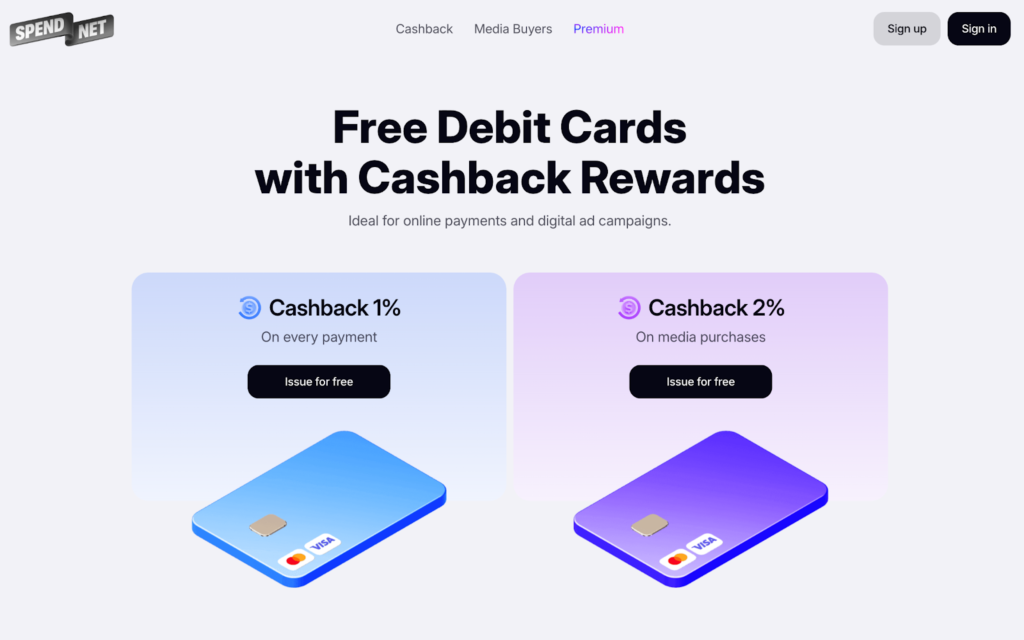
A key feature is automatic 2 percent cashback, used by buyers for extra testing budget. Spendnet has twenty BINs, six of which are unique. Issuers support 3DS and stable handling of ad account MCCs.
The platform offers team features with role and task allocation, convenient for agencies. The interface focuses on top-ups, balance, and CSV or XLS exports. Onboarding via Google or email is fast. Support is available 24/7.
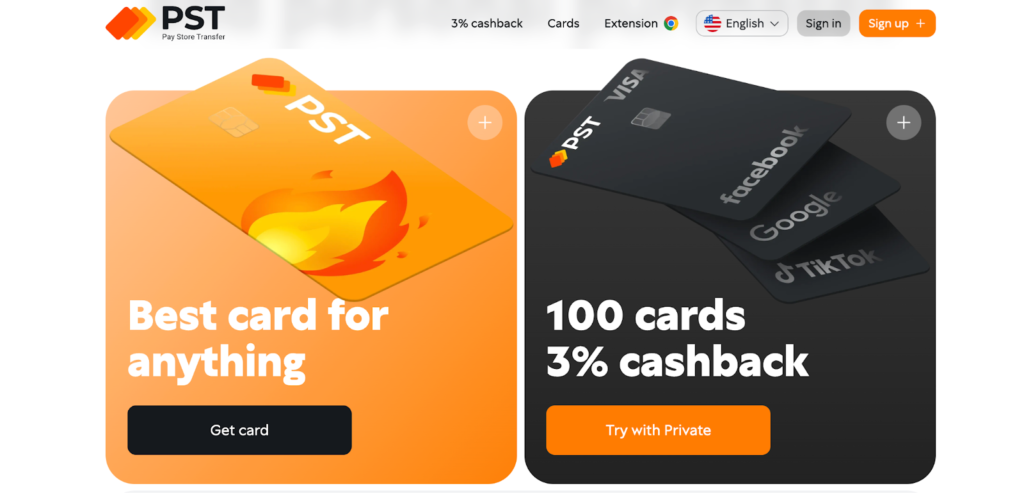
PSTNET issues cards for specific ad platforms. BINs are optimized for Facebook or TikTok. A Facebook-focused card won’t be used on TikTok, reducing declines. For general expenses, there’s the “for advertising” card, and for infrastructure like proxies, hosting, and AI, there’s the Ultima card.
The main PST Private product offers 3 percent cashback and the ability to issue 100 cards without turnover requirements. US and European issuers provide high stability. Cards work with Visa and Mastercard, support 3DS and two-factor authentication.
PSTNET offers more than twenty-five BINs. Payment risk is below average due to tokenization quality and predictable DPAN behavior. Top-ups are available via eighteen cryptocurrencies, SWIFT, SEPA, or Visa and Mastercard. Only incoming fees over two percent apply. New clients get USDT top-ups free of charge.
The platform includes team functions, subaccounts, limit management, and auto top-ups. Reports, transaction history, and live cashback display are available. Registration can be done via Apple ID, Google, Telegram, WhatsApp, or email. Support is 24/7.
Capitalist offers CardsPro with selectable BINs for specific ad accounts. Nine BINs are available from the US, UK, and Europe, allowing operations in different regions without a tied bank.

Transactions are free. Decline fees are minimal, up to thirty cents, reducing the impact on budgets during high-volume payments. Cards support Visa and Mastercard and ad account MCCs.
Top-ups can be obtained through internal balance, cards, SWIFT and SEPA transfers, or cryptocurrency. Adding users, allocating roles, and setting up subaccounts are all part of team management. Auto top-ups are available. Reports can be exported. Registration requires a short form and brief interview. Support is via Telegram.
Limits should only increase once the algorithm sees organic growth: rising spend, positive spend growth, and account age. Limits must grow in line with stabilized spending.
Spikes on cold accounts trigger payment integrity reviews. Platforms detect sudden pattern changes and flag the account for review. This slows campaign rollout.
Different BINs suit different account maturity stages. Testing uses softer BINs. Growth stages use medium-risk BINs. Scaling relies on stable BINs with deep antifraud coverage.
Paying for ads on major platforms is no longer a simple technical step. Meta, Google, and TikTok antifraud systems analyze everything, from behavioral patterns to BIN structures and limit distribution. Choosing the right card has become a matter of ad account survival, not convenience.
The three services we examined demonstrate different approaches to managing risk. Spendnet focuses on platform-specific specialization and precise BIN configurations, reducing the likelihood of declines during campaign launches. PSTNET provides infrastructure with a large number of BINs, in-depth analytics, and flexible team management, suitable for agencies with distributed teams and variable traffic volumes. Capitalist takes the opposite approach, giving agencies maximum freedom to test BINs and adapt cards to platform requirements themselves.
The parallels between these services point to the main trend of 2025: ad payment tools are becoming full operational systems for media buying. The card is no longer just a balance carrier. It is part of an ecosystem with transaction analytics, team access, risk limits, and the ability to modify BIN behavior and predict antifraud reactions.
Agencies should evaluate not only fees, issuance speed, or supported cryptocurrencies. The criteria are shifting toward predictable card behavior in billing, precise limit configuration, BIN coverage, integration convenience, and transaction analytics depth.
To sum up in one sentence: in 2025, the winners are not those chasing “the cheapest card,” but those building a controlled, predictable payment infrastructure. Spendnet, PSTNET, and Capitalist offer three different paths to this predictability, and choosing the right solution depends less on budget size and more on the maturity of the agency’s internal processes.
Q1 What is the best payment method for Facebook ads?
Ans: Credit cards or co-branded debit cards, including: American Express in one of their accepted currencies. Mastercard. Visa.
Q2 How much does FB pay for 1000 views in India?
Ans: On Facebook in India, 1,000 views don’t guarantee a fixed income; it’s more like ₹8 to ₹25 (roughly $0.10 – $0.30 USD) or even less,
Q3 Which marketing factors influence consumer behaviour?
Ans: Factors influencing consumer behaviour in marketing are generally categorized into Cultural, Social, Personal, Psychological, and Economic factors.
