
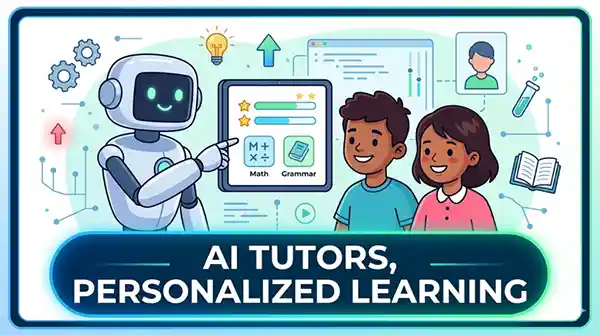
Existing educational systems are undergoing a major change, where the traditional method of teaching children using a universal standard leaves many unsuccessfully. Some fail to progress due to the lack of challenge and success in completing the curriculum, while others cannot keep up due to being outpaced by the instructor in a classroom of 30 – 35 students.
Adaptable learning platforms utilize real-time data monitoring, enabling students to receive instant feedback on their skills and abilities. Platforms such as Brighterly adjust math lessons according to a child’s progress.
Based on the child’s progress, the program identifies what additional practice is required to fill in the knowledge gap before the child can continue to the next lesson. Therefore, the child can then progress at their own speed.
KEY TAKEAWAYS
- Adaptive platforms provide real-time feedback by introducing support or challenge based on performance.
- AI tutors eliminate the “waiting period” for assistance, thus avoiding the creation of bad habits through permanent mistakes.
- Real-time tracking replaces traditional report cards and allows parents and teachers to assist immediately when a learning roadblock occurs.
- Interactive subjects (math and ELA) incorporate game-based mechanics to make high-retention drills enjoyable and fun.
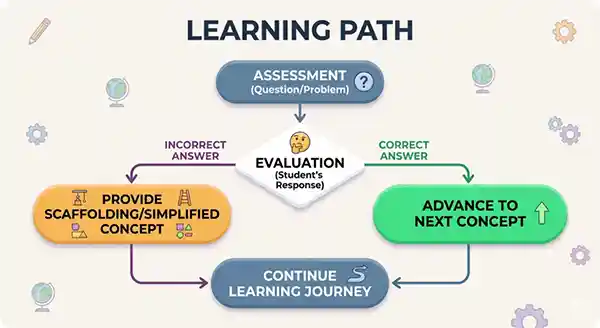
An adaptive learning platform acts as a private tutor to create an ongoing assessment of the student with each question they complete. If a student is successful and finishes a problem quickly, the system will give them a more difficult problem to attempt.
In case a student struggles to solve a problem, the system will provide them with additional assistance until they are able to solve that problem and develop confidence in their ability.
As part of traditional homework, parents are required to act as teachers. At home, this creates stress. An adaptive platform changes this dynamic. They provide immediate feedback. It is instantaneous for students to see where they make errors. A positive feedback loop prevents the formation of bad habits.
A teacher will be managing a class of thirty students; if a student raises their hand, it is impossible for the teacher to stop to help him immediately. As a result, an individual student may become impatient and lose their motivation to ask that question at all.
However, with the use of an AI tutor for children, when a student completes a problem, they receive instant feedback. Thus, the student is able to promptly rectify any errors and therefore will develop bad habits.
It is important to note that these tools do not replace teachers. Instead of acting as supervisors, they act as assistants:
Teachers receive this data. They then guide class discussions on tough topics. They focus on concepts rather than simple drills. By doing this, teachers can start more complex discussions in the classroom. In addition to school hours, students receive high-quality support.
Each student’s learning will adapt to the student’s learning pace. Therefore, a child may learn best through visual clues, while others may learn best through written instructions.
The AI will also assess what type of delivery method (visual or written) the student successfully learns from and customize how they deliver the content based on these results to keep the student engaged with the lesson material.
It is common for students to dislike subjects like math because they feel tedious. Gamified math learning changes this perspective. It turns problem-solving into an interactive experience.
Gamification has become very popular in the education field; therefore, students are interacting with lesson material by way of game-like rewards. By utilizing these types of rewards, students will be making connections between numbers and good feelings. Some platforms are taking advantage of the gamification concept for their teaching.
ELA tutoring benefits from similar technology. Modern platforms use natural language processing. Software scans for grammar and structure errors in real time. It highlights run-on sentences and weak verbs immediately. Before moving on, the student fixes the suggested text. The result is a reduction in the development of bad habits.
As a result of this, the student interacts with the code as if they were talking with it in the process of editing. The process of developing skills independently has also changed due to this method, making writing no longer a mystery but rather an exercise in logic.
In terms of student growth, these technologies offer the following advantages:
Traditionally, report cards summarize the past. Students receive them after completing a unit, which takes around a week. The delay creates a reactive environment in the classroom. A teacher sees the final grade. In their absence, they don’t understand how hard the work is.
With live data on student progress, this relationship shifts; teaching becomes proactive rather than reactive; instead of providing a static summary of past performance, the dashboards offer a real-time view of performance.
The digital tools track specific metrics, such as the time spent answering questions. They keep track of every attempt to solve a problem. It is easy for teachers to see exactly where roadblocks are. Students who struggle with geometry angles appear on the dashboard immediately.
Having this type of information allows for adjustments to happen instantly; therefore, it would be impractical to cover an entire unit again; instead of having long, formal lessons, they could provide small, targeted sessions to keep students on track.
Parents benefit from these reports because they provide clarity. Every day, they see progress. It is no longer necessary to guess about homework requirements. Data creates a bridge between school and home. It creates a sense of accountability between the teacher, the parent, and the student.
Personalized learning transforms K–12 education. A platform that adapts to the learner is more effective than rote memorization. They place a high priority on individual progress. Technology serves as a support system. By doing so, students gain confidence in subjects such as math and language arts.
To transform education, we need to change our habits. Both parents and educators should use these types of tools daily; thereby, there is a growing level of responsiveness in education. The skills students possess will allow them to succeed. In the future, education will be based on continuous data and real-time adjustments.
