The major struggle that stands as a barrier in creating a successful music track is the path from converting an idea into a track. That initial push towards assisting the idea feels the most difficult. Gathering the right tools, setting up tunes, and organizing the right timings are more difficult than most people admit.
This is exactly where the right use of an AI Music Generator changes how frictionless and smooth the music creation process becomes. Instead of manually passing layers of composition, production, and recording, it simply completes the process in a single step.
But how does this actually happen? Learn more about why AI music generators reshape creative starting points and provide a musical output.
Key takeaways
- AI music generators direct how music gets an effective start to lead an attractive starting point.
- Instead of defining things manually, one simply needs to share intent, and the rest of the things will be managed by the tools.
- Traditional ways of music generation are still more useful where precision is required.
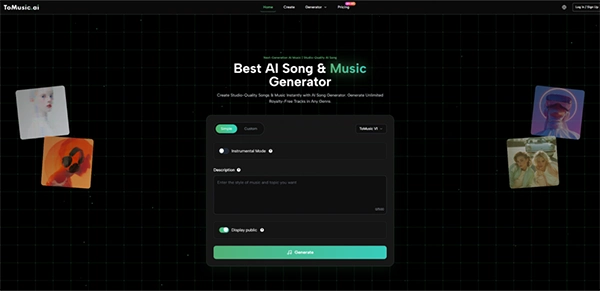
At its core, the system operates through a layered transformation process that turns descriptive language into structured sound. Let’s explore the process in a detailed way:
When a user enters something like “slow emotional piano,” the system interprets:
This mapping is not exact, but it follows recognizable patterns.
From these inputs, the system builds:
These elements are assembled based on learned relationships rather than explicit rules.
Finally, everything is synthesized into a full piece:
The result feels closer to a finished track than a draft.
Effectively using an AI music generator is less about starting from scratch and more about using a guided process to generate music step by step. Explore the three major steps to get an idea of how these platforms are actually used:
Users can either:
Both approaches lead to different types of output control.
Options typically include:
These guide the generation but do not fully determine it.
The system produces multiple versions. In practice:
This process feels more like filtering than building.
At some point, many users move beyond simple prompts and start using structured text. This is where something closer to a Lyrics to Music AI experience emerges.
When lyrics are included:
Even with lyrics:
This adds expressive variation but also unpredictability.
AI-based workflow and the traditional way need to be used altogether or with the requirement, as they are not replacements for each other. Explore this with the below-mentioned comparison:
| Aspect | Traditional Workflow | AI-Based Workflow |
| Entry Barrier | High | Low |
| Time To Output | Long | Short |
| Creative Control | Precise | Indirect |
| Iteration Cost | High | Low |
| Output Diversity | Limited | Broad |
The comparison highlights a trade-off rather than a replacement.
The traditional music creation way might be very time-consuming. Modern AI music generators are one of the most effective tools in situations where time is limited but flexibility and volume is needed:
Creators working on:
benefit from speed and variation.
Instead of imagining outcomes:
This reduces uncertainty early on.
People who think in narratives rather than sounds can –
This opens access to music creation.
While the process seems very smooth and seems simple at the first glance, it has certain limitations to be considered. Explore how consistency and control fluctuate with continued use:
Small wording changes can lead to:
This requires careful phrasing.
You cannot always define the following:
Control exists, but indirectly.
In my experience:
This introduces a different kind of effort.
The deeper shift is not about music, but about interfaces. It shares about how manual control is changed with intent-based systems.
In simple terms, we are moving from –
To:
Music generation is one example of this broader pattern.
The exact role of a creator is broadly reshaping with AI tools. Instead of building everything manually, users are taking advantage of automation; now they simply –
Creativity becomes partially curatorial.
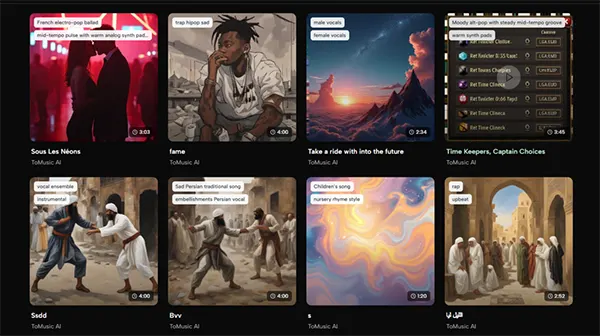
It’s easier to create a perception for this as a bridge between ideas and execution. But in reality, it may be more useful to think of this system as the following:
rather than a replacement for traditional production.
The real impact goes beyond music—it reduces the gap between idea and output and changes how people start projects. That alone can influence:
The tool does not remove complexity. It simply moves it out of the user’s immediate path.
The benefits of an AI music generator are not limited to producing songs in less time. It helps to create timeless music tracks that were previously just planned to be built. It effectively analyzes the idea, understands the input, and then provides a considerable result.
Earlier, creators usually used to get stuck on the first step, that is, the initial stage of idea conversion into music. With the right prompt and proper control and refinement of the provided result, the music can be enhanced further.
Hence, AI music generators effectively shift the focus from manual composing to creative results.