

“The best way to find yourself is to lose yourself in the service of others.”
— Mahatma Gandhi (Indian Freedom Fighter)
Turning a social idea into a formal organisation isn’t just about passion. It’s about structure, accountability, and protecting everyone involved. You can have a crystal clear idea of your cause, but realizing it requires tackling many legal and regulatory hurdles, which can easily disrupt that clarity.
A company limited by guarantee (CLG) offers a clean solution. It protects members with limited liability while keeping the focus firmly on purpose over profit. Once you break the process into clear steps, the path becomes far less intimidating and much more doable.
In this guide, I’ll break down setting up a guarantee-based organisation step by step. The following sections contain clear, practical steps covering structure, registration, compliance, and key requirements.
KEY TAKEAWAYS
- A company limited by guarantee is ideal for mission-driven, non-profit-focused organisations.
- Instead of shareholders, there are guarantors with limited financial liability.
- Early clarity on purpose and structure prevents future complications.
- Consistent compliance and governance are essential for long-term stability.
Before any paperwork, lock in your “why.” A clearly defined purpose acts like a compass, guiding decisions around operations, funding, and governance.
A company limited by guarantee is uniquely designed for organizations concerned with social or community results rather than profit distribution.
This structure does not have shareholders or shares. Guarantors shoulder the firm, promising to contribute a fixed amount in case it shuts down. As a result, it is important to ensure that your objectives align with a model in which surplus funds are reinvested rather than distributed.
By creating this clarity initially, you prevent any structural changes in the long run, and you have a solid foundation to rely on with your organization.

Your company name is more than a label; it’s your first impression. Choose something that reflects your mission while staying compliant with regulatory rules.
One must make sure that the name is original and not already in use, since duplication postpones the process. Moreover, some words can be prohibited or checked, particularly those with implications of a specific status or authority. Consequently, early verification of name availability is beneficial to streamline the process and avoid needless complications. An appropriate name also makes your purpose clear while building the organization’s credibility.
Instead of shareholders, you’ll have guarantors. These are members who agree to contribute a fixed amount if the company winds up.
This guaranteed sum is often quite minimal and established in the formation process. The main advantage in this case is limited liability, where each member has a fixed personal financial limit with regard to the amount agreed upon.
Consequently, personal assets remain secured above that threshold. The resulting collective responsibility augments the common cause efforts, blurring personal gains.

The Articles of Association act as your organisation’s rulebook. They define how decisions are made, how funds are handled, and how members interact. It is very critical in making sure that operations are consistent and transparent.
In the case of a company limited by guarantee, the Articles generally focus on the reinvestment of excess funds towards the organization’s goals. They also specify the process of member admission and the way their roles can evolve.
Although there are standard templates, a customized document would be more indicative of the unique requirements of your organization. This document should be prepared thoughtfully so there’s no confusion and future operations remain smooth.
Finally, you register the firm with Companies House. This involves submitting details like your company name, registered address, and key members. You will also need to provide the Memorandum and Articles of Association as part of the application.
The process is typically completed online and, if everything is in order, approval can be granted within a short time frame. Upon successful registration, your company becomes a separate legal entity. This means it can enter into contracts, hold assets, and operate independently from its members, which adds both credibility and legal protection.

With registration done, shift focus to operations. Start by opening a business bank account to keep finances clean and separate from personal funds.
At the same time, you should establish a clear system for recording income and expenditure. Even if financial activity is limited at the beginning, maintaining accurate records from the start makes future reporting much easier.
Although a company limited by guarantee can generate surplus income, this surplus is generally reinvested into the organization’s activities rather than distributed. The foundation of simple financial processes supports compliance and long-term sustainability.
Registration isn’t the finish line. You’ll need to regularly file accounts, submit confirmation statements, and keep records updated. These requirements ensure that your organization remains legally compliant and continues to operate as intended.
In addition, following the governance rules set out in the Articles of Association is essential for consistency and accountability. Regular communication among members and clear decision-making processes help maintain stability within the organization. By staying organized and proactive, you can ensure that your company continues to operate effectively while maintaining trust with stakeholders.
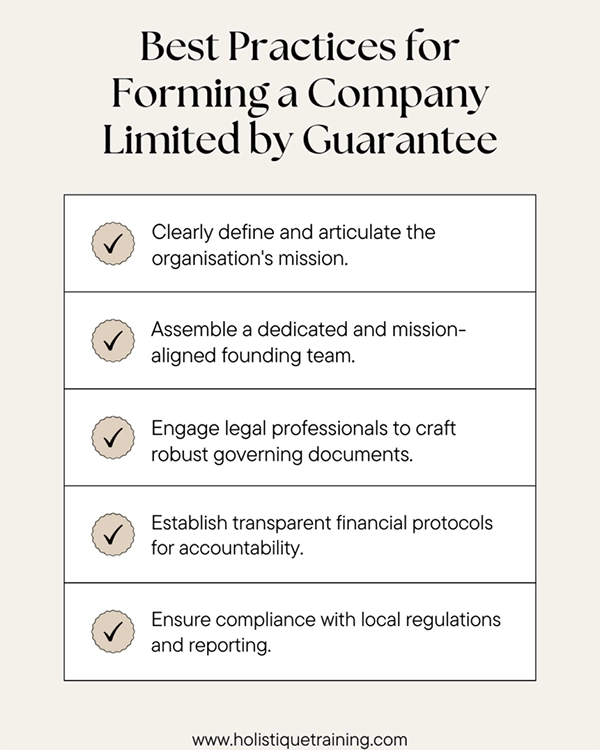
The following infographic summarizes the best practices for a CLG formation:
Alt: CLG Formation Best Practices
Setting up a guarantee-based company may seem complex at first, but it becomes straightforward when broken into clear steps. From defining your objectives to completing registration and maintaining compliance, every stage contributes to building a stable and credible organization.
This structure offers a practical balance between limited liability and operational flexibility, making it well-suited for community-focused and mission-driven groups. Reinvesting surplus funds and limiting personal financial exposure support long-term sustainability without unnecessary risk.
With careful planning and consistent management, you can create an organization that not only meets legal requirements but also effectively supports its intended purpose.
