

Artificial intelligence has made it a lot easier to build SaaS products that feel smart, responsive, and useful, right from the start. But the production cycle doesn’t run as smoothly as expected, and the real challenges show up.
The way the organization wants to run the final product is where the issues originate, as the applications require a dedicated host and proper maintenance, to make everything feel smooth. Get this wrong, and even a good product starts to feel unreliable.
So how do firms counter this problem? Where do they begin? Let’s explore with this article.
Key Takeaways
- All AI workloads require a different type of setup, where priorities must be discussed when designing an application
- A VPS provides a dedicated CPU and RAM with full control over the environment, so that a firm can customize its app based on its needs
- Dedicated servers become a necessity when there is a high amount of traffic going through the app, and the system’s operation needs to be running at all times
- AI in home surveillance systems is a major plus for ensuring security, as they come with the functionality of smart object recognition and automated alerts
Not all AI workloads are equal, and treating them the same is where most hosting decisions go wrong.
There’s a big difference between:
Each setup requires a different level of compute power, response time, and stability.
If your product depends on fast responses, latency becomes critical. If you’re processing large datasets across your operations, storage, and throughput matter more, and if you’re just conducting API calls, then reliability and uptime are the main concerns.
Once you are clear on the business goals and objectives, choosing the right infrastructure becomes much simpler.
A lot of teams jump straight into cloud platforms without thinking twice. It feels like the safe choice.
But in reality, many AI-powered SaaS products don’t need that level of complexity early on.
This is where it makes sense to explore different VPS hosting options first.
A VPS gives you:
For SaaS products that rely on external APIs or run smaller models, this is often more than enough.
You can handle:
And you can do it without dealing with the pricing volatility or configuration overhead that comes with larger cloud setups.
Another advantage is control. You’re not locked in a specific ecosystem, and you have the freedom to customize your environment exactly how you prefer.
But there are limits. VPS environments usually don’t include GPUs, so they’re not built for heavy training workloads. But for running a product? They’re often the most efficient place to start.
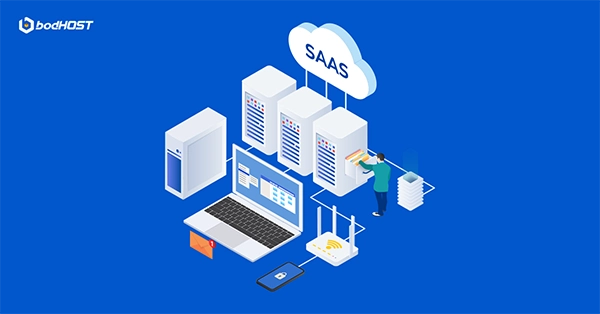
At some point, your application might scale and outgrow a single server. Maybe traffic becomes unpredictable. Maybe you start running heavier workloads. Maybe you need to scale different parts of your system independently.
That’s where cloud hosting starts to make sense.
Cloud platforms give you:
If your AI-powered application requires dynamic scaling or access to the GPU, cloud infrastructure becomes a necessity.
But there’s a trade-off.
Costs can accumulate quickly, especially when your business is dealing with data-heavy applications or constant processing. What appears affordable at the beginning may become difficult to manage as usage scales.
That’s why many teams don’t start here. They move to the cloud when they actually need its flexibility, not before.
Once your SaaS product reaches a steady level of usage, consistency becomes more important than flexibility.
Dedicated servers offer exactly that.
You’re working with:
This is especially useful for:
You lose some flexibility compared to cloud platforms, but you gain stability and often better cost control at scale.
For many mature AI SaaS products, this becomes the long-term solution.
Fun Fact
Unlike shared or virtual hosting (VPS), a dedicated server allocates all processing resources to a single user, preventing performance throttling caused by others.
AI applications don’t just process data – they expose endpoints, handle user input, and connect to external systems. That makes them a target.
As your SaaS product grows, so does its attack surface. Even simple AI tools can be abused if you’re not paying attention to access control, rate limiting, and monitoring.
Traditional security setups can only go so far. AI systems are dynamic by nature, and threats evolve quickly.
That’s why more teams are moving toward adaptive, behavior-based security approaches. Instead of reacting after something goes wrong, the goal is to detect patterns early and respond in real time.
Security isn’t something you bolt on later. It needs to be part of your infrastructure decisions from the start.
One area where these infrastructure choices really show their impact is home surveillance.
Modern systems go far beyond basic video recording. They depend on AI tools to detect motion, recognize faces, reduce false alerts, and trigger actions in real-time.
That changes everything about how these platforms are built.
If you’re working on a SaaS product in this space, you’re dealing with:
Some processing happens on-device, but a large part still depends on backend systems.
Latency becomes a key factor. If alerts are inconsistent and unreliable, users lose trust quickly. At the same time, storing and processing structured video at a large-scale can become quite expensive, especially if everything runs through the cloud.
That’s why many platforms use a hybrid approach. They combine edge processing with centralized infrastructure, balancing speed and cost.
If you’re evaluating how these systems are built – or planning to build one yourself – it helps to understand the practical differences between setups.
A solid reference point is this article: Choosing the Right Home Surveillance System, which breaks down how these platforms work and what matters when selecting or building one.

One pattern shows up across almost every successful SaaS product.
They don’t start with complex infrastructure.
They start with something that works, something they can control, and something that doesn’t drain resources before the product is proven.
For many AI tools, that means:
Then, as the product grows:
Infrastructure should follow the product, not lead it.
Running AI tools for SaaS isn’t just about models or features. It’s about the system behind them.
The right hosting stack depends on where you are:
There’s no single “best” setup. There’s only the one that fits your current needs.
And if you get that part right, everything else becomes easier to scale.
