
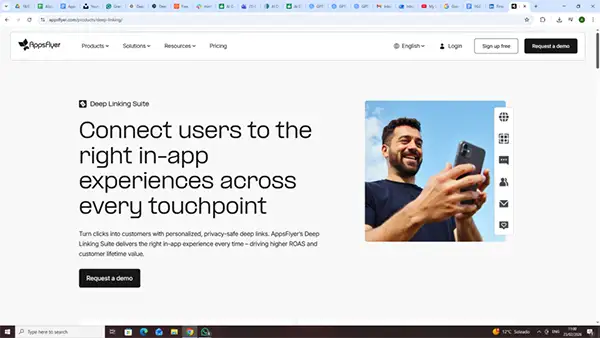
AppsFlyer’s OneLink Deep Linking Suite converts clicks into customers with fully customizable, privacy-safe deep links. Organizations looking for the right in-app experience for their traffic make use of Appflyer’s solution to achieve it.
Furthermore, it prioritizes transforming engagement into interest across every interface, including web, email, QR, or social, making it very straightforward to drive higher ROAS and customer lifetime value.
Let’s explore the AppsFlyer website and understand the functioning of its deep linking tools, along with its various features. Read on for a full review of what you can expect.
Key Takeaways
- OneLink is a single multi-platform link system that supports attribution, redirection, and direct and deferred deep linking.
- The website defines two main deep-linking types and wraps both under UDL, the API designed to handle new and existing users in a single flow.
- The UDL documents state that AppOpen. Attribution will discontinue, and that code should transition to OnDeepLink.
- The wide range of functionalities included by the platform ensures that users are guided through the right in-app experiences, right from the start.
Its core value is OneLink, a single multi-platform link system that supports:
And it does all that across web, email, SMS, QR, social, and other touchpoints. And it’s not just a link shortener, as some other providers on the market are.
The suite is within the broader OneLink and customer experience suite, designed to route users differently depending on whether the app is installed, the platform they are on, and the campaign context attached to the click.
The official OneLink guide states it can send new users to the correct store or web URL, send existing users into the app, and deep link to specific pages or experiences.
It can do everything you want a deep linking suite to do.
The website defines two main deep-linking types:
It then wraps both under Unified Deep Linking (UDL), the API designed to handle new and existing users in a single flow.

Here are some of the standout features that position their OneLink Deep Linking Suite as the best in the market.
The operational simplicity is so valuable. The platform states that OneLink works across devices, operating systems, channels, and platforms,
and lists supported experiences such as:
Brands running numerous touchpoints really benefit from this all-in-one package approach.
The platform leans heavily into owned media like website traffic, banners, email, text, QR, and social posts.
Its Smart Script documentation states that Smart Script, a JavaScript tool placed on websites to convert mobile visitors into app users by dynamically updating button links, is designed to convert and attribute mobile web visitors into app users. The latest setup guide recommends Smart Script V2 for new implementations.
Brands needing to funnel site traffic or CRM traffic to app opens and installs benefit from this.
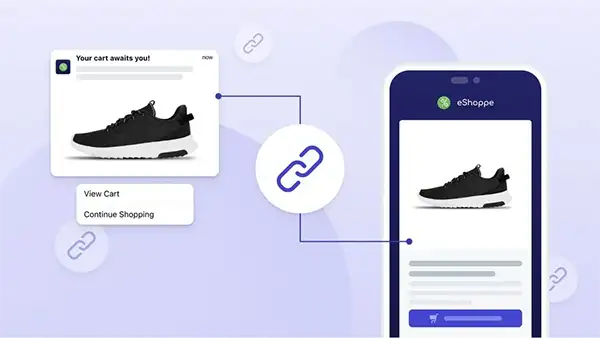
Their product pages and developer documents make deferred deep linking absolutely critical to the core value proposition of the product.
If the app isn’t installed yet, the user is redirected to the correct store and then routed to the intended location or app page after complete installation.
That is one of the strongest reasons to select their platform for your app’s interface transformation instead of just relying on plain universal links or app links.
Did You Know?
Unlike standard deep links that fail if the app isn’t installed, deferred deep links work across the “install gap”, turning potential frustration into a smooth and personalized onboarding experience.
They have guided developers toward Unified Deep Linking (UDL). The UDL documents state that AppOpenAttribution will discontinue, and that code should transition to OnDeepLink.
Yes, teams with legacy links will still need migration work, but it’s a move towards modernization.
They support UI-based link creation and programmatic creation through the OneLink API. The API overview states v2.0 is the current version, and v1 leaves on June 1, 2026.
The large-scale campaign document describes programmatic short-link generation for SMS, email, web, and QR, which is a real plus for lifecycle marketing teams and large apps with automated campaigns.
The Deep Linking Suite is undoubtedly the best on the market. You won’t find a more comprehensive suite of tools designed to connect users to the right in-app experiences across every touchpoint. For us, here are some of the standout pros and cons.
There’s a lot that can be accomplished with AppsFlyer’s OneLink Deep Linking Suite. The wide range of efficient tools guides users exactly where they want to go, right from the first interaction, and that’s exactly what you want from deep linking tools.
