

“Trust, but verify.” — Ronald Reagan (Former US Prez)
In today’s compliance-heavy world, that line is philosophy and policy at the same time. Regulators are making scrutiny even stricter, while financial risks and fraud rise and become even more sophisticated.
This is where Customer Due Diligence (CDD) steps in. It doesn’t just tick regulatory boxes; it actively strengthens risk-based compliance by helping organizations understand who they’re dealing with, spot threats early, and act with confidence.
In this article, I’ll explain how Knowing Your Customer (KYC) strengthens risk-based compliance by improving risk detection, regulatory adherence, and decision-making.
KEY TAKEAWAYS
- Knowing Your Customer helps identify and manage risk from the start of any business relationship.
- A risk-based approach ensures resources are focused on high-risk clients.
- Ongoing monitoring is essential for detecting evolving threats.
- Strong CDD practices improve compliance, trust, and decision-making.
Every business relationship starts with a question: Who exactly are we dealing with?
Customer due diligence (CDD) is the answer as it:
Institutions gather and examine government-issued documents like ID cards and business licenses. They verify information against reliable sources.
It is to help ensure that clients are selective about their identity and do not hide any dangers. The risk changes with the environment, so it also takes care of that.
Not all customers carry the same level of risk, so why treat them the same?
A risk-based approach allows organizations to prioritize resources where they matter most.
This makes it possible for institutions to assign a risk level to a client based on the information collected and, instead of treating all clients the same, to treat them differently, whether good or bad.
High-profile clients receive additional review, while low-profile clients receive less stringent review. Not only does it conserve resources, but it also helps to focus efforts where they are most needed.
It also shows a commitment to compliance (more on that in a moment) and sound decision-making.
CDD isn’t a one-time exercise. It’s more like a live security feed than a snapshot.
Customer behavior, financial activity, and external conditions can change quickly. An organization can detect suspicious activity and remain alert as early as possible through regular monitoring.
Transactions and client behaviors are continuously reviewed to flag irregularities. With vigilant monitoring, institutions can act swiftly and revise risk assessments accordingly. But without such a proactive stance, it becomes impossible to identify illegal activities in time.
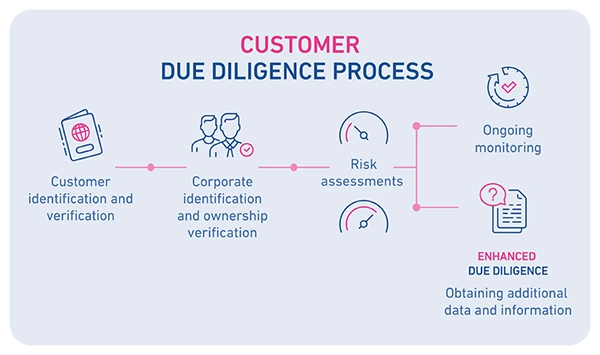
The entire CDD process, along with ongoing monitoring, looks something like this:
Mere promises don’t build trust. It’s built through proof.
Strong due diligence firms look serious about compliance to customers, partners, and regulators. Token shows efforts in crime prevention, making customers feel safer.
Regulators know that compliance requirements are being taken seriously. Such trust can result in stronger commercial partnerships and lower regulatory penalties.
Regulations around financial crimes like money laundering and fraud are constantly evolving. You can’t fall behind.
CDD helps organizations stay compliant by maintaining accurate records and conducting regular risk assessments.
Organizations that have a robust KYC process can also demonstrate compliance within minutes if authorities make direct requests. This preparedness minimizes the chances of legal action.
One mistake and years of accumulated credibility can go to waste.
Without proper due diligence, organizations expose themselves to:
Regulatory penalties and loss of customer trust can result from unmanageable risks. This is what institutions protect themselves from with careful reviews and ongoing monitoring. We all know that early detection is key to avoiding potentially expensive and painful mistakes.
Good compliance and KYC make for a robust safety net.
Better data leads to better decisions. Simple as that.
CDD brings all customer risks to the open, enabling firms to go ahead with the right partnerships while avoiding the problematic ones.
Knowledge of risks informs decisions and reduces uncertainty, allowing healthy development. Employees can make confident decisions because they have the information necessary to evaluate risk and reward.
Compliance isn’t static, and neither is risk.
KYC gives organizations the flexibility to evolve with new regulations and emerging threats. Regular reviews and revisions of policies keep organizations ready.
A well-versed staff and a revised standard operating procedure help accommodate changes quickly. Such adaptability enables institutions to stay a step ahead and show an eagerness to scale up to new standards.
KYC is a compliance requirement as well as a strategic advantage. It helps organizations identify risks early, meet regulatory demands, and build lasting trust.
Constant vetting and monitoring create a strong barrier against financial crimes. Such an approach can help target efforts and resources more effectively.
Organizations that recognize the imperative of these practices will be able to safeguard their interests and continue to hold themselves out as bastions of integrity in a particularly challenging time.
