
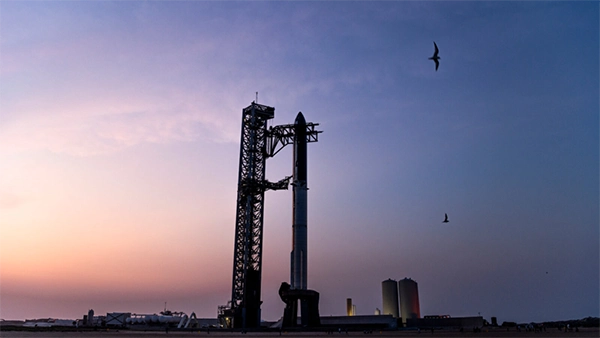
With the evolution of industry trends, companies have begun to invest more in the future-centric space sector. And with this comes a rise of SpaceX, a global attraction for investors.
Founded by Elon Musk, the buzz around discussions for a potential SpaceX IPO date is what has driven the commercial market to notice it even more.
SpaceX is renowned for its incredible progress in rocket technology, deep-space ventures, and satellite internet access, building a strong reputation, especially for investors across borders.
Read further to know how you can get the best returns on your investment in SpaceX, where the present builds the future.
Key Takeaways
- Learning IPO from scratch, from its meaning to its role in future endeavours.
- Analysing the key reasons why SpaceX has not announced its IPO yet.
- A thorough evaluation of investment returns and returns from the stocks in the IPO.
- How the market gets affected by IPO, along with a comparison table to best understand the private and public space companies.
Let’s begin with learning the fundamentals initially. The first question that pops in head when you hear ‘IPO’ is ‘What is it?’
The answer is that it is an initial public offering (IPO) that primarily occurs when a private company offers its shares to the public.
This allows retail investors to purchase stock through public exchanges such as NASDAQ or the New York Stock Exchange.
Coming onto its role in private markets,
It helps companies raise capital, contributing to expansion, research and long-term business development. Also, an IPO provides an opportunity to invest in companies for private investors as well.
Despite strong investor interest, SpaceX has not officially confirmed plans for a public listing. Several strategic factors explain why the company may prefer to remain private for now.
Some key reasons include:
Remaining private gives SpaceX the flexibility to focus on innovation rather than short-term market performance.
This is why SpaceX continues to hold reservations towards announcing an IPO.
Several major projects have strengthened SpaceX’s position as a leader in the commercial space industry. These initiatives also play a major role in increasing speculation about a potential IPO.
This is because some major SpaceX programmes are reusable, such as Falcon rockets, which reduce launch costs dramatically, and Starship spacecraft, designed for future missions to the Moon and Mars.
Other factors even include satellite launch services for global communication companies and collaboration with NASA for astronaut transport missions.
These technological developments have positioned SpaceX as one of the most innovative companies in aerospace engineering, attracting investors throughout the year.
If SpaceX eventually becomes publicly traded, it could create significant interest in global financial markets.
This is because technology companies with strong growth potential often attract large numbers of investors during their IPO phase.
Because SpaceX operates in multiple industries, including satellite communications, rocket launches, and space exploration, its IPO could influence several segments of the market.
This allows diversity along with uniformity.
Investor excitement around space companies is driven by the rapid expansion of the global space economy, along with major advancements in technology as well.
Under such situations, some key areas of growth include satellite internet services, Earth observation and climate monitoring, government space exploration programmes, etc.
As these sectors grow, companies involved in space infrastructure and technology are expected to attract increasing levels of investment.
While no official timeline has been announced, several factors could influence when SpaceX decides to go public. Some factors that trigger an IPO include the following:
Apart from the above factors, market conditions and investor demand may also play a role in determining the timing of any future public offering.
Even though the company is not publicly traded, investors closely monitor industry updates, valuation estimates, and market discussions related to SpaceX.
Here’s how the prices of shares are moved, as depicted in the infographics:
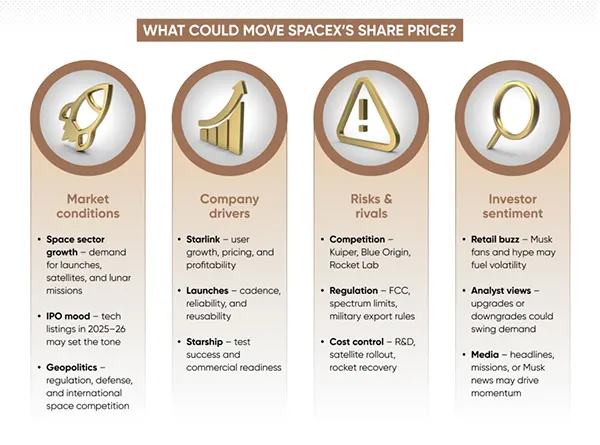
Financial market platforms often track private company valuations and industry trends, allowing investors to follow developments in the aerospace sector.
This is what helps analysts to evaluate potential opportunities if the company eventually announces a public listing.
A future SpaceX IPO date could have ripple effects across the global technology and aerospace sectors. This even impacts the global markets.
The success of such an IPO could also encourage other private space companies to consider public listings, making it a new trend.
Understanding the difference between private and publicly traded space companies helps investors evaluate potential opportunities.
It also allows making clear demarcations based on factors such as availability, regulatory requirements, etc.
The following table can be further utilised to understand this distinction:
| Feature | Private Space Companies | Public Space Companies |
| Share availability | Limited to private investors | Open to retail investors |
| Regulatory requirements | Lower reporting obligations | Strict financial disclosure |
| Investment access | Restricted | Easily accessible through exchanges |
| Market transparency | Limited financial data | Publicly available financial reports |
This difference explains why many investors are closely watching developments related to a possible public listing for SpaceX.
SpaceX has transformed the aerospace industry through advanced technologies, reusable rockets, and ambitious exploration missions.
For investors interested in tracking developments related to SpaceX and the broader space economy, financial analysis platforms, valuation estimates, and industry trends.
Therefore, making SpaceX a prime choice for investment and a scientific success at the same time.
