
Instacart has grown from a small startup in 2012 to one of the largest grocery delivery platforms in North America. For the thousands of shoppers who power the platform, one question matters the most: how much does Instacart actually pay?
The actual answer is more complicated than a single number, as the earnings depend on various factors that influence pay.
This guide breaks down every component and factor of Instacart pay in detail, from comparing earnings to competing platforms, also covering tax obligations that can affect your total take-home if not prepared for.
Key Takeaways
- The working of Instacart pay, its pay structure breakdown, and average earnings
- Earnings comparison between Instacart and other gig platforms
- Tax obligations that shoppers and gig workers must account for before calculating their total earned pay
- Strategies that maximise deductions and how people earn more using the multi-apping strategy
Instacart does not pay shoppers a traditional hourly wage. Instead, the platform uses a batch-based payment system where each delivery order (or group of orders) is assigned a batch payment.
This batch pay is calculated using an algorithm that considers the number of items in the order, the estimated driving distance to the store, the customer’s address, the complexity of the order, and the current demand in your area.
Individual batch payments can range significantly. A small, local single-order batch might pay as little as $6.22, while a multi-store batch with heavy items and longer driving distances can pay $21.63 or more. Instacart guarantees a minimum batch payment, which varies by market but is typically between $5 and $7 for a single order.
There are two kinds of Instacart shoppers: The full-service shoppers, who work as independent contractors who shop and deliver orders, and in-store shoppers, who are part-time employees who only shop orders in-store without delivering.
Full-service shoppers earn batch pay plus tips, while in-store shoppers receive an hourly wage (typically $12-$16 per hour, depending on location) without tips.
| Pay Component | Description | Typical Range | Who Receives It |
| Batch Pay (Base) | Algorithm-based payment per order batch | $5-$22 per batch | Full-service shoppers |
| Customer Tips | Added by customer before/after delivery | $2-$20+ per order | Full-service shoppers (100%) |
| Heavy Pay Bump | Extra for orders with heavy items (40+ lbs) | $5-$15 per batch | Full-service shoppers |
| Distance Bump | Additional pay for longer delivery distances | $0.60/mile over threshold | Full-service shoppers |
| Peak Boost | Surge pricing during high-demand periods | $2-$8 per batch | Full-service shoppers |
| Promotional Bonuses | Complete X batches for bonus pay | $20-$100+ per promo | Full-service shoppers |
| In-Store Hourly Wage | Fixed hourly rate for in-store shopping only | $12-$16/hour | In-store shoppers (employees) |
Instacart shopper earnings vary dramatically by geographic location. According to data from ZipRecruiter and Glassdoor compiled in early 2026, the national average for personal shoppers is approximately $22.36 per hour, with a range from $11.25 to $33.75.
In high-cost markets like San Francisco, New York City, and Los Angeles, experienced shoppers report consistent earnings of $25-$35 per hour. In smaller markets, earnings typically fall in the $14-$20 range.
Weekly earnings are also variable. Shoppers report weekly take-home ranging from $200 to $700, depending on the total hours worked, market conditions, and order availability. Full-time shoppers working 35-40 hours on average per week in a strong market can earn $800-$1,200 weekly before accounting for expenses.
For a detailed analysis of current pay rates and earning strategies, Everlance’s instacart pay guide provides market-specific breakdowns and real shopper data.
In California specifically, personal shoppers earn an average of $19.95 per hour, with a range from $10.05 to $30.30. California’s Proposition 22, which went into effect in 2021, guarantees gig workers a minimum earnings floor of 120% of the local minimum wage for active time, plus a per-mile stipend of $0.35 for driving during active deliveries.
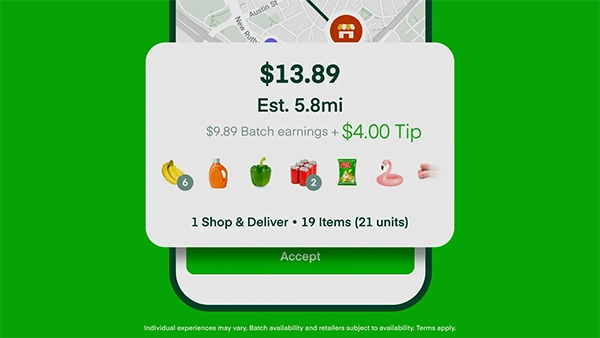
Tips are an important component of Instacart earnings, often accounting for 30-50% of a full-time shopper’s total income. The app allows customers to tip before placing an order and adjust the tips for up to 24 hours after a delivery has been completed.
The platform suggests tip amounts based on a percentage of the order total, typically offering 5%, 10%, 15%, and 20% options with a custom amount field.
According to multiple shopper surveys and forum data from 2025-2026, the average Instacart tip is approximately $5-$8 per order. However, larger orders ($150+) frequently generate tips of $15-$30 or more.
Some shoppers report that consistently high service quality (good communication, careful item selection, fast delivery) leads to higher tip adjustments after delivery.
Unlike some delivery platforms, Instacart passes 100% of customer tips directly to shoppers. Instacart faced a major controversy in 2019 when it was discovered that the company was using tips to subsidize base pay.
After a significant backlash, Instacard tweaked its policy and now includes tips on top of batch pay rather than factoring them into the base calculation like earlier.
How does Instacart pay compare to other gig economy platforms? The answer depends on your market, vehicle costs, and the type of work.
Grocery delivery generally pays more per order than food delivery but involves more time per batch (shopping + delivery versus pickup + delivery only).
| Platform | Avg. Hourly (Before Expenses) | Avg. Tips | Vehicle Wear | Time Per Order | Best For |
| Instacart | $18-$25/hour | $5-$8/order | Moderate | 30-60 min | Higher per-order pay, flexible schedule |
| DoorDash | $15-$22/hour | $3-$6/order | High (more driving) | 15-30 min | Quick orders, high volume |
| Uber Eats | $14-$20/hour | $3-$5/order | High | 15-30 min | Urban areas, surge pricing |
| Shipt | $16-$22/hour | $5-$10/order | Moderate | 30-60 min | Target shoppers, loyal customers |
| Amazon Flex | $18-$25/hour | Rare | High (routes) | 3-5 hour blocks | Guaranteed block pay, no shopping |
| Walmart Spark | $15-$20/hour | $2-$5/order | Moderate | 20-40 min | Walmart-only, less shopping time |
Many gig workers increase their earnings by using multiple apps or running two or more delivery platforms simultaneously, and accepting the most profitable orders from each.
Although this strategy requires careful management of time and an equal understanding of every platform’s pay structure, experienced users report earning 20-40% higher than single-platform shoppers.
The rates quoted above are gross earnings before expenses. For Instacart shoppers, the main expenses include fuel costs, vehicle depreciation, maintenance, insurance, and much more.
According to the IRS, the standard mileage rate for 2026 is 72.5 cents per mile, which represents the total estimated cost of operating a vehicle.
A typical Instacart shopper drives 50-100 miles per day during active shopping hours. At 75 miles per day, five days per week, that is 19,500 annual miles. At 72.5 cents per mile, the estimated vehicle cost is $14,137.50 per year.
If you gross $40,000 annually, your actual net earnings before taxes would be approximately $25,862, or roughly $12.43 per hour based on 40-hour workweeks.
This is why gig workers need to track their expenses. Every mile driven, every insulated bag purchase, and phone accessory bought for the delivery setup is a deductible business expense that reduces your total income.
Fun Fact
The Instacart Pay app uses heat mapping (red or orange rings) around stores to help shoppers identify high-demand, higher-paying areas
Full-time Instacart shoppers are classified as independent contractors, meaning that Instacart will not withhold taxes from their earnings.
You are responsible for paying income tax, self-employment tax, and any applicable state and local taxes on your net earnings.
| Tax Type | Rate / Threshold | Details | Filing Requirement |
| Federal Income Tax | 10%-37% (brackets) | Based on total taxable income after deductions | Form 1040 + Schedule C |
| Self-Employment Tax | 15.3% on net earnings | 12.4% Social Security (up to $168,600) + 2.9% Medicare | Schedule SE |
| 1099-NEC Reporting | $600+ in calendar year | Instacart issues 1099-NEC if you earn $600+ | Report all income regardless |
| Quarterly Estimated Taxes | Owe $1,000+ expected | Due Apr 15, Jun 15, Sep 15, Jan 15 | Form 1040-ES |
| State Income Tax | Varies by state (0%-13.3%) | Most states tax gig income; 9 states have no income tax | State return required |
| QBI Deduction | Up to 20% of net income | Qualified Business Income deduction for pass-throughs | Calculated on Form 8995 |
| Mileage Deduction | 72.5 cents/mile (2026) | Standard mileage OR actual expense method | Schedule C, Line 9 |
The self-employment tax of 15.3% is often the biggest surprise for new gig workers. On $30,000 of net self-employment income (after deducting mileage and expenses), the SE tax alone is approximately $4,238.
Combining this with the federal income tax, total taxes can account for 25-35% of net earnings. However, you can deduct half of the SE tax as an above-the-line adjustment on Form 1040.

Every deductible expense reduces your taxable income and lowers both your income tax and self-employment tax. Common deductions for Instacart shoppers include:
Instacart has made several changes to its pay structure and transparency in recent years. In 2023, Instacart went public through an IPO on the Nasdaq, bringing increased scrutiny to its labor practices.
The company has also introduced more detailed breakdowns of earnings in the shopper app, showing every component of each batch payment, including base pay, heavy pay, and peak boosts.
In early 2025, Instacart updated its batch pay algorithm to more heavily weight item count and driving distance, resulting in higher pay for larger, more complex orders. The business also expanded on its tipping features, making it simpler for customers to increase tips after a delivery.
Several cities and states have enacted gig worker protection laws that affect Instacart pay. New York City requires a minimum pay rate for delivery workers. Seattle has a similar ordinance.
California’s Proposition 22 mandates a minimum earnings guarantee based on active time. These regulations generally benefit shoppers but vary significantly by jurisdiction.
Tax planning is not optional for shoppers using Instacart to earn. The IRS expects independent gig workers (full-time contractors) to pay taxes as they earn, not as a lump sum at the end of the year. Here is a simple quarterly tax planning framework:
