

Technology has been shaping the business world forever. And the speed of that is only accelerating. In recent decades, digital tools have transformed how businesses operate, attract customers, and make decisions. It’s the time of AI and automation. And in 2026, they’re no longer “nice-to-haves”; they are essential to be in the race.
Gartner predicts that 40% of enterprise applications will have some agentic AI integration by the end of 2026; that number was 5% in 2025 end.
Firms are applying these technologies in innovative ways to improve their reach and efficiency. Those waving these technologies off are themselves getting waved off.
But just adopting these emerging technologies is not enough unless you have a plan to use them for your long-term growth.
In this article, I’ll expand upon the practical approaches you can consider in 2026 around these technologies to catch up to the competition and even beat them.
KEY TAKEAWAYS
- Digital tools integration is no longer optional but essential for business growth.
- Agentic AI and automation possess great applications for businesses.
- Data is a precious resource for better strategic decision-making.
- While tech integrations don’t take cybersecurity considerations lightly.
Digital innovation has moved from the fringes to the mainstream. Almost all business departments are embracing new technologies. Sales teams use automation platforms to manage leads more efficiently. Marketing teams rely on data-driven insights to refine campaigns. Customer service departments deploy intelligent chatbots to improve response times.
It’s not just digitization. Businesses are redesigning their processes around these technologies.
Look at cloud-based and mobile technology infrastructure. The tech has erased the geographical distance gap, making global collaboration possible. This enables faster decision-making and better coordination between departments.
The result is a more agile organization. One that can respond quickly to changing market conditions while continuing to deliver consistent value to customers.
Artificial intelligence (AI) is reshaping the entire world, including businesses. It’s automating many routine business operations and processing large volumes of data in seconds.
This leaves time for teams to focus on more strategic thinking. Instead of spending hours reviewing spreadsheets or reports, decision-makers are drawing actionable insights faster.
AI-driven tools are particularly valuable in areas such as:
For instance, e-commerce platforms can use it to offer better product recommendations to their customers. Financial institutions can detect unusual transactions within seconds. Healthcare organizations can analyze patient data to improve treatment planning.
The impact is clear. AI is helping businesses make smarter decisions faster.
Today, huge amounts of data are being produced, but for businesses, every single bit of that is valuable. Every digital interaction: a website visit, online purchase, customer inquiry, is a data point. That can be analyzed to derive a better business strategy.
The challenge lies in turning this data into meaningful insights.
Advanced analytics platforms help companies interpret complex datasets and uncover trends that might otherwise go unnoticed. Leaders can then use these insights to guide strategic decisions.
For example, businesses can analyze customer behavior to identify which products generate the most engagement. Marketing teams can track campaign performance in real time and adjust strategies quickly. Operations teams can monitor supply chain performance and anticipate disruptions before they occur.
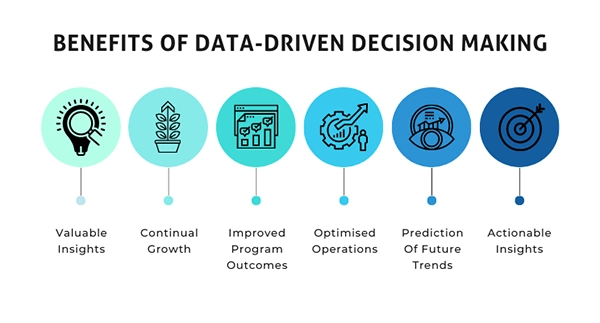
Reliable information leads to better decisions. Over time, this creates a strong foundation for sustainable growth. Various other benefits of data-driven decision-making are listed in the following infographic:
An abundance of options has spoiled customers for choice, and their expectations are now sky-high. Digital channels have wired people for fast responses, personalized experiences, and seamless interactions.
But technology has empowered businesses to fulfil these inflated expectations with ease.
Customer relationship management (CRM) systems allow companies to maintain detailed profiles of their customers. These platforms track interactions, preferences, and purchase history. With this information, businesses can tailor communications and offers more effectively.
Automation also plays an important role. Chatbots and virtual assistants provide immediate support for common inquiries. Self-service portals allow customers to find answers quickly without waiting for assistance.
These improvements may seem small individually. Together, however, they create a smoother and more satisfying customer journey. That experience builds trust, which ultimately drives loyalty and repeat business.
Just tech integration is not enough; you need to keep innovating to have a business edge. And that responsibility falls on the leadership. Executives should encourage experimentation and support teams that explore new ideas. Employees should feel comfortable testing new tools and approaches without fear of failure.
Training is equally important. As digital platforms evolve, employees must develop new skills to use them effectively. Regular learning opportunities help ensure teams remain confident and capable when adopting new technologies.
Businesses that embrace this mindset are better prepared to adapt to change. They do not view innovation as a one-time project but as an ongoing process.
Integrating a technology in isolation just bottlenecks its potential. It should be spread across departments homogenously.
Marketing platforms connect with sales systems. Customer service tools share information with product development teams. Operations software has access to supply chain networks.
This level of integration improves efficiency and visibility. Decision-makers get a comprehensive view of the organization and how its parts interact with each other.
Many organizations describe this process as part of their broader digital transformation journey, where technology supports not just individual processes but the overall business strategy.
All is not hunky dory with tech integrations. There is a considerable security risk associated with it. Data breaches and cyberattacks can damage a company’s reputation and lead to significant financial losses.
Organizations must invest in strong security measures to protect sensitive information. This includes encryption, multi-factor authentication, and continuous system monitoring.
Security awareness training is also essential. Employees should understand common threats such as phishing attacks and suspicious links. A well-informed workforce adds an additional layer of protection.
When companies prioritize security, they build trust with customers and partners. That trust becomes a valuable competitive advantage.
New technologies will keep emerging, and old ones will keep evolving. Artificial intelligence will become more sophisticated. Automation will expand into new areas. Data analytics will become even more powerful.
Organizations that prepare now will be better positioned to benefit from these changes.
This preparation involves both strategy and mindset. Businesses should identify technologies that align with their goals, invest in employee training, and remain open to new ways of working.
Ans: Technology, Data, Process, and People.
Ans: Agentic AI and distributed cloud.
Ans: Digital employee twins and consolidating many digital tools into unified platforms.
