

“Everyone enjoys doing the kind of work for which he is best suited.”
— Napoleon Hill (Author)
Making your employees feel special for the work they do for your business is one of the best ways to keep them happy.
But there are various methods to do that: raising their salary, recognition awards, paid time off on request, etc.
However, all this is not always feasible, for example, when the company is running on shoestring profits. But you also have to keep your employees from resigning. Many people also leave their organizations as they feel unseen, overworked, and even stuck.
So, what to do now?
One bad move and your entire life’s efforts go down the drain.
It might sound impossible to believe, but you can keep your workforce morale and engagement high even with a pay raise. Provided you keep everything else in place as per their liking.
Before getting to the specifics of how to do that, let’s round up the operational meaning of employee engagement. It’s actually pretty simple. People stay engaged if their day-to-day work has clarity, autonomy, and fairness. Also, they must see a future for themselves working at your organization.
If you also want to know which non-monetary aspects employees value at work, learn about motivating talent without pay raises.
In this article, I’ll elaborate on strategies that can help you keep your employees engaged without inflating the payroll.
KEY TAKEAWAYS
- It might seem impossible, but you actually can retain employees without any pay raise.
- Clarify your position on work and pay scale to your employees, keep work culture flexible, and invest in quality managers.
- Present your employees with a growth plan, recognize their genuine efforts publicly, and don’t even dare to overwork them.
Keep it clear around work and compensation; it only builds trust.
One of the fastest ways to drain engagement is uncertainty: shifting priorities, unclear decision rights, and surprise deadlines. Even high performers burn out when they can’t predict what “good” looks like.
Try two simple operating upgrades:
You don’t need a new framework; you need consistency. People are more motivated when they can see how to win.
Employees can handle tough news better than ambiguous news. If raises are limited, explain:
Then follow through. Trust is a compounding asset; broken promises are an engagement tax that never stops charging interest.
If employees keep putting out the same type of work for long, even they get bored. To counter this, formulate a progress path around their skill growth.
A common engagement failure is “same job, more pressure.” Even without promotions, you can create progress by expanding the scope thoughtfully.
Examples:
The trick is to make growth observable. People should be able to point to new skills, new responsibilities, and new proof of impact—ideally within a single quarter.
“Career development” often collapses into generic goals (“improve leadership”). Instead, pick one or two concrete skill bets tied to business needs: negotiating scope, writing briefs, stakeholder management, data storytelling.
A practical template:
This costs little and signals investment loudly.
Don’t let the efforts of any employee go unnoticed. In fact, recognize them in public with awards.
Recognition works when it’s specific, timely, and connected to outcomes. Most companies wait too long (“end of quarter awards”) and talk too vaguely (“great attitude”).
Aim for a weekly cadence. A quick note that says, “The way you handled X reduced risk and helped us hit Y” is fuel. You can also reinforce these moments through more formal recognition, such as corporate awards presented at the annual gala, giving standout contributions a level of visibility that extends beyond day-to-day acknowledgment. It also teaches others what excellence looks like.
If you want one lightweight ritual: reserve five minutes in a team meeting for “wins and thanks,” but keep it grounded in concrete behaviors and results.
Status is a non-financial motivator that can backfire if it looks political. Used well, it’s powerful:
Make the criteria transparent. If recognition feels like favoritism, engagement drops faster than if you did nothing at all.
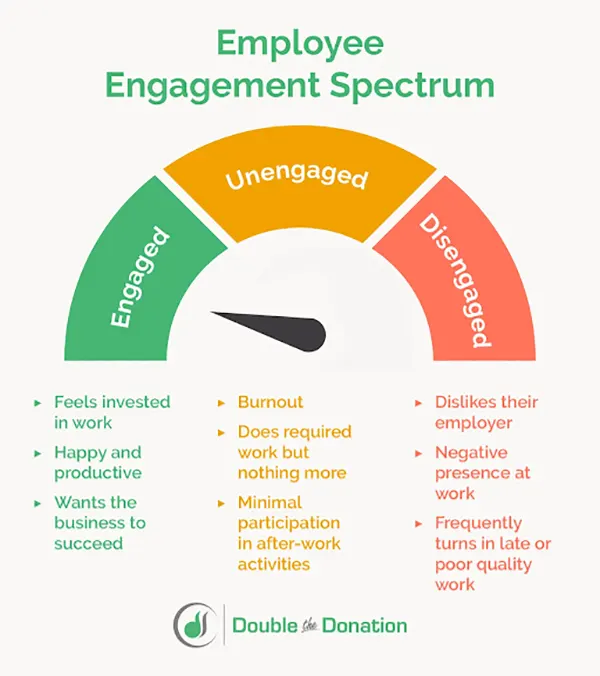
To know if your employees are engaged or not, you can use the following employee engagement spectrum:
Keep the work culture flexible but don’t let it loosen the work focus.
Across industries, flexibility has shifted from “nice-to-have” to a core expectation. But it only helps if it’s workable in practice.
Set clear norms:
The goal is to reduce friction. Employees disengage when flexibility exists on paper but they’re punished informally for using it.
If calendars are clogged and priorities churn daily, engagement falls—even if people like their coworkers. Introduce “focus protection” norms:
This isn’t about being trendy. It’s about giving people the conditions to do good work and feel proud of it.
Burdening your employees with overwork while keeping their compensation stagnant is a perfect recipe for business bankruptcy.
When employees hear “take care of yourself” while sprinting nonstop, cynicism spikes. Instead, look for leading indicators:
Then make visible trade-offs. Cancel or delay a project. Reduce scope. Add a buffer week. Nothing communicates care like leadership making a hard prioritization call.
Your managers are your strongest interface to your employees.
If you can’t raise pay, invest attention in manager quality. Gallup and other research consistently tie engagement to the direct manager relationship—employees don’t just work for a company; they work for a person.
Give managers a simple playbook and inspect the basics:
One strong manager can stabilize engagement across an entire group. One weak manager can erase the impact of every perk you offer.
Craft a short, realistic plan, focusing on just a few moves. In the next month, commit to:
Engagement isn’t a mystery; it’s a set of experiences you can shape. When raises aren’t available, the companies that retain talent are the ones that still make people feel valued, effective, and hopeful about what comes next.
So, you have learnt the magic of retaining employees without appraisals. But just use this approach only when it’s the last resort. If your employees get to know that you can give out raises but keeping from it just for a slight increase in profits, it won’t end well for the business.
Ans: The 5 C’s of workforce involvement are: Care, Connect, Coach, Contribute, and Congratulate.
Ans: Interactive games, themed potlucks, and DIY workshops are some of the fun activities that can keep employees engaged.
Ans: Keep the communication trustworthy and transparent, invest in quality managers, and present employees with a clear growth plan.
Ans: Some non-monetary motivators at work are: recognition, growth, autonomy, and a positive work culture.
