
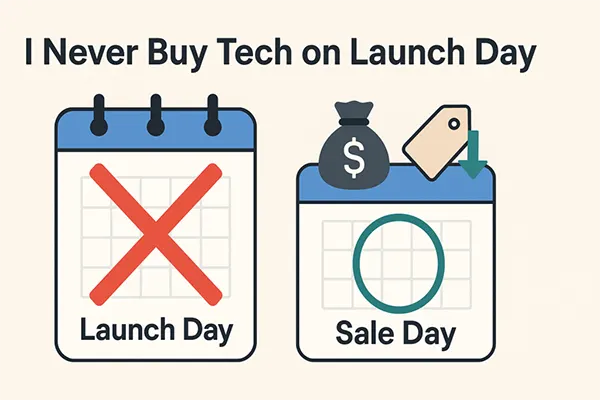
With social media as a centrepiece for deciding trends in the modern age, the hype you experience around the latest movie launch is not just emotional but also derived from a feeling of coordination.
The Launch day effect can be best understood by considering an example.
When a new web series or a movie is about to be launched, you might experience your entire social media feed filled with content related to the movie/series, significant app updates, and more!
This is how the launch effect works. If you wish to know more, browse this article for related information.
Timing is structural in digital releases.
A game or experience that launches on a specific date creates a Schelling point: a moment everyone knows to show up at without needing to coordinate explicitly.
The feedback loop that most people perceive as hype is created by the launch window, which condenses a significant amount of social activity into a brief amount of time.
Content creators and streamers accelerate this significantly.
When a big game comes out, audiences watching those streams are also watching their social media feeds fill with reactions, and dozens of channels are simultaneously creating first-impression content.
The density of coverage in a 48-hour window creates a sense that the cultural conversation is happening right now and will be less relevant later, which is largely accurate.
The pressure to participate before the conversation moves on is real.
For anyone who has wanted to discuss a story-heavy game without spoilers, the launch window is genuinely the best time to play it.
That practical consideration converts into urgency, which looks, from the outside, like irrational hype.
This is why the question of what constitutes a compelling new game goes beyond the game itself.
The surrounding community, the shared vocabulary of reactions and references, is part of the product people are actually consuming.
Playing a game in relative silence six months after its launch is not the same as playing it in an active community.
Pre-release marketing has become its own genre of content.
The months before a major launch are structured to release information in controlled doses:
The most effective pre-release campaigns use anticipation as a tool rather than a side effect.
When From Software released Elden Ring, the months before launch were characterized by deliberately minimal reveals.
The community filled the gaps with analysis and speculation, producing enormous volumes of engaged content before anyone had played the game.
Months of concentration on the product’s meaning, not just its features, had prepared the audience for launch day.
This pattern repeats across different categories of digital experience.
A Netflix series that drops one episode a week plays the same game differently:
Neither approach is strictly better; they optimize for different shapes of engagement.
Research on fear of missing out and social urgency confirms that the anxiety of being excluded from a shared experience is a powerful behavioural driver — one that pre-release campaigns are increasingly designed to exploit deliberately.
There is a practical layer to the launch experience that rarely gets discussed alongside the cultural one.
The technical setup around playing a new game shapes the experience in ways that are easy to underestimate.
Just as server delivery infrastructure and content caching directly affect how fast and reliably a product reaches the end user, local hardware and software configuration affect how immersive a first play-through actually feels.
They are further impacted by factors such as :
The launch window is precisely when people are most likely to be playing in suboptimal conditions.
One of the small but recurring friction points for PC players in particular is how to turn off the Discord overlay in games.
This defaults to active and can interfere with certain games or simply add visual clutter during a first play-through.
The setting’s path is straightforward
From User Settings to Activity Settings to toggle Game Overlay, but it is the kind of thing that most players only think of addressing when something goes wrong at the worst possible moment.
Right in the middle of an opening sequence they have been anticipating for months.
The broader point is that first impressions are partly an optimization problem.
Players who have dialled in their technical environment get more out of a launch window than those who discover issues mid-session.
The hype machine makes you want to jump in right away, but in actuality, setting up for ten minutes before launch actually enhances the experience you’ve been working toward.
The most interesting thing about well-executed digital launches is how much content they generate after the window closes.
Cultural one.
It’s easy to underestimate how the technical setup of a new game shapes the experience.
Local hardware and software configuration have an impact on how immersive a first play-through truly feels, just as server delivery infrastructure and content caching have a direct impact on how quickly and reliably a product reaches the end user.
They are further affected by things like:
• Sound configurations
• Display adjustment
• Configuration of the controller
• and management of overlays all affect immersion,
During the launch window, people are most likely to be playing under less-than-ideal circumstances.
How to disable the Discord overlay in games is a minor but frequent annoyance for PC gamers in particular.
During a first play-through, this can cause visual clutter or interfere with specific games because it defaults to active.
The setting’s trajectory is simple.
It’s the type of thing that most players only consider fixing when something goes wrong at the most inconvenient time, like User Settings, Activity Settings, or Game Overlay toggle.
They’ve been waiting months for this opening sequence.
The main idea is that initial impressions are partially an optimization issue.
Launch windows are more beneficial to players who have dialled in their technical environment than to those who find problems in the middle of a session.
Hype collapses without quality underneath it.
The experiences that sustain communities for months do so because they give people something real to talk about, argue about, and return to.
The most honest thing about how new releases capture attention is that the anticipation is often as good as, or sometimes better than, the experience itself.
The weeks before a launch, when the possibilities are still open, can carry a quality that no actual product fully delivers.
It is simpler to actively participate in hype rather than letting it carry you when you are aware of that asymmetry.
Launch Day effect is a vital component that determines the success of a digital release.
Especially with the rising trends of social media and virtual spaces, content that does not make it to the virtual crowd often remains isolated.
Therefore, if you want your content to be a chartbuster, make sure it excels in the launch day effect!
