

“If you can’t measure it, you can’t improve it.“ — Lord Kelvin (Mathematician)
The centuries-old statement still holds water. Maybe even more so in this fast-paced digital world driven by data.
Businesses rely on systems to collect, measure, and process data to come up with actionable insights. Those lead to great business decisions, resulting in firm growth. Especially the advertising field. It’s really bullish on this data-driven approach.
One such example of this is mr.Booster agency. They beautifully connect analytics, creative production, paid acquisition, SEO, and conversion optimisation into one revenue-focused process.
In this article, I’ll expand upon the rise of data-driven marketing. The following sections discuss analytics that guide decision-making, which in turn adds to overall revenue, the role of creatives in all this data, the supremacy of organic traffic, and what businesses can expect from data-driven ad agencies.
KEY TAKEAWAYS
Modern marketing agencies utilize data to arrive at actionable insights.These, in turn, help in better decision-making and boosting revenue.However, creatives and organic traffic still have their own place.
Most of the firms are online-heavy in today’s business environment. And they also have all their eggs in just one basket as far as marketing is concerned. The basket being the internet.
Campaigns generate clicks, content attracts views and social media creates engagement, yet revenue growth remains inconsistent. The problem is not always a lack of effort. More often, it is a lack of alignment between analytics and decision-making processes.
Data-driven promotion solves this problem by turning performance signals into actions. Rather than asking how many people saw an ad, brands start to ask which channel brings qualified users, which landing pages convert best, which audiences produce repeat purchases and which content contributes to long-term revenue. This shift separates random promotion from structured growth.
This is why a capable marketing agency no longer just supplies traffic. Today, businesses expect more from a DM agency. They want a partner that can interpret data, connect channel performance to revenue and identify where money is leaking from the funnel.
Data is not there just to get an idea of the situation we’re in, but to act upon it. Useful analytics should answer the following practical questions:
When businesses do not connect analytics to action, they end up optimising for vanity metrics. A campaign can demonstrate high levels of engagement yet still underperform commercially. A page can attract heavy traffic and still fail to convert visitors into customers. A piece of viral content can generate attention without attracting buyers.
A smart marketing agency helps businesses move beyond surface metrics and focus on commercial performance. This involves tracking not only clicks and reach, but also cost per qualified lead, customer acquisition efficiency, customer retention behaviour and revenue contribution by channel.
Most businesses make the mistake of isolated observation of channels:
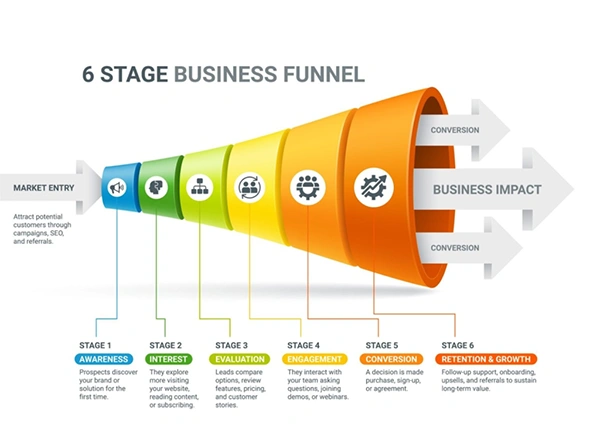
However, customers do not experience a business through individual channels. They move through a whole journey.
For example, a visitor may first discover a brand through media, then return later via a search to read a blog article, compare offers and finally convert after seeing a retargeting ad. If a business measures each step separately, the full picture is missed.
This is where a full-cycle marketing agency can add real value. By connecting analytics across acquisition, engagement and conversion, it becomes easier to understand what truly drives revenue. Rather than asking which channel is most effective, brands can explore how channels work together.
This is particularly important for businesses that are balancing paid growth with organic traffic. Search often builds trust and generates long-term demand, while paid campaigns increase visibility and capture immediate intent. When these systems are measured together, budget decisions become more informed.
The following infographic depicts the entire business market funnel that requires complete observation all at once:
The age-old war of left and right brain, logic vs abstraction, data vs creativity. One team focuses on numbers, while the other produces concepts and neither side learns enough from the other. The result is predictable: creative teams build assets without receiving any feedback on their performance and analysts review numbers without improving the messaging.
A stronger model connects the two. Data reveals which angles attract attention, which offer prompt action and which formats maintain engagement. Creative teams can then use these insights to build better campaigns. This is where viral creativity becomes more useful. Rather than chasing reach for its own sake, brands can develop creative concepts that spread and support qualified acquisition and conversion.
For a modern DM agency, striking this balance is crucial. The goal is not simply to make ads more noticeable. It is to make them more commercially effective.
Many brands in their infancy resort to paid campaigns, and that’s understandable too. However, long-term revenue growth depends on organic traffic.
Organic search provides more than just extra visits. It creates resilience. It reduces dependence on the volatility of advertising costs. It captures users who are already researching a solution and are driven by intent. It also establishes authority, which can improve conversion rates even when the final touchpoint comes from another channel.
The work of a responsible marketing agency doesn’t end with just data collection. It should handhold the client towards actionable insights for better strategic decision-making, as far as marketing is concerned.
That should include:
A strong, full-cycle agency should also be able to explain what the numbers mean in business terms. This is important because raw analytics alone cannot grow a company. Better decisions do.

In data-driven marketing, the keyword is driven, not data. You don’t need thousands of reports elaborating on a huge amount of data. Just a few insights condensed from its interpretation are sufficient. For online businesses, that means understanding which channels are most valuable, which messages are most effective and how creative, SEO, paid traffic and customer intent work together.
The companies that grow most efficiently are usually not the ones with the most data. They are the ones who know how to use it. This is why businesses increasingly value a DM agency that can connect performance analysis, media marketing, organic traffic and viral creative to real revenue outcomes.
Ans: Product, Price, Place, and Promotion.
Ans: Customer, Cost, Convenience, and Communication.
Ans: Price, Positioning, Pace, and Performance.
