
Speed of digital solutions emboldens customer trust. Studies consistently show that even a few seconds of delay can hurt user confidence, and email is no exception. Nearly 62% of customers expect invoices and receipts within 5 minutes or less after the purchase (Source). A late password reset or missing order confirmation doesn’t just annoy users, it quietly chips away at your credibility.
That’s why triggered messages, once an afterthought, have become mission-critical in 2026. Teams now expect more than “it sends.” They want speed, reliability, clean APIs, and pricing that doesn’t sneak up on finance. Let’s break down what actually matters and which providers are worth your shortlist.

KEY TAKEAWAYS
- The speed and deliverability of transactional emails directly impact user trust.
- People want authentication (SPF, DKIM, DMARC) and API-first platforms.
- Different tools excel for different team types.
- Always test providers with real traffic before committing.
Not all email infrastructure is built equally. The best platforms quietly handle chaos so your users never notice anything.
A modern transactional email API service needs to get three things right:
Infrastructure is the first step to deliverability: dedicated IPs, automatic warm-up, and detailed reputation management.
When outages happen (and they do), you need real-time webhooks and human support that answers in minutes, not business days. Lastly, the integration story has to respect engineering reality: clear SMTP credentials for simple jobs, a RESTful JSON endpoint for deeper logic, and client libraries you can drop into existing CI pipelines without forking the codebase.
We should also recognize that mid-market companies often outgrow basic dashboards. When you’re supporting multiple brands, compliance regimes, and data-sovereignty rules, the platform doubles as an enterprise email solution – complete with SSO, role-based access, and region-locked data storage.
If you peek into any dev or marketing Slack channel, three themes keep popping up.
Google’s and Yahoo’s bulk-sender rules, along with Microsoft’s and Apple’s iCloud postmaster policies, make SPF, DKIM, and DMARC alignment a must. Apple’s MPP also hides open-rate data, so senders have to rely on click-based engagement signals instead. Providers that automate authentication or offer guided IP warm-ups reduce a lot of trial and error.
Feature releases move faster when email triggers sit in the same repo as the rest of the product code. That’s driving demand for concise JSON endpoints and SDKs that fit continuous-integration pipelines.
While promotions are still going on, marketers want to know how many people are interacting with them. When bounces go up, developers need webhook alerts. Providers can now show latency, delivery, and engagement metrics in minutes instead of hours.
Those trends set the bar for the contenders below. Only vendors that consistently pass deliverability tests, expose modern APIs, and publish transparent status pages made the list.
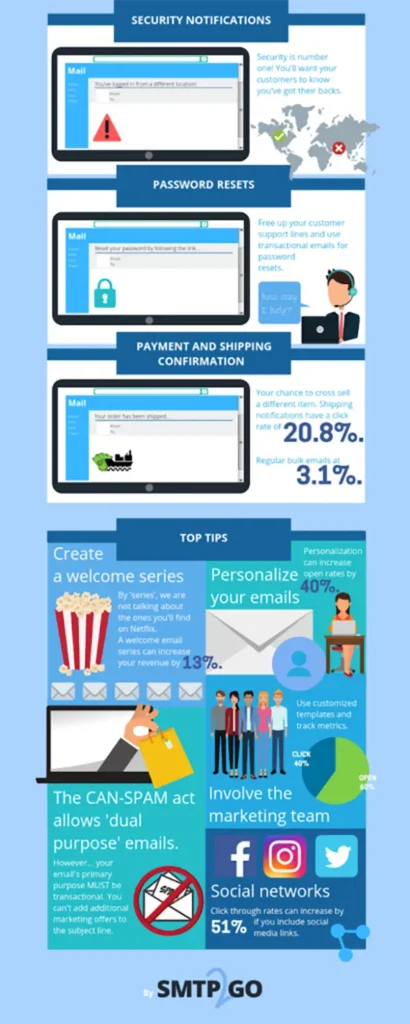
The following infographic lists some tips for your transactional mail strategy in 2026:
All five platforms below deliver fast, support SMTP + REST, and offer flexible pricing. What separates them is philosophy: some chase raw throughput, others polish UX for non-technical teams. Read the overviews, skim the feature lists, and keep your own roadmap in view before picking a long-term partner.
UniOne’s average inbox arrival time hovers around five seconds. Engineers can start with SMTP in minutes, then switch to the richer Web API for higher concurrency.
Key strengths:
A few trade-offs sit under the hood. Official SDKs cover Ruby, PHP, and C#, so JavaScript or Go teams must roll their own wrappers. Advanced automations – think multi-step drip sequences – live behind higher-tier plans, though core webhooks stay free.
UniOne’s pricing model is easiest to read when placed in a table:
| Monthly Volume | Price | Unit Cost per 1 000 | Notes |
| 6,000 (trial) | $0 | – | Four months free |
| 10,000 | $6 | $0.12 | Starter plan |
| 100,000 | ~$40 | $0.40 | Scales via sliders |
| 1,000,000+ | Custom | $0.30 and below | Volume tiers |
Beyond raw cost, the platform ships 200+ templates, an AI-assisted HTML editor, 45-day log retention, and 100-day analytics data storage – perks rarely bundled at this price. Those extras, plus recognition from G2 and Capterra, explain why many startups label UniOne the best transactional email software for velocity and value.
Postmark walls off transactional traffic on infrastructure isolated from bulk marketing sends. That single design choice protects the sender’s reputation and helps the service hit its 10-second SLA.
Highlights include:
Limitations surface when teams need beyond-basics templating or deep conditional logic; Postmark deliberately focuses on core sending. Still, for companies whose primary goal is “arrive instantly and never in spam”, Postmark ranks among the best triggered message services. Its mid-tier pricing feels fair for the peace of mind delivered.
Born in the dial-up era, SMTP.com has modernized into a high-volume powerhouse. During tests, batches of 100,000 messages landed across major ISPs in under eight seconds.
Standout capabilities:
Its costing start at $25 for 50,000 sends. Yes, a bit steeper than even newer rivals, but the fees drop sharply as the sends go past half a million. For enterprises moving millions of tickets, OTPs, or shipping notices each day, the granular controls justify the spend. Smaller SaaS teams, however, may find the dashboard overwhelming and the price overkill, so weigh needs carefully before joining these transactional email providers.
Mailgun remains the darling of engineering teams thanks to its flexible REST API, inbound parsing, and address validation endpoints. You can programmatically create templates, run placement tests, and pipe Google Postmaster data back into dashboards.
Why it shines:
Downsides crop up for non-technical marketers; the UI speaks in JSON and webhooks more than WYSIWYG. Also, features like dedicated IPs or long-term storage live in higher tiers. If your org automates everything literally, Mailgun could be the best transactional email software; if you need drag-and-drop editors, look elsewhere.
MailerSend aims squarely at product and lifecycle marketers who need brand-perfect messages but lack front-end engineering cycles. Its visual builder rivals standalone email-design apps while still exposing a JSON API.
Core perks:
Deliverability remains solid, if not elite: spring 2026 uptime clocked 99.97%, and average inbox placement was under fifteen seconds. Support is email-only, and advanced monitoring trails UniOne or SMTP.com. For many DTC brands, however, the combination of aesthetics and low entry cost places MailerSend among today’s best transactional email services.
Picking a provider isn’t about “best overall.” It’s about fit.
If you push sub-100,000 messages a month, UniOne or MailerSend cover the needs at attractive prices. Beyond that, evaluate SMTP.com and Mailgun for sustained throughput.
Code-centric shop? Mailgun’s expressive API and Postmark’s event webhooks slide easily into CI pipelines. Visual-first marketers? MailerSend’s builder saves design hours.
Healthcare or fintech? UniOne’s optional HIPAA endpoint and SMTP.com’s SOC 2 docs keep auditors calm. Require round-the-clock assistance? Postmark and SMTP.com both staff phones 24/7.
Set up SPF, DKIM, and DMARC, then send live traffic for two weeks. Track latency, inbox placement, and support ticket response. Litmus’s 2025 Report notes that 12% of email marketers cited A/B testing as a key part of their strategy for improving ROI.
Triggered messages work best when they’re invisible. No delays, no failures, no surprises.
The right provider won’t just send emails. It will quietly protect your user experience, your reputation, and your sanity. Choose based on how your team works today, not just where you hope to be tomorrow. Because when email fails, everyone notices. When it works, no one even thinks about it.
