

“Without data, you’re just another person with an opinion.”
— W. Edwards Deming (Economist & Consultant)
Information rarely fails loudly. It drifts quietly. Pipelines keep running, dashboards look clean, and everything feels “fine” until an audit exposes gaps that have been there since day one. By then, the damage isn’t just technical, it’s financial.
This guide cuts through the noise. Instead of glossy claims, it focuses on what top data mining companies actually deliver in 2026, from pipeline engineering to compliance readiness. If you’re shortlisting vendors for a real problem, not just filling a procurement sheet, this is built for you.
TABLE OF CONTENTS
- What Makes a Data Mining Company Worth Evaluating
- Ten Data Mining Companies Worth Shortlisting in 2026
- Choosing the Right Data Mining Vendor
- FAQs
Choosing a vendor isn’t about size or brand recall. These won’t save you when the pipeline crumbles three weeks after go-live.
Five factors separate vendors worth your time from the rest:
What you want to ask for: incident logs from the past twelve months. How many source-breaking changes hit? How fast did the vendor recover each time? Those numbers are worth more than any slide deck.
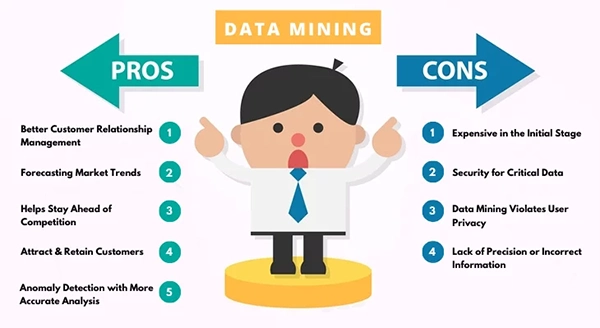
But before choosing a vendor, understand whether extraction services are even for you or not by learning about the pros and cons:
Not all vendors play the same game. Top firms in this space break into three categories: builders (they construct ingestion pipelines and processing systems), domain specialists (they know your industry cold), and volume processors (they handle massive throughput at set rates). Three of the ten straddle more than one category, and we’ve flagged those.
Each profile covers the vendor’s category, what they do day-to-day, and the buyer type they’re built for — because among top service providers in this domain, what the marketing page claims and what the engineering team actually ships are frequently two different things.
Category: Builder
GroupBWT runs large-scale scraping and pipeline operations from Ukraine, with offices in the US, UK, and Cyprus. Production numbers: 335M+ price records/month across OTA platforms, 959K products daily from Korean marketplaces that actively block automated collection. Toolchain: Scrapy, curl_cffi for TLS fingerprint rotation (bypassing bot detection that reads cipher suites), Camoufox (stealth browser automation), Kubernetes on AWS EKS. Client relationships going back 6–7 years — in a space where clients own all the code and switching costs are low, that retention tells you something.
You own the code. You own the ETL (extract-transform-load) logic. Output feeds into Snowflake, Databricks, or your PostgreSQL instance. No CSV dumps. No vendor-controlled black boxes.
“When a client owns the full pipeline — code, schema logic, warehouse config — there’s no exit penalty. We keep the relationship because the work holds up, not because anyone’s locked in.” — Dmytro Naumenko, CTO, GroupBWT
Best for: Engineering teams who want complete pipeline ownership from ingestion to warehouse. You walk away with the code, not a dependency.
Category: Domain Specialist
ScienceSoft leans heavily into regulated industries like healthcare and finance. It’s been in business for 35 years in Texas. Frost & Sullivan recognized their patient engagement tech in 2025. The UNM Health app (shipped early 2026) serves 400K+ adults. Atlas Credit’s lending system, built on ScienceSoft’s work, won the 2025 FinTech Innovation Award for underwriting automation. FT fastest-growing for 4 consecutive years. Newsweek Most Reliable Companies 2025.
Certifications: ISO 9001, 27001, 13485. Stack: Hadoop, Spark, Kafka, Azure Synapse, Redshift — production tools, not vanity listings.
Best for: Healthcare or financial firms needing BI consulting from someone who already knows the regulatory maze. Strong on analytics over structured information. Not a raw extraction vendor.
Category: Volume Processor
~3,000 people, five continents, 18,000+ customers, ₹140 Crores FY2025 revenue — among the biggest data processing providers by headcount here. In mid-2025, they spun off Flatworld.ai for agentic AI (autonomous task-executing agents). Published results: 27% logistics route improvement, 30–50% faster mortgage closings, ~50% back-office cost reduction. ISO 27001:2022, ISO 9001:2015 certified. NASSCOM member.
The work skews toward structured data entry, document conversion, and annotation — not scraping or complex ETL.
Best for: Organizations with document volume or data entry backlogs spanning multiple regions. BPO at its core — processing muscle, not data engineering.
Category: Domain Specialist
Rely blends OCR and RPA to turn manual-heavy workflows into automated systems. 15M smart-meter reads reconciled against billing, 99.8% paper-to-digital accuracy on insurance claims. 2025 revenue: $75M. Salesforce Certified.
Best for: Finance or insurance teams needing measurable, auditable cost reductions from process automation — with documentation that holds up when the CFO asks.
Category: Builder + Domain Hybrid
Hybrid onshore/offshore, 1,400+ engineers, 25 years. The draw: their AI 10X Accelerator — $20K, four weeks, scoped to identify savings opportunities. 100+ completed, participants cite $200K+ in identified savings. Named client: Tony Robbins’ Wealth Mastery. Stack: PyTorch, TensorFlow, LangChain, MLOps (machine learning operations), NLP (natural language processing), and computer vision.
Builder side: custom AI data extraction tools from scratch. Domain side: reshaping those tools for specific industries.
Best for: Companies wanting custom AI tools with U.S.-based project management. $20K accelerator validates the approach before you commit to a six-figure build.
Category: Domain Specialist
B2B contact insights: mining, verification, and a 98% accuracy guarantee — records below threshold get re-verified and replaced within seven days, no charge. 50+ researchers run AI-plus-manual verification across job changes, funding events, healthcare directories, and compliance databases in 25+ industries. ISO 27001. Five privacy frameworks under one roof: GDPR, CCPA, CASL, PIPEDA, and LGPD. Revenue: $15M, 500+ enterprise clients.
Best for: Sales and marketing teams running cross-border outreach who can’t afford compliance mistakes. Lead intelligence, not general-purpose extraction.
Category: Builder + Volume Hybrid
Damco operates at enterprise scale, combining modernization projects with processing workflows. The largest entry here by revenue: ~$750M in 2025, 50+ technology stacks, 24+ sectors. CMMI Level 3, Microsoft Gold, Salesforce Gold, OutSystems partner (July 2025). Everest Group PEAK Matrix 2024 for low-code services. Great Place to Work 2023–2025.
Best for: Large enterprises where data extraction is one piece of a bigger modernization program. If extraction is all you need, a specialist will move faster.
Category: Domain Specialist + Volume Hybrid
Fifty years in business. BSE/NSE-listed (audited financials). FY2025: ₹1,723 crore (~$205M+), up 11.2% YoY. Team: 5,800–7,700. Mumbai HQ, US/UK offices.
TruCap+ (ML-based document extraction) pulls information from unstructured documents — claims, invoices, loan applications, medical records — at high straight-through rates. TruBot (RPA) handles downstream routing, validation, and reconciliation. Production deployments: ATM dispute automation for a Middle Eastern bank, 99.9% currency demand forecasting for South Asia’s largest central bank, automated claims processing for a global insurer. CMMI Level 5, ISO 27001, SOC 2 Type II. Everest Group Major Contender in IDP and IPA, 2025.
Trade-off: South Asian delivery footprint. No web scraping or anti-bot engineering. Q3 FY2026 net profit dropped 51% despite revenue growth — margin pressure worth watching.
Best for: Banking, insurance, and healthcare organizations with large volumes of unstructured documents needing ML-based extraction, not manual entry.
9. Inputix — Precision Data Entry and Annotation
Category: Volume Processor
Accuracy numbers that hold up: 99.9% general data entry, 98.9% enrollment processing, both independently verifiable. ISO/IEC 27001, ISO 9001, GDPR, and HIPAA compliant. 350-person team, 24/7 operations, encrypted connections, role-based access. Clutch Indian Leader Award 2021. Pricing: $5–10/hour.
Best for: Projects with strict accuracy targets and compliance documentation from day one — especially healthcare digitization and insurance claims.
Category: Volume Processor
UniquesData offers cost-effective services without heavy enterprise overhead. Rates start at $4–5/hour. Sixteen years in business, 1,150+ projects, 225+ clients, 80% retention. Multi-layer validation: 99% accuracy. GoodFirms Top Data Services Provider 2025, DesignRush #1. Clients stick around for the flexibility: mid-project requirement changes without change-order paperwork.
Best for: Startups and mid-market teams needing quality processing without enterprise pricing. Constraint: 150 people, one location in Ahmedabad, zero geographic redundancy.
The pattern is simple once you notice it: vendors who handed over full code ownership maintained the longest client relationships. The ones who kept the pipeline behind their own walls? Those relationships rarely lasted past the second renewal.
These ten vendors cover the full spectrum across custom pipeline construction, AI-augmented document processing, domain consulting, and high-volume manual processing.
