

“Revenue is vanity, Profit is sanity and Cash is king.” – Alan Miltz (Financial Consultant)
A business can look profitable on paper and still feel unstable day to day. Sales go up, margins look fine, yet the bank balance keeps dipping after payroll. Reports come in late, and no one can clearly explain why a “good” month didn’t feel good.
That’s usually the point where owners start looking for an outsourced CFO firm. Not for more reports, but for clarity, control, and forward direction.In this article, I’ll explain what a Fractional Chief Financial Officer does, when your business needs one, and how it compares to a full-time CFO. The following sections list clear signs, benefits, and practical insights.
KEY TAKEAWAYS
- Outsourced CFOs offer flexibility without long-term commitment.
- They focus on strategy, not bookkeeping.
- The role becomes valuable when complexity increases, not just revenue.
- Forecasting and cash planning are the biggest immediate wins.
Think of a Fractional Chief Financial Officer as the person who turns financial data into decisions. They support a company on a part-time, project or contract basis, instead of joining as a full-time executive.
The role sits above bookkeeping and routine accounting. A bookkeeper keeps transactions organised and reconciled. An accountant often supports the month-end close and compliance. A CFO focuses on direction, using the numbers to guide decisions, priorities, and risk.
Most engagements start with a reset of the basics. The Chief Financial Officer checks how the business tracks revenue, costs, and cash. They tighten definitions so reports stay consistent. Then they set a cadence that fits the business, usually a monthly performance review plus a separate cash check-in.
This model works well when you need senior judgment, but not every day. It can also bridge a gap during growth, a transition, or a finance team rebuild.
Titles don’t matter. Outcomes do.
A good outsourced CFO doesn’t just “analyze numbers.” They create tools that the business uses repeatedly, not a one-time memo. It also turns financial conversations into clear next steps.
Here are typical deliverables from a Fractional Chief Financial Officer :
The practical value shows up fast in cash flow. Many businesses run into a timing problem, not a sales problem. Revenue rises, yet cash drops because receivables stretch while payroll and vendors stay on schedule. A CFO will track that gap, adjust terms and collections, and align spending with realistic inflows.
This is where financial planning and forecasting for small businesses become useful. Instead of “we should be fine next month,” you get a forecast that shows the week when cash tightens. That gives you time to act, rather than react.
A Chief Financial Officer also improves internal discipline. Simple approval rules, cleaner categorisation, and consistent month-end close reduce rework. Over time, leadership stops chasing numbers and starts using them.
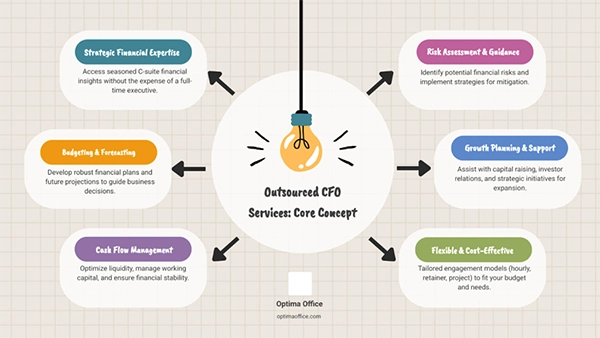
The following infographic summarizes the services offered by an outsourced CFO:
Most businesses don’t “decide” they need a CFO. They feel it.
The signals show up in day-to-day friction. Decisions slow down, numbers don’t add up, and cash starts behaving unpredictably.
Common signs include:
These are not failure signals. They are stage signals. A business has moved beyond basic tracking and needs stronger finance leadership. An outsourced CFO provides financial leadership to small businesses that can’t afford a full-time hire.
Another sign is repeated cleanup. If books require heavy corrections each month, forecasting stays unreliable. A Chief Financial Officer can reset the process so the team spends less time fixing and more time steering.
This isn’t about status. It’s about need.
Choosing between a fractional and a full-time Chief Financial Officer often comes down to how much leadership the business needs each week.
| Factor | Outsourced CFO | Full-Time CFO |
| Best fit | Growth, transition, cleanup, scaling | Ongoing complexity needing daily leadership |
| Cost profile | Fractional engagement | Full executive compensation package |
| Time commitment | Set hours or project scope | Day-to-day involvement |
| Typical focus | Cash rhythm, forecasting, and reporting discipline | Org-wide finance leadership, investor demands |
| When it changes | The scope can expand or shrink by quarter | Needs stay consistently high |
Outsourced support fits well when the business needs senior guidance but not constant presence. It is also useful during financing events or operational shifts. You can scale the engagement up for a few months, then reduce it once the system is stable.
A full-time CFO often makes sense once finance becomes a daily execution. That may include multi-entity operations, multi-location complexity, investor reporting, frequent fundraising, or deeper process control needs. At that stage, a permanent leader may be the right move.
Outsourced support can prepare the company for that step. It sets reporting standards, cash routines, and decision frameworks. It also clarifies what a future in-house hire should own.
The wrong Chief Financial Officer creates friction. The right one creates momentum.
Their work touches hiring pace, spending priorities, and growth plans. You need someone who communicates clearly and can challenge assumptions without creating friction.
Look for a provider who can work with your current team. They should strengthen their bookkeeper or accountant, not compete with them. Ask how they handle month-end close, reporting timelines, and follow-through on action items.
Use these practical checks when comparing fractional CFO services:
Also, ask what happens after the first ninety days. A strong partner does not stay in “diagnosis mode” forever. They should move from cleanup to a stable operating rhythm.
The right outsourced CFO would make the business calmer to run on the financial front. Decisions get faster, reporting gets clearer, and cash stops feeling like a surprise. That is the real measure of the engagement.
