
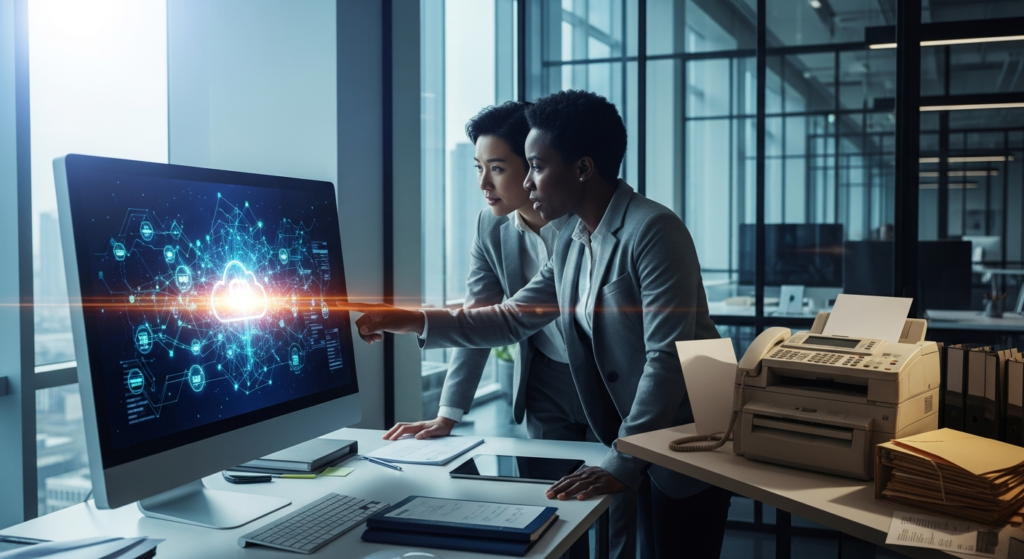
Even with the prevalence of instant messaging and email, a surprisingly robust technology still manages important business communications.
As of 2023, a survey revealed that 82% of German companies still relied on fax for business, and in the U.S. healthcare sector,approximately 70% of providers still use it to exchange vital patient information.
Faxing has continued to hold a special and essential place due to legal and regulatory considerations. A key question is thus brought up: Why has this technology endured, and how has it changed to fit the digitally-first world of 2026?
The solution can be found in its transition from noisy, paper-based devices to safe, cloud-based online faxing. This guide will explain how contemporary technology functions, why it is still necessary, and how it has improved in security and usability.
Let’s begin!
Key Takeaways
- Uncovering the fax evolution in detail
- Uncovering the modern cases of this domain
- Looking at some crucial tools and tech integration
- Decoding the connection between analog and secure digital future
The journey of the fax machine is a story of profound technological adaptation. What started out as a commonplace in offices in the 20th century, with its characteristic screeching sounds and dependence on hardware, has evolved into an advanced cloud service. This shift was not merely an upgrade but a complete reimagining of the technology’s purpose and function, driven by the need for greater security, accessibility, and cost-efficiency in a digital economy.
Understanding this evolution is key to appreciating why internet faxing is not a relic but a highly relevant tool for modern communication challenges.
Interesting Facts
70% of healthcare providers still use fax to exchange medical information. Online faxing is now heavily used to ensure HIPAA, GDPR, and SOX compliance via encrypted, audit-trailled transmissions.
The classic fax machine operated through a straightforward analog process. An internal scanner would read a physical document, converting the light and dark areas into a series of audio tones. After that, these tones were sent over the Public Switched Telephone Network (PSTN), which is the same network that landline calls use. These tones would be decoded by a different fax machine on the receiving end, which would then turn them back into an image and print it onto thermal paper.
This process, while revolutionary for its time, came with significant drawbacks. It required expensive physical hardware, a dedicated phone line, and a constant supply of paper and ink. Security was virtually non-existent, as sensitive documents were often left sitting on a publicly accessible machine. Furthermore, the lack of remote access meant business could only be conducted where the machine was located. The high operational costs are a major factor driving change; analysis shows that switching to online faxing can generate annual savings of up to 400% by eliminating these very expenses.
Internet faxing, also known as online fax, e-fax, or cloud fax, is a modern service that acts as a digital bridge between the internet and the traditional telephone network. It completely removes the need for a physical fax machine. Users send and receive documents instead using well-known interfaces, such as a specialized mobile application, a secure web portal, or an email client.
The intricate technical backend is handled by the internet fax provider, which also modifies digital files (such as Word or PDF documents) for legacy fax machines and sends them over the PSTN. Conversely, when an old-school fax machine sends a document to a user’s online fax number, the service receives the analog signal, converts it into a digital file, and delivers it directly to the user’s secure online inbox.
The clear distinctions between the old and new approaches demonstrate the enormous benefits of cloud-based solutions for contemporary professionals and enterprises.
| Feature | Traditional Fax Machine | Internet Fax Service |
| Transmission | Public Switched Telephone Network (PSTN) | Internet (VoIP) to PSTN |
| Hardware | Requires fax machine, toner, paper | None required; uses computer or mobile device |
| Security | Low; documents are physically exposed | High; end-to-end encryption and secure login |
| Accessibility | Limited to the physical location of the machine | Accessible from any device with internet access |
| Cost | High (hardware, dedicated line, supplies) | Low (subscription-based, often with free fax trials) |
| Archiving | Manual filing of physical paper copies | Automatic digital storage in the cloud |
The continued use of faxing is not coincidental in an era of sophisticated cyberthreats and strict data privacy laws; rather, it is a direct reaction to the drawbacks of alternative forms of communication. While email is convenient, it can be vulnerable to interception and phishing, and its legal standing for binding agreements can be ambiguous.
Internet faxing addresses these gaps by combining the verifiable, point-to-point transmission record of traditional faxing with the advanced security protocols of modern cloud technology, creating a uniquely trustworthy channel for sensitive information.
Fax transmissions are often considered more legally valid than emails because they provide a clear, verifiable record of a successful point-to-point delivery. Its continued application in the legal, financial, and governmental sectors is largely due to this. In order to comply with the Health Insurance Portability and Accountability Act (HIPAA), this dependability is crucial for the U.S. healthcare sector.
The act mandates strict safeguards for Protected Health Information (PHI). Reputable internet faxing services that are HIPAA compliant offer a secure, auditable method for transmitting patient records, prescriptions, and insurance forms. This compliance is a primary driver behind the fact that 70% of healthcare providers continue to rely on faxing to bridge communication gaps between different electronic health record (EHR) systems.
The physical security risk of a traditional fax—a sensitive document left in a tray for anyone to see—is replaced by robust digital security with online services. The risk of physical exposure is eliminated because documents are sent straight to a user’s encrypted, password-protected inbox. Leading services employ advanced security features like end-to-end 256-bit SSL encryption and store data in secure, compliant data centers.
The need for such purpose-built channels is constantly reinforced by current events. For instance, the recent inadvertent exposure of personal information by the Illinois Department of Human Services underscores the critical importance of secure communication. Furthermore, widespreadphishing campaigns that exploit file-sharing services highlight the security advantage of a closed-loop, verifiable system like internet fax.
Adopting internet faxing in 2026 is a straightforward process designed for simplicity and efficiency. The technological obstacles have been removed by contemporary platforms, which provide user-friendly interfaces that are as comfortable as sending an email.
From sole proprietors to large enterprises, the tools are now available to integrate secure document transmission directly into existing digital workflows, enhancing productivity without the burden of managing physical hardware. This accessibility is a key reason why the Small and Medium Enterprises (SMEs) segment has become a significant driver of the online fax market’s growth.
The user journey for sending an online fax is designed to be seamless and intuitive, requiring no specialized technical knowledge. Here is how it typically works:
As a prime example of a modern, user-centric internet faxing solution, Fax.xyz is a platform designed to make this technology both powerful and accessible for everyone from individuals to large organizations. It exemplifies the industry’s shift from clunky hardware to a streamlined, software-based approach.
With end-to-end encryption and complete HIPAA compliance, the platform’s fundamental strengths are security and trust, making it a dependable option for transmitting private legal or medical documents. In a digital environment where new vulnerabilities are constantly being discovered, as seen in the January 2026 Microsoft Patch Tuesday alerts, a service built on enterprise-grade protection offers critical peace of mind.
Beyond its robust security, Fax.xyz emphasizes accessibility and ease of use. It offers a seamless cross-device experience—as easily as using email—available on web, iOS, and Android. With its easy-to-use features like cloud storage integration, automated cover pages, and real-time delivery tracking, it’s a great low-cost option for SMEs who want to digitize their processes without a significant learning curve. To allow users to experience these benefits firsthand, many modern providers, including Fax.xyz, offer a freefax trial period. This approach has proven popular with businesses who prefer predictable costs, with subscription-based models accounting for nearly 63% of the market share in 2024.
Despite the perception that faxing is going extinct, the market for online faxing is growing quickly worldwide. It was valued at USD 4.18 billion in 2024 and is projected to grow to USD 12.52 billion by 2031.
This growth is largely fueled by the increasing need for secure and compliant document transmission in a world of tightening data privacy regulations. Currently,North America holds the largest share of this market, driven by high cloud service adoption and strict regulatory demands in key industries like healthcare, finance, and law. This trend indicates a healthy future for a technology that has successfully adapted to meet modern challenges.
The history of internet faxing is ultimately about developing a reliable communication tool for the demanding needs of the present and the future, not about holding onto the past. It successfully combines the legal weight, reliability, and universal compatibility of traditional faxing with the security, cost-efficiency, and flexibility of modern cloud technology. Internet faxing has proven its value by addressing critical needs that other digital communication tools cannot fully satisfy, especially when security and compliance are non-negotiable.
In 2026, as businesses and professionals navigate an increasingly complex digital landscape fraught with security risks, online faxing stands as a critical tool. It bridges communication gaps between legacy systems and modern workflows, ensuring that even the most sensitive documents can be exchanged with unwavering confidence and compliance. It is a testament to how the right technology, when thoughtfully adapted, can remain essential for decades.
Ans: The document is usually converted to PDF or TIFF format and sent by the Web server to the fax server, which then transmits it to the receiving fax machine via the telephone network.
Ans: Electronic faxing, digital fax, or eFax are new-generation utilities that are replacing the traditional ones.
Ans: Yes, because they are encoded with AES 256-bit encryption.
