
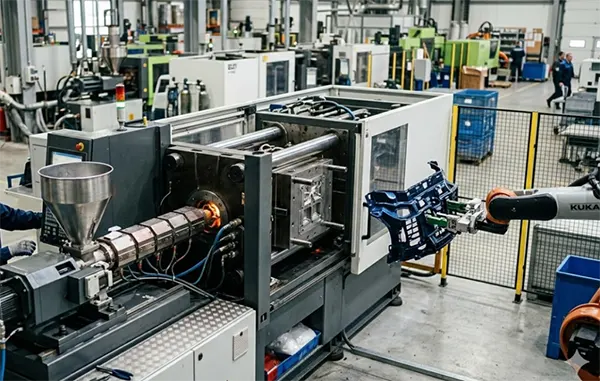
Injection molding projects depend upon their timely transition from design to production. Conversely, small design or process issues can result in increased costs, longer lead times, and unnecessary quality issues. The successful development of modern plastic products requires speed, precision, and early implementation of risk reduction measures.
One aspect of the phases of injection molding simulation that is extremely important is understanding how a part will perform prior to cutting steel and starting the production process.
KEY TAKEAWAYS
- Proper understanding makes communication easier between product designers, mold makers, and process engineers.
- Companies that use simulation are generally better prepared to manage complexity.
- The injection molding process starts with smart part design and continues through detailed modifications.
Injection molding is not a single action but a connected chain of technical decisions. Every stage influences the next one, from the first part concept to mold design, sampling, and later process optimization. If one step is handled poorly, the result may include warpage, sink marks, air traps, weld lines, weak areas, or unnecessary production costs.
A proper understanding of all engineering/molding process steps will help align part geometry with material selection, gate placement, cooling layout, and machine settings. This can enhance the ease of communication between design engineers, mold builders, and process engineers.
Simulation plays a major role here because it turns assumptions into visible, testable results. Instead of waiting for expensive trial-and-error in production, teams can evaluate filling behavior, pressure development, thermal effects, and expected part deformation in a virtual environment.
The first phase begins long before the mold exists. At this point, the focus is on the plastic part itself, including its:
During the early part of the design, simulation is especially useful because the component can be studied without the full influence of the tool. This enables engineers to create a reference model based on idealized conditions. In simple terms, the team can see how the part would act in an optimized scenario before the tool layout introduces additional variables.
Main priorities in the part design stage:
At this phase of development, many engineers look at the most critical factors affecting the final quality of the part they are producing. The use of computerized simulation will allow a team to review the filling characteristics of the part (if it will fill properly), determine the reasonableness of the applied pressure, and find other preventative design changes that may create defective parts.
By providing this type of early evaluation, the chance of having to redesign a component later in the process is minimized. Another important point is process-induced properties.
Cooling gradients, fiber orientation, and shrinkage behavior can affect stiffness and dimensional stability. Even in the part design phase, these factors should not be overlooked if the final component has tight tolerances or mechanical requirements.
Once the article geometry is designated, attention shifts to the mold. This is the stage where tool-specific influences become critical. A well-designed part can still fail in production if the cooling concept, runner layout, or gate system is poorly planned.
The focus of the evaluation stage is to verify and optimize the injection mold design using virtual tools prior to any physical manufacturing activity. It is validating a design before having the tool manufactured out of steel.
Simulation provides an opportunity for manufacturing teams to compare tooling design concepts, make a determination of weaknesses in the design, and then decide on the most robust tooling to be produced.
Key mold-related factors that must be checked:
In this stage, the earlier reference from the part design phase becomes very valuable. The engineering team can benchmark idealized part performance against part performance resulting from the impact of using a real tool.
This comparison helps identify which problems are caused by the component itself and which are introduced by the tool design. Fewer corrections after tool completion, and more reliable sampling results, so simulation at this step supports smarter mold engineering.
After the mold concept is defined, the next step is to understand what happens during the actual molding cycle. This is where the classic processing phases are examined in detail.
Filling of molten material into a cavity is referred to as the filling phase:
The combination of these three phases is used to define the internal and external quality of the finished part.
What engineers typically evaluate in these analyses:
These results allow teams to answer practical questions.
By addressing such questions before production, manufacturers reduce costly surprises.
Injection molding does not end with a filled cavity. The final part must also meet mechanical and dimensional requirements in real service conditions. This is why structural-mechanical analysis is often combined with process simulation.
An example of directionality of performance can be observed when using a fiber-reinforced thermoplastic material, which shows direction-dependent performance with respect to the alignment of the fibers in relation to the flow of the melt.
Additional examples of potential quality issues based upon the design of the tool include localized shrinkage as well as thermal stresses that create dimensional inconsistencies or increase the chance of part failure due to load.
A more advanced assessment may include:
This step is especially important for technical plastic components used in automotive, medical, electronics, and industrial applications. The earlier such issues are detected, the easier it is to improve both design and manufacturability.
Even after a successful selection phase, optimization often continues. Once production starts, real manufacturing data may reveal residual defects, stability issues, or opportunities to enhance efficiency. At this point, simulation remains valuable.
Instead of adjusting parameters blindly, engineers can use virtual studies to test corrective actions. This may include changes to process settings, gate concepts, cooling conditions, or other influencing factors. Design of Experiments, or DoE, can be used to study how several variables interact and which combination produces the best result.
Typical optimization targets:
This stage demonstrates that simulation is not only a development tool. It is also a support tool for continuous modification after SOP, especially when parts show quality fluctuations or when productivity must be supplemented without sacrificing quality.
A structured injection molding strategy connects tool engineering, part design, process analysis, and later optimization into one analytical workflow. That is why simulation should not be treated as an isolated technical check. It should be part of the decision-making process from the beginning.
The biggest advantages of this approach are clear:
Companies using simulation to create their plastic parts are typically in a better position to handle complexity when designing challenging plastic parts with close tolerances or difficult-to-process materials.
For teams that want a deeper understanding of the key phases of injection molding simulation https://www.moldflow.eu/en/simulation-time-steps/, it is worth viewing the process as a connected system rather than a series of isolated tasks. That perspective leads to better tools, better parts, and more stable production results.
The injection molding process is not just limited to filling a mold with molten plastic. In fact, the process begins with properly designing the part, progresses through detailed validation of the mold, and continues into process control and structural evaluation after the product has launched to customers to optimize the part for the intended application. Each step has an impact on quality, cost, and manufacturing reliability.
