

In UK colleges and universities, research takes up a good part of your academic life. Not only that, research also helps you excel in that. Studies suggest that research involvement can greatly boost your GPAs.
But the characteristic of great research is how it transforms raw, collected data and interprets it into actionable insights. And that is half achieved by choosing the correct method to analyze data based on the topic and type of research.
In this article, I’ll list the six most common of them. The following sections discuss each in detail, best use cases, and how they lead to great research outcomes.
KEY TAKEAWAYS
- Information analysis methodologies are structured techniques that researchers use to examine and interpret data.
- These methods analyse information to uncover patterns, test relationships, and validate hypotheses.
- There are six key methodologies to analyze data: Descriptive, Regression, Case Study, Thematic, Process-tracing, and Mixed-Method.
- These help you analyze data more structurally.
Information analysis techniques are structured approaches to process collected data and arrive at meaningful conclusions. They are vital in higher education, transforming information into high-quality academic results.
The data is either numerical or qualitative. Using proper methodology to analyze that information will not only guarantee the soundness of your arguments but also ensure they are evidence-based, says Josiah Bailey, Project Manager at The Academic Papers UK, a legit dissertation writing service.
| Type of Analysis | Description | Common Use in UK Colleges |
| Quantitative | Analyses numerical data using statistical tools | Economics, psychology experiments |
| Qualitative | Interprets textual or observational information | Sociology interviews, education research |
| Mixed-Methods | Combines quantitative and qualitative approaches | Dissertations and applied research projects |
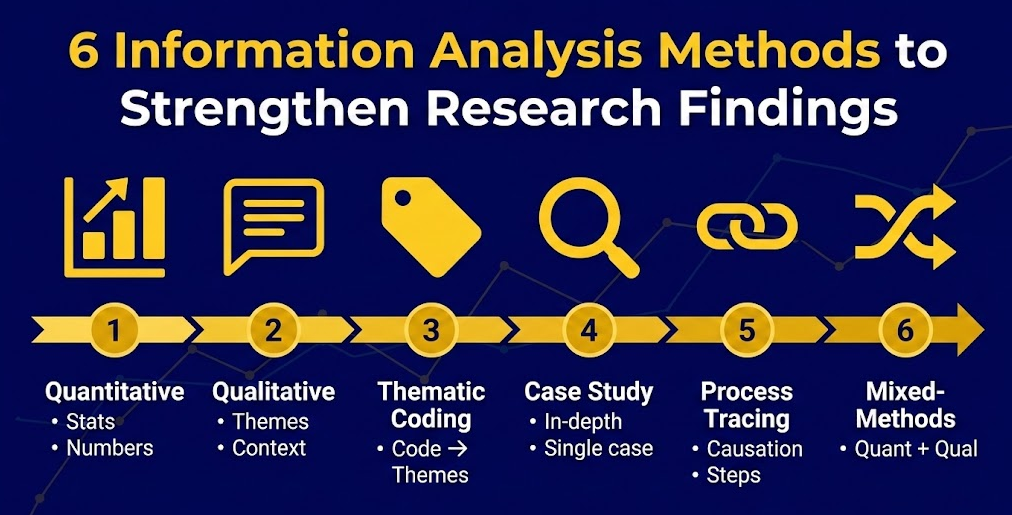
These methodologies broadly fall into two categories: quantitative and qualitative. Analyzing quantitative data focuses on statistics and numerical data, whereas analyzing qualitative information focuses on language, meaning, and context. A large number of contemporary research studies use both to enhance validity.
Quantitative statistics analysis addresses numeric data and statistical models. It breaks down the information presented in numbers using math and statistics. On top of that, descriptive statistics are used by researchers to synthesise a dataset, and inferential statistics are used to make predictions or test hypotheses.
A real-world example would be to sum up the average hours university students play games like CODM or PUBG during the first days of the semester. Key techniques for analysing information used include:
Regression is aimed at textual or non-numeric information to identify meanings, perspectives, and circumstances. It uses different themes and insights rather than numbers, unlike quantitative methods. An example of a quantitative method is to study historical financial data to identify candlestick breakouts in trading and their relation to price movements. The following table answers how to analyse information effectively using qualitative techniques:
| Feature | Quantitative | Qualitative |
| Data type | Numerical (countable measurements) | Textual, visual, or audio (words) |
| Purpose | Test hypotheses; generalise results | Explore meaning and context |
| Output | Statistics, graphs, models | Themes, narratives, insights |
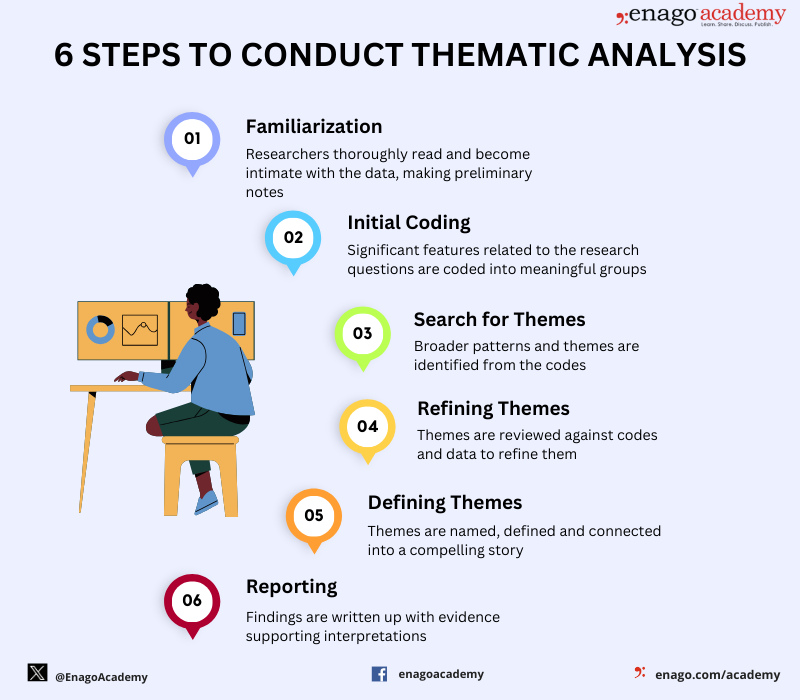
Thematic coding (often just called thematic analysis) is one of the research methods in which researchers label segments of text and group them into recurring themes or patterns. In practice, you carefully read your data and assign short “codes” or tags to relevant phrases or paragraphs. After coding, you review all codes and cluster similar ones into broader themes that capture the main ideas. This systematic process helps turn unstructured text into organised insights.
The following infographic describes the entire thematic analysis process in six simple steps:
Case study is an in-depth examination of a single case occurrence in reality. Case studies, such as political language and rhetoric texts, enable the researcher to gain holistic insight into the issue when it is not amenable to analysis through a controlled variable. The method tends to integrate various pieces of evidence (interviews, documents, observations, and media).
Process tracing is a qualitative, case-based approach that reveals causal processes. It does not simply correlate A with B, but it analyzes the pattern of events or the stages of intermediate events. An example of business decision analysis methods is tracing the chronological order of marketing decisions through feedback loops and patch updates.
Key Features of Process Tracing
A key definition of information processing and analysis methodology is “the systematic examination of diagnostic evidence… in light of research questions and hypotheses”. In practice, researchers begin with a theoretical causal pathway and then gather evidence to confirm each step. For a practical guide on methodologies in social science research, see this guide to commonly used methods in social science research. Here are the key features:
Mixed-methods research combines quantitative and qualitative approaches within a single study. The idea is to leverage the strengths of both: numbers and statistical trends from quantitative analysis, together with rich context from qualitative analysis. A study published in Sage Journals in 2025 also supports this, mentioning that the use of mixed methods has increased 2.97%. Below are the best techniques for analysing research information in a mixed way:
| Stage | Method | What’s done |
| Data collection | Survey (quantitative) | Collect numerical data from many respondents to identify trends. |
| Follow-up | Interviews (qualitative) | Conduct interviews with a subset of participants to explain why those trends occur. |
| Analysis | Integrated interpretation | Combine statistical results and interview insights into a unified understanding. |
Choosing the correct method for analyzing data is crucial to your path to a great research piece. Many students understand the theory behind descriptive statistics and mixed methods. The real challenge appears when these techniques must be applied within a full dissertation structure.
This stage often requires guidance from experienced academic researchers. In this regard, UK dissertation writing services help students organise datasets and interpret results in an academic form. With expert support, your information analysis aligns with your research questions, methodology, and objectives. As a result, your research becomes evidence-based and suitable for university standards.
The right methodologies beget correct research outcomes. Quantitative methods, including statistics and modelling, are rigorous and generalizable. The context and meaning are disclosed with qualitative approaches such as coding and case studies. When combined to analyze data, these two approaches provide the strongest evidence by leveraging the strengths of both techniques.
In all scenarios, thoroughly analyzing information is necessary to ensure the results are valid, reliable, and useful.
Ans: Examples can be both quantitative and qualitative analysis methodologies. These include descriptive statistical methodology, regression analysis, and hypothesis testing. Alternatively, qualitative methods such as thematic coding, content or discourse analysis, or mixed methods that combine survey findings with unstructured interviewing. Overall, an evaluation of data of any systematic type is considered an analysis method.
Ans: There are numerical and narrative techniques to analyze information. These are quantitative techniques for students of descriptive and inferential statistics, factor analysis, and predictive modelling. Coding text by themes, case study, grounded theory, and process tracing are examples of qualitative methods.
Ans: Some common basic statistical techniques include descriptive statistics, t-tests, ANOVA, chi-square tests, and regression. Such information evaluation methodologies include data exploration, hypothesis testing, and drawing inferences from the information.
