

Traditional SOP documentation demanded considerable time and effort, with much back and forth. The process was slow and error-prone. Also, maintaining a balance in knowledge transfer to the actual users of the SOP.
But AI is transforming documentation as well, similar to all other business operations. It’s speedier, more accurate, and adaptable. AI can write SOPs at a tenth of the cost and a tenth of the duration compared to manual methods (Source).
With cost optimization being the buzz in 2026, AI-powered SOP writing tools are being lapped up by most of the businesses.
In this article, I’ll explain everything about AI-powered SOP creation and how it has marked the end of manual documentation. The following sections list the advantages of the former, limitations of the latter, and everything in between.
KEY TAKEAWAYS
- AI-powered SOP creation is replacing slow and costly manual documentation.
- AI is changing the game in business operations documentation.
- It is speedier, more efficient, and consistent in SOP writing.
- Collaborating with AI in SOP creation enables real-time updates to the document.
In the high-tech world that runs on constant updates and advancements. Manual SOP Creation can lack in various areas, such as :
Further, Many organizations still rely on outdated documents that no longer reflect current processes.
This gap creates inefficiencies and frustrates employees who depend on accurate guidance.
As a result, when the businesses scale, manual documentation struggles to keep pace, which makes it clear that a better solution must take its place.
Now, let’s explore how AI changes the dynamics of documentation in such circumstances.
AI follows a smarter approach, which leads to :
This reduces the time frame of starting from scratch; employees refine AI-generated drafts and focus on accuracy.
The shift reduces workload and ensures consistency across documents.
In fact, AI also adapts to updates, which keeps SOPs relevant without constant manual intervention.
Hence, Organizations gain a dynamic system that evolves with their processes, rather than relying on static documents that lose value over time.
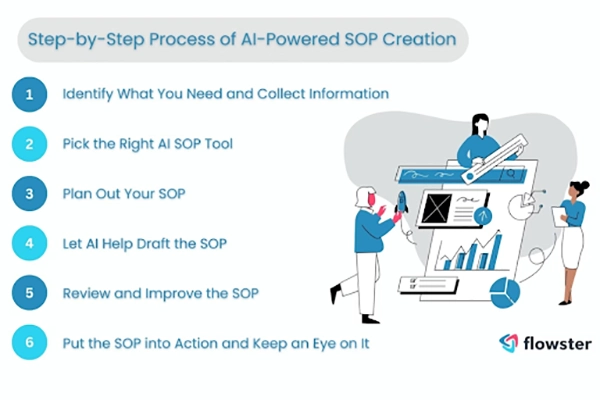
The following infographic lists all the steps involved in the AI-powered SOP creation process:
AI-powered tools drastically reduce the time required to create SOPs.
What once took hours or days now takes minutes. Teams can input raw data or recorded workflows.
And, AI converts them into structured, readable documents without even bringing the time constraint into the process.
This speed allows organizations to respond quickly to operational changes. Faster documentation also supports onboarding, as new employees receive up-to-date instructions without delay.
Therefore, the productivity multiplies.
Efficiency improves not only in creation but also in updates, since AI handles revisions seamlessly.
Businesses that embrace this approach eliminate bottlenecks and maintain momentum. The result feels like a smoother, more responsive workflow that keeps pace with evolving demands rather than following a constant rush.
Consistency defines the quality of any SOP, and AI ensures that every document follows a standardized format.
This makes the process uniform for all.
Manual efforts often lack this quality as they show variations in :
AI removes that inconsistency by applying predefined templates and rules.
Thus, each SOP maintains clarity, regardless of who initiates the process.
This uniformity helps teams understand instructions quickly and reduces misinterpretation.
Clear communication strengthens collaboration and minimizes errors in execution, making them look seamless.
Organizations benefit from a cohesive documentation system that reflects professionalism and precision.
Consistency no longer depends on individual effort; it becomes an automatic feature of the system that is easy to maintain and work with.
For any venture to be successful, it is important to stay constantly updated.
Business processes evolve constantly, and SOPs must reflect those changes without delay.
AI-powered systems track modifications and update documentation in real time.
Teams no longer need to rewrite entire documents after minor adjustments, which reduces the workload.
Instead, AI integrates changes seamlessly into existing SOPs. This adaptability ensures that employees always have access to the latest information.
It also reduces any confusion that outdated documents often cause. Organizations stay agile because their documentation evolves alongside their operations.
Real-time updates eliminate the risk of working with obsolete instructions. This approach strengthens accuracy and supports better decision-making across departments without slowing progress at the same time.
AI-driven SOP tools encourage collaboration by centralizing documentation in accessible platforms.
As a result, Team members can review, edit, and approve documents without long delays.
Shared access further ensures that everyone works with the same information, which reduces misunderstandings within the teams, promoting teamwork.
AI also supports version control, so teams can track changes and maintain transparency.
Accessibility improves because employees can retrieve SOPs from any location or device, making the task hassle-free in case it is lost on one system.
This flexibility supports remote work and global teams. Collaboration no longer depends on manual coordination; it becomes an integrated part of the system overall.
Organizations build stronger connections between teams and create a more unified workflow.
AI-powered SOP creation marks a clear shift away from traditional documentation methods.
It offers :
Organizations benefit from consistent, up-to-date, and scalable documentation that supports their growth.
Teams spend less time on repetitive tasks and more time on meaningful work. This change leads to multiple benefits, such as :
As AI continues to develop, its impact on SOP creation will only grow stronger. Businesses that adopt these tools position themselves for long-term success. The era of manual documentation fades, while AI-driven solutions define the future of operational excellence.
