

“Data is a precious thing and will last longer than the systems themselves.”
— Tim Berners-Lee (Computer Scientist)
AI has completely transformed how businesses operate. Now they automate workflows and generate insights at unprecedented speed. But as AI capabilities grow, so do the security risks surrounding the data, models, and systems that power them. A single vulnerability in an AI pipeline can expose sensitive information, compromise decision-making, or create large-scale operational risks. Risks like shadow AI add $670,000 to average breach costs, with insider risk driven by AI negligence costing organizations $10.3 million annually.
That is where an AI security platform becomes essential. They protect AI assets throughout their lifecycle so organizations innovate with confidence, keeping security, compliance, and trust firmly in place.
In this article, I’ll explain how this system protects data, models, and workflows across the AI lifecycle through monitoring, governance, access control, and risk management.
KEY TAKEAWAYS
- AI security platforms protect data, models, and workflows throughout the complete AI lifecycle.
- Security risks evolve from development to deployment, requiring continuous monitoring and oversight.
- Identity management and access controls reduce unauthorized access and insider threats.
- Strong AI security practices support compliance, build trust, and enable responsible AI growth.
It’s a system that works throughout the lifecycle, protecting:
As AI gets deeper into business operations, the security situation becomes even more complex. AI introduces new attack surfaces where data, models, and automated decisions require protection at every stage.
An AI security platform addresses these needs by providing centralized visibility, risk assessment, and controls tailored specifically for AI environments.
Modern enterprises often operate across cloud, on-prem, and hybrid infrastructures, making security management complex. Without a unified approach, teams may struggle to understand where data is stored, how it is used by AI systems, and who can access it. By aligning security practices with AI use cases, organizations can reduce exposure, prevent misuse, and ensure AI projects scale safely. This makes such platforms a critical foundation for responsible and secure AI adoption.
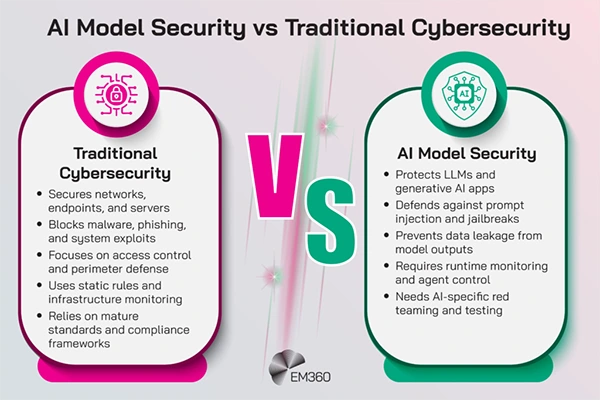
The following infographic lists all the differences between traditional and AI security:
AI systems take birth at their development and training stage. These stages also contain an organization’s most valuable information assets. Weak controls at this phase can create security gaps long before a model reaches production.
An AI security platform helps secure this process by providing:
By combining visibility, contextual intelligence, and automated safeguards, AI security platforms help organizations build and train AI models with greater confidence while protecting critical data assets from the earliest stages of development.
Launching an AI model into production does not mark the end of security concerns. In many cases, it becomes the point where risks become more dynamic and harder to predict.
Deployed models interact with live data, users, and connected applications, making them attractive targets for misuse, unauthorized access, and data leakage. This system helps secure production environments through:
By maintaining continuous visibility and proactive protection, AI security platforms help organizations operate AI systems safely, reduce operational risk, and ensure reliable performance in live production environments.
Access management sits at the center of AI security. Even the strongest systems become vulnerable when the wrong users have the wrong permissions.
An AI security platform centralizes control over who can access AI data, models, and tools, helping organizations reduce excessive permissions and strengthen governance across complex AI environments.
Key capabilities include:
By combining identity governance with continuous monitoring, AI security platforms help ensure that only authorized users and systems can interact with sensitive AI resources at the appropriate time.
AI ecosystems never remain static:
This makes just periodic security reviews inadequate. Continuous monitoring is essential to understand how risks change over time. An AI security platform provides ongoing visibility into data usage, model behavior, and access activity, allowing teams to detect issues as they arise. Automated risk scoring helps prioritize what needs attention, reducing noise and focusing efforts on the most critical exposures.
Policy enforcement is equally important. Security and compliance rules can be applied consistently across all AI assets, no matter where they are deployed. When violations occur, predefined actions such as alerts, access revocation, or workflow triggers can be initiated automatically. This combination of monitoring and enforcement enables organizations to stay ahead of threats without relying solely on manual processes. As AI adoption grows, this proactive approach becomes key to maintaining trust and resilience.
Governments and industry bodies are placing growing scrutiny on how organizations develop, deploy, and manage AI systems.
An AI security platform supports compliance by providing clear visibility into data sources, usage, and controls. This transparency makes it easier to demonstrate adherence to data protection laws, industry standards, and internal governance policies. Detailed reporting and audit trails help organizations respond confidently to regulatory inquiries and stakeholder concerns.
Beyond compliance, strong security practices build trust. Customers, partners, and employees want assurance that AI systems are used responsibly and securely. By embedding governance into everyday AI operations, organizations can show that innovation does not come at the expense of privacy or safety. Over time, this trust becomes a competitive advantage, enabling wider adoption of AI solutions while maintaining accountability and ethical integrity across the enterprise.
AI security is no longer limited to just IT. And for organizations building AI-driven products and operations, it’s nothing less than a strategic requirement.
From early development to production and ongoing operations, AI systems introduce unique risks that traditional security tools are not designed to handle. By offering unified visibility, access control, continuous monitoring, and governance, these platforms help organizations protect sensitive data and maintain control over complex AI environments.
As AI adoption accelerates, the ability to manage risk without slowing innovation becomes a defining factor for success. A well-implemented AI security platform enables teams to move faster with confidence, knowing that security, compliance, and trust are built into every stage of the AI lifecycle. Investing in the right security foundation today prepares organizations to scale AI responsibly and sustainably in the future.
