

Many businesses have embraced AI tools in their workflow, whether it’s for drafting content, summarizing a meeting, or sorting comprehensive data. But there’s a clear gap between using AI tools and actually transforming your total workflow.
That gap is where agentic AI comes in. A capable system that can reason through multi-step problems, take actions across various systems, and develop in real time, all without a prompt.
Here are twelve practical agentic AI uses that apply to virtually any company.
Table of Contents
- 12 Examples of Agentic AIWhat Makes AI “Agentic”?
- 1. Intelligent Call Handling and Reception
- 2. Customer Service Triage and Resolution
- 3. Real-Time Sales Coaching and Conversation Intelligence
- 4. IT Help Desk Automation
- 5. HR and Employee Onboarding
- 6. In-Conversation Employee Assistance
- 7. Financial Operations and Invoice Processing
- 8. Appointment Scheduling and Calendar Coordination
- 9. Quality Assurance and Compliance Monitoring
- 10. Omnichannel Context Continuity
- 11. Multilingual Interaction and Language Auto-Switching
- 12. Customizable Workflow Orchestration
- The Most Promising Agentic AI Platforms to Watch in 2026
- How Will Your Business Grow With Agentic AI?
- FAQs
The following are a few examples of real-world applications of agentic AI:
Before diving into agentic AI examples, it helps to understand what separates agentic AI from the traditional automation and AI tools most companies already have. Traditional AI follows rigid rules: if X happens, do Y. Agentic AI operates more like a capable employee.
AI agents can interpret context, make decision-making calls autonomously, coordinate across multiple systems, and adjust when conditions change — all within defined guardrails and clear escalation paths.
Where traditional AI requires continuous human intervention to move between steps, agentic AI systems handle that orchestration independently.
The success of any agentic AI work depends on several core capabilities: autonomous decision-making within set parameters, memory retention across different interactions, and multi-step execution of a task connected across various business platforms.
With that foundation in place, here are the agentic AI examples redefining how companies operate.
One of the most immediate agentic AI examples is replacing outdated IVR trees and voicemail boxes with AI agents that actually understand why someone is calling.
Rather than sending callers through a maze of menu options, an agentic AI agent greets callers, understands their intent, answers frequently asked questions, captures information, schedules appointments, and hands off to a human agent, preserving full contextual data.
This is especially valuable for businesses that depend on phone-based engagement. A healthcare practice, service company, or real estate firm that misses inbound calls is losing revenue in real time.
An agentic voice AI agent eliminates that problem by handling multiple calls simultaneously, operating around the clock, and integrating with CRMs so that every interaction—whether it results in a booking, a lead capture, or a transfer—carries full context forward.
These agentic AI tools increase real-time business intelligence, directly translating to captured revenue that would otherwise be lost to missed calls and hold queues, making this one of the agentic AI examples delivering measurable business value from day one.
Contact centers generate a large volume of interactions across chat, email, phone, and social channels. Agentic AI serves as the first line of response by not just handling tickets but actually fixing a significant share of regular tasks.
These AI agents don’t simply follow scripts; they apply contextual decision-making to assess each situation and determine the best path forward.
An agentic customer service AI agent can assess the nature and urgency of an inquiry, pull relevant customer data from connected databases, resolve routine tasks like order status checks, password resets, or billing questions, and escalate complex cases to human agents with a complete interaction summary already attached.
Industry forecasts from Gartner suggest that by 2029, agentic AI could autonomously handle the vast majority of routine customer service issues, fundamentally reshaping contact center staffing and operations.
The main difference is that these evolved AI agents make decisions on their own from end to end without any manual intervention at every step.

Sales teams generate hours of call recordings every week, but the insights buried in those conversations rarely surface fast enough to matter.
Agentic AI changes this by deploying AI agents that analyze live and recorded interactions, helping sales teams identify patterns in user behavior and customer sentiment, flag deal risks, and deliver coaching in real time through data analysis that would take human reviewers days to complete manually.
An agentic conversation intelligence system can monitor calls as they happen, score engagement and sentiment, highlight moments where a deal advanced or stalled, and generate coaching summaries for managers—all without requiring anyone to manually review recordings.
For sales teams managing high call volumes, this kind of AI intelligence layer converts every conversation into a learning point that improves the next one. The decision-making support provided helps teams focus on closing deals rather than spending hours on end doing manual work, making this one of the fastest maturing agentic AI use cases in corporate environments.
IT help desk environments are among the most natural settings for agentic AI implementation. Security teams and IT staff deal with high volumes of requests that range from routine tasks (password resets, access provisioning) to complex incidents (security breaches, system outages), and they require AI agents to work across multiple systems simultaneously, applying consistent decision-making at each step.
An agentic AI agent in this context can triage incoming tickets, determine severity and category, resolve straightforward issues autonomously, and escalate appropriately when human intervention and judgment are needed.
Security teams benefit particularly from AI agents that can monitor for anomalies around the clock, correlating signals across autonomous systems and flagging threats before they escalate.
The result is faster resolution times for users and more bandwidth for IT teams to work with, preventing repetitive troubleshooting issues. This is a core example of how agentic AI delivers operational efficiency.
New employee onboarding involves dozens of coordinated steps across human resources, IT, facilities, and management.
Agentic AI systems can copy this entire workflow, triggering account provisioning, sending welcome materials, scheduling orientation programs, enrolling employees in benefits systems, and following up on outstanding tasks without any single person needing to manually track every step.
The AI agents coordinating this process handle dozens of touchpoints across autonomous systems that would otherwise require manual follow-up.
Beyond onboarding, agentic AI agents handling human resources inquiries can handle common employee questions about PTO balances, benefits details, and company policies through natural conversation, pulling answers from internal knowledge bases.
Businesses that have adopted AI agents for HR purposes report great reductions in response time and administrative burden, freeing teams for strategic workforce planning.
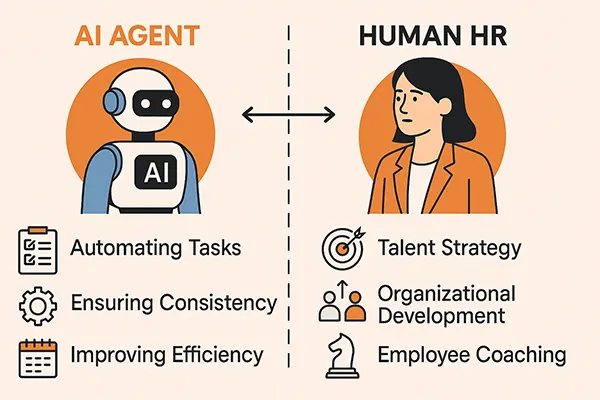
Not every agentic AI example is about automation running in the background. Some of the most valuable agentic AI applications happen during live interactions, providing real-time AI assistant capabilities to employees as they work.
An in-conversation AI agent can offer real-time transcription, intelligent search across knowledge bases, message composition assistance, and product or process guidance—all surfaced during a live call or meeting without the employee needing to leave the conversation.
Rather than replacing what employees do, this kind of AI agent removes friction from daily workflows—providing the right information at the right moment so business users can focus on the conversation instead of hunting through multiple systems and external tools.
Although the decision-making stays with the employee, the AI agent handles information retrieval. This is one of the agentic AI examples that shows how agentic AI depends on strong integration with existing platforms to deliver real value.
Finance teams spend significant time on manual document handling: processing invoices, matching purchase orders, verifying compliance, and chasing approvals. Agentic AI agents can handle the repetitive elements of these workflows while applying judgment to exceptions that would otherwise require human intervention.
An agentic AI agent in financial processes is capable of extracting customer data from invoices, irrespective of the original format, cross-referencing purchase orders and contracts, routing approvals based on organizational rules, flagging anomalies for human review, and processing payments once all conditions are met.
The distinction from traditional AI and robotic process automation is the AI agent’s ability to handle variation—invoices with unusual formatting, missing fields, or amounts that fall outside normal parameters without breaking the workflow.
Every step in this chain is logged automatically, simplifying the audit and compliance reviews, delivering value to the business through its operational efficiency.
Did You Know?
Unlike basic scripts that break when a website changes its layout and interface, agentic AI uses multimodal models to “see” the new layout, locate buttons, and continue working
Scheduling across multiple people, time zones, and calendars is a perennial productivity drain. Agentic AI agents can manage this complexity by interpreting scheduling requests, checking availability across participants, proposing optimal times, sending invitations, and rescheduling when conflicts arise.
The decision-making involved—weighing preferences, time zones, and priorities—is exactly the kind of contextual reasoning agentic AI handles well.
For customer-facing businesses, this extends to client-facing scheduling too. Healthcare providers using agentic AI solutions, for example, can let patients book, reschedule, or confirm appointments through a phone conversation with an AI agent, freeing front-desk staff for in-person patient care.
These agentic AI solutions show how AI agents can handle user behavior patterns to optimize scheduling over time.
Manual quality assurance processes are inherently limited by sample size. A human QA team might review a few hundred interactions per month.
Agentic AI systems can monitor every interaction at scale, with AI agents flagging compliance risks, scoring quality against defined criteria, and identifying patterns through data analysis that indicate systemic issues—enabling decision-making based on complete data rather than small samples.
The scale difference is massive. Organizations that previously manually audited a few hundred calls per month are now using AI-powered management to audit thousands monthly.
This kind of comprehensive coverage, powered by agentic AI tools that track user behavior across thousands of interactions, provides a far more accurate picture of operational quality and risk exposure.
It substantially reduces reliance on human intervention for routine monitoring while maintaining appropriate escalation paths for edge cases that require judgment.
Many customers don’t interact with a business through a single channel. A conversation that starts as a phone call may continue over SMS, pick back up through a messaging app, and eventually require a transfer to a live agent.
In traditional service environments, each channel resets interactions, with customers having to re-explain their concerns, and agents starting from scratch without context. Agentic AI transforms this completely by treating every connected conversation as a continuous thread, instead of disconnected ones.
An agentic AI system built for omnichannel continuity can carry intent, verification status, prior responses, and action history across voice, SMS, and digital messaging so neither the customer nor any human agent who inherits the conversation ever has to start from scratch.
This is more than a convenience improvement. For businesses handling high interaction volumes, context loss at channel transitions is a direct driver of repeat contacts, escalations, and customer frustration.
When an AI agent can hand another agent a complete and structured summary of every task performed that has already happened on a separate channel, resolution times drop drastically, and first-contact resolution rates improve.
As customers increasingly expect seamless cross-channel experiences, this becomes a competitive differentiator, not just an operational efficiency.
Language barriers create a predictable bottleneck for organizations like regional hospital systems and international businesses that serve diverse populations.
A caller who doesn’t speak the dominant language gets placed on hold while a suitable agent is located, transferred between departments, or simply abandons the call completely. Each of those results carries a cost: a missed appointment, an unresolved service request, or a patient who doesn’t receive the care they called about.
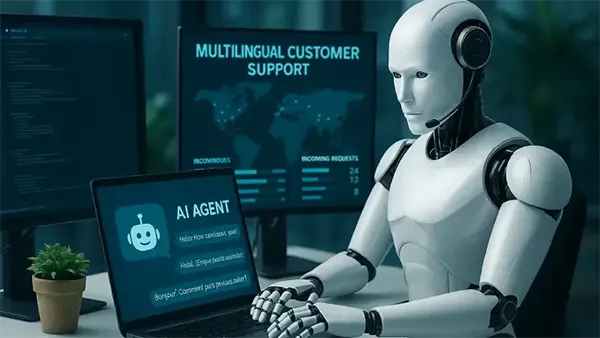
Agentic AI eliminates this bottleneck by detecting a caller’s language automatically from the first few words of a conversation and switching into that language without any delay, menu selection, or manual routing.
If a conversation shifts mid-call, as it sometimes does when a patient is speaking on behalf of a family member or a customer switches between languages naturally, the AI agent adjusts in real time without losing the thread of the interaction.
The operational benefits compound exponentially at scale, with average handle times dropping because there’s no delay in transfer. First-contact resolution rates improve because the caller is understood from the start.
And the experience itself signals to the caller that the organization is prepared to serve them, which matters particularly in high-stakes environments like healthcare, where communication clarity directly affects outcomes.
Perhaps the most ambitious agentic AI example is also the one with the highest ceiling: connecting AI agents across workflows so that workflows end-to-end without manual handoffs.
Instead of AI systems conducting isolated tasks, orchestrated agentic AI networks share context and coordinate decision-making across the organization through multiple systems working in concert.
What makes modern orchestration different from traditional automation is where the intelligence lives. Older workflow tools execute a fixed sequence of steps.
Agentic orchestration gives each agent the ability to reason—interpreting the state of a workflow, deciding what to do next, pulling from connected knowledge sources, and triggering downstream actions—all within boundaries that humans define in advance.
Business teams establish certain parameters to limit actions and permissions an agent is authorized to take, that includes escalation and integrations it can access.
The agent operates solely within those guidelines, handling varying requests and exceptions that basic automation would break on.
With the use cases clear, the next question is where to start. The agentic AI platform market is maturing quickly, and the vendors gaining the most traction are those combining autonomous AI agent capabilities with enterprise-grade orchestration, governance, and integration.
Here are the agentic AI platforms worth evaluating as you plan your strategy—because the right platform depends on where your highest-value agentic AI examples sit.
RingCentral — RingCentral’s agentic AI platform spans the full conversation lifecycle through an integrated product suite: AI Receptionist (AIR) for automatic inbound call handling and lead capture, AI Virtual Assistant (AVA) for real-time in-conversation employee support, and AI Conversation Expert (ACE) for post-interaction analytics and coaching.
AI Representative (AIR Pro) is a packaged, voice-first intelligent virtual agent designed for mid-market and enterprise organizations that want agentic AI outcomes quickly.
It ships with vertical-ready templates, a no-code Agent Studio interface, a built-in knowledge hub, multi-language support with auto-switching, and conversation and ROI analytics from day one.
Dialpad — Dialpad positions itself as an AI-native communications platform, with a proprietary large language model. Its agent platform includes voice and chat AI agents that can resolve common customer requests autonomously without pre-training or decision trees.
Dialpad’s strength lies in real-time transcription and coaching processes incorporated directly into the communications layer, along with a no-code agent builder.
It is best suited for mid-market businesses, particularly revenue and support teams that want AI included across both UCaas and CCaaS. Some advanced features and marketplace capabilities are still maturing.
Five9 — Five9’s Genius AI Suite brings agent capabilities to its cloud contact center platform, with AI agents that can handle informational, actionable, and fully agentic interactions across voice and digital channels.
The platform’s agentic experience engine delivers personalized, goal-driven customer journeys with adjustable levels of AI input and human oversight.
Five9 is strongest in high-volume, regulated contact center environments—financial services, healthcare, and insurance—where AI-to-human handoff quality, customer data governance, and security teams’ compliance requirements are critical.
Its shift toward interaction-based pricing reflects where the CCaaS market is headed, though it remains primarily a contact center play rather than a full unified communications platform.

Genesys — Genesys Cloud is introducing an Agentic Virtual Agent powered by Large Action Models rather than relying solely on LLMs, an approach designed to prioritize deterministic task execution over text generation.
Built into Genesys Cloud AI studio, it grants CX leaders control over the AI agent limits, permissions, and audit trails. It also excels in complex, global enterprise deployments that require multiple channel coordination, advanced workforce management, and deep customization.
Its AI roadmap includes support for open standards for cross-platform AI agent collaboration. Pricing and implementation complexity can be significant for smaller organizations.
Nextiva — Nextiva’s Unified-CXM platform combines voice, video, SMS, and chat communications with AI-powered virtual agents and its XBert AI receptionist.
Nextiva emphasizes ease of deployment and transparent pricing, with XBert available at $99 per month, including 100 conversations—making AI-powered call handling accessible for SMBs and mid-market companies.
Its intelligent virtual AI agents handle scheduling, routing, and FAQ resolution with a no-code setup, and the platform includes real-time sentiment analysis and agent coaching.
Nextiva is a solid choice for small and growing businesses that want AI-enhanced call handling without a steep learning curve.
Its agent capabilities are less mature than those of platforms with dedicated agent orchestration layers.
ServiceNow — While not a communications platform, ServiceNow’s AI agent capabilities are worth noting for organizations focused on IT service management, HR, and internal workflow orchestration.
Its Now Assist AI agents operate across IT service management, HR case management, and customer workflows with deep integration into enterprise systems of record. ServiceNow’s strength is in turning its existing workflow automation footprint into a multi-agent orchestration platform where AI agents coordinate routine tasks end-to-end.
For companies that are already part of the ServiceNow ecosystem, its capabilities offer a natural extension, though it doesn’t address voice AI or communications-layer use cases without a partner platform.
UiPath — UiPath’s Maestro platform extends its robotic process automation leadership into agent territory, enabling organizations to build AI agents that combine traditional automation with reasoning powered by large language models.
Its key advantage is deep connectivity to legacy enterprise systems like SAP, built-in governance and compliance guardrails inherited from its robotic process automation heritage, and an orchestration layer for coordinating multiple AI agents across business processes.
UiPath is a strong candidate for organizations with heavy back-office automation needs—finance, procurement, supply chain—where AI agents need to interact with autonomous systems that lack modern APIs.
Each of these platforms takes a different approach, and the right choice depends on where your highest-value agentic AI examples sit.
Organizations whose workflows center on customer and employee conversations will benefit from platforms that natively embed intelligence into the communications layer.
Those focused on back-office process automation or IT workflow orchestration may find better alignment with workflow-first platforms. In either case, the deciding factors in 2026 are integration depth, human oversight controls, and the ability to scale AI agents across multiple systems without creating new silos.
