

In the field of content, artificial intelligence has penetrated everywhere, from blogs and product descriptions to even email campaigns. AI is helping businesses to augment their output.
At the same time, there is a concern brewing in the larger society. The AI-slop is unable to connect with the masses. 55% of online users prefer human content over NLP-generated one, 62% of them being Millennials (Source).
Techzeel deals with MNCs in providing them with custom software solutions. And let’s accept this: all of them are using AI in their content department at least. But many of them are having a problem where their matter has stopped ranking on search engines. A common thread across all the deranking ones is that they have not invested in humanizing their content before publishing. The words are perfectly there, but they’re entirely soulless.
In this article, I’ll explain why straightaway copying and pasting the generative output won’t take you far, why even humanize AI content, and how to implement a strategy for the same.
KEY TAKEAWAYS
- People are rejecting AI-generated content and firms that rely on it.
- Humane material has more value than AI slop.
- You should humanize your content properly before publishing.
Chatbots like ChatGPT or Claude are Large Language Models (LLMs). They are trained on large datasets of text for language comprehension and writing. Their writing output is generally well-structured and grammatically accurate. And the speed and scale are miles ahead of a human writer.
But that doesn’t make AI material compelling. Raw generative output tends to be generic, repetitive, and lacking the subtle qualities that make writing feel authentic — things like personality, cultural awareness, lived experience, and emotional intelligence.
When a potential customer lands on your website and reads content that feels templated or robotic, it erodes trust before a conversation even begins. In industries where credibility matters — technology, finance, healthcare, consulting — that first impression can make or break a deal.
The following infographic lists the major reasons why AI output needs humanization:
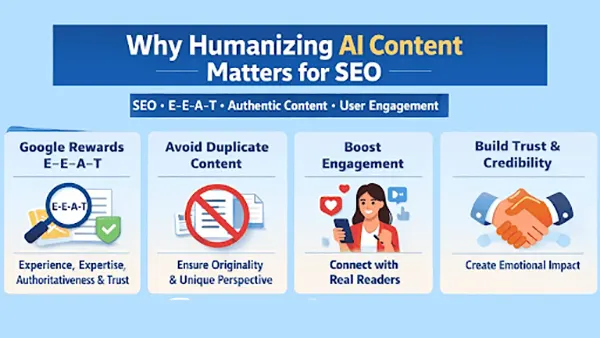
Humanizing is not like decorating a wall with portraits so that people don’t notice the generic AI wall behind. It’s about ensuring the final output reflects your brand’s unique voice, speaks to your audience’s real concerns, and reads like it was crafted by someone who understands the subject matter deeply.
In practice, this means pairing efficiency of artificial intelligence with human editorial judgment. SMEs need to review and refine AI drafts so the material carries genuine insight, not just generic and surface-level information. It means injecting storytelling, real-world examples, and a conversational tone that makes readers feel like they’re engaging with a knowledgeable partner rather than reading a Wikipedia entry.
At Techzeel, our approach to digital consultancy has always been rooted in understanding the human side of technology. Whether we’re engineering a custom software platform or advising on content strategy, we believe that the best digital experiences are the ones that feel personal — even when they’re powered by sophisticated systems behind the scenes.
If your firm also employs generative content, please follow some best practices so that your customers don’t immediately write off your material as soon as they see it:
AI is capable of end-to-end production, and that too at a scale that was never imaginable with a human workforce. But that doesn’t mean it should be used like that.
The companies that will win the content game aren’t the ones producing the most; they’re the ones producing work that feels real, relevant, and unmistakably human. In a digital landscape saturated with machine-generated noise, authenticity isn’t just a nice-to-have. It’s a competitive advantage.
At Techzeel, we help businesses bridge the gap between cutting-edge technology and meaningful human connection. If you’re ready to elevate your digital presence with material that actually resonates, let’s talk.
Ans: Artificial intelligence accelerates output and even overcomes writer’s block.
Ans: Keep a conversational tone and varied lengths of sentences; also include personal anecdotes.
Ans: The rule restricts automation to 30% of any specific task; the other 70% needs to be handled by humans like before.
