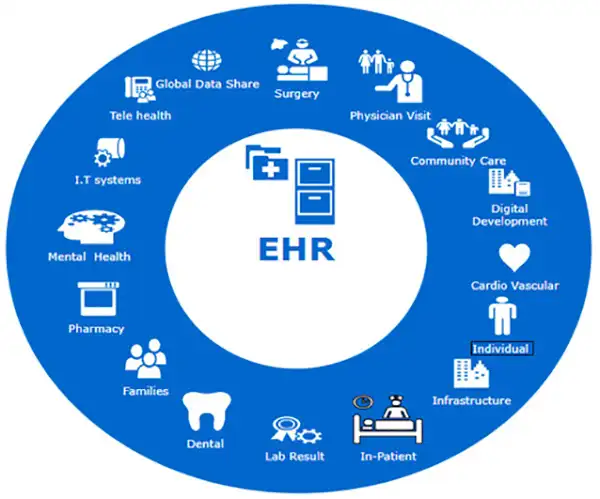
Are you wondering how a reliable infrastructure, such as EHR, can shape the digital confidence in healthcare? Well, the answer is here.
As mentioned in Tebra’s survey,40%of providers state that mobile EHR access is extremely important.
Hence, this article aims to discuss the importance of a reliable EHR network, analyse how the EHR developer copes with the problems in these systems, identify the problems with this system, and more!
Key Takeaways
- Fragmentation does not announce itself
- System lagging leads to a culture shift
- The stress of expansion
- Governance is not an optional choice
- Reactions to recovery as an afterthought
- Scaling without structural foresight
- Adoption does not happen automatically
- Why predictability matters more than speed
- Small frictions that matter
Healthcare organizations do not collapse because they lack data. They struggle because data becomes scattered.
Intake information may exist in one module. Lab updates in another. Billing platforms function independently. Staff switches tabs constantly. Notes are entered twice. Corrections are made quietly.
At first, nothing breaks. Work simply feels heavier.
Over time, that heaviness shows up as:
• Repeated verification
• Slower collaboration
• Uneven reporting
• Subtle delays that affect scheduling
Fragmentation rarely feels dramatic. It feels tiring.
A well-structured EHR does not remove complexity from healthcare. It aligns it. It centralizes movement, so information travels in one organized path instead of several disconnected ones.
Efficiency, in this context, is not acceleration. It is alignment.
When systems lag, the difference between consistent systems and the inconsistent ones becomes visible.
On one hand, teams that are confident about their systems upgrade to early task completions without hinderance leading to growth.
Whereas, on the other hand, teams that doubt the systems they are working on seem to grow suspicious of the efficiency leading to double checks, which procrastinates the tasks and slows the growth.
These effects are subtle. They are rarely measured directly. Yet they shape daily experience.
Platforms like Onstipe operate on a similar principle in digital engagement. When scattered content is unified into one consistent stream, brand perception strengthens. Inside healthcare, unified internal systems create comparable stability.
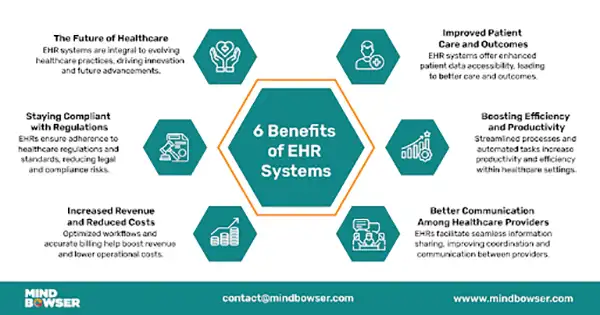
The benefits of an ideal EHR can be seen as follows :
Picture a regional healthcare provider introducing remote consultation services. Patient volume increases steadily. What worked comfortably at lower capacity begins to strain. Reports refresh slowly. Cross-department updates lag by minutes instead of seconds.
Nothing crashes outright. But pressure builds.
After restructuring database layers and consolidating integrations, performance stabilizes. The visible improvement is speed. The invisible improvement is clarity. Departments no longer second-guess information flow.
That difference rarely comes from cosmetic adjustments. It comes from structural recalibration.
Fun Fact The Mayo Clinic in Rochester, Minnesota, was one of the major systems to adopt an EHR.
Healthcare operates under constant regulatory oversight. Audit requests arrive without warning. Documentation must be produced quickly and accurately.
If logging mechanisms are inconsistent, stress follows. Staff manually reconstruct timelines. Departments coordinate hurried explanations.
When audit tracking is built into the EHR architecture from the start, compliance becomes procedural. Access histories are structured. Updates are timestamped automatically. Retrieval is straightforward.
Preparedness reduces pressure. Reduced pressure improves performance.
Data loss does not always come from large cyber incidents. Sometimes it is a server failure. A corrupted update. A failed synchronization between modules.
When recovery planning is not part of the original architecture, the response becomes improvised. Teams search for the most recent backup. Restoration takes longer than expected. Certain records reappear incomplete. Confidence drops.
In healthcare, even short disruptions create tension. Clinicians cannot wait while records rebuild. Administrators cannot delay reporting deadlines. Every minute of downtime feels amplified.
Recovery readiness should not depend on emergency improvisation. It should be embedded into the environment from the start. Redundant storage layers, structured replication, and tested restore procedures reduce panic when something unexpected happens.
The difference between a recoverable disruption and a reputational crisis often lies in preparation. And preparation begins during development, not after deployment.
Growth introduces variables. More users. More records. More simultaneous queries.
Without thoughtful planning, performance degrades gradually. Response times lengthen. Integrations become unstable under load.
This is where the foresight of a capable EHR developer becomes evident, as they anticipate database growth. Designing flexible schemas. Planning for concurrency before volume increases.
Scalability should feel natural. It should not require rebuilding foundational layers each time demand shifts.
Even strong systems encounter hesitation. Healthcare professionals are cautious for good reason. Workflow changes affect patient care directly.
If a platform feels overly complex, resistance appears quietly. Teams create parallel documentation. Workarounds emerge.
When development aligns with actual clinical routines rather than theoretical processes, adoption improves. Simplicity reduces resistance. Familiar navigation patterns lower hesitation.
Technology integrates more smoothly when it respects existing practice rather than attempting to overwrite it.
In a critical sector like healthcare, consistency is the key. A system that works consistently and develops trust in customers is a system that healthcare requires.
Even minor delays can create dissatisfaction amongst people working on those systems, driving them to a second choice.
A system that is predictable, works consistently, and causes no delays is the one that best suits the healthcare sector, where the focus is completion of task without delays them indulging in the complexities of the tool.
Inside a clinical setting, people rarely discuss architecture diagrams. They notice other things.
Small frictions accumulate. So does their removal.
A stable EHR does not draw attention. It simply reduces background noise.
Electronic Health Record systems have set a benchmark for communication in healthcare, allowing information to be accessible easily, improving speed and interactions—something that modern healthcare app development services continue to enhance through more connected and scalable digital solutions.
The qualities, such as dependability, steadiness, and no constant requirement for checking back, make it a suitable fit for the health sector, where the demand for records is endless.
Ans: EHR contributes to providing the medical history of patients online.
Ans: Epic Systems Corporation serves as the largest provider of EHR systems, working for over 40 years.
Ans: The EHR system helps in improving communication by allowing messages and other electronic communication between patients and doctors.
Ans: Patient portals make medical help easily accessible to patients and other people associated with them.