

With the evolution of technology, financial services have transformed too in recent years. Tech is not just a fancy tool anymore, but the sole force behind efficiency, innovation, and customer satisfaction.
Technology has become the frontrunner by directly influencing various facets of the industry, boosting productivity and security, and creating opportunities for businesses and consumers.
This article will explore the many benefits that tech tools provide in financial services, which benefit the industry as a whole by offering personalized solutions and enhanced operations, etc.
Key Takeaways
- Enhanced security and prevention
- Personalized finance solutions
- Improvement in customer experience
- Better regulatory compliance
One of the most significant advantages of leveraging tech tools in financial services is the increased efficiency in operations.
Manual processes that once took hours or days can now be completed in mere seconds. Financial institutions rely on automation to handle routine tasks such as data entry, transaction processing, and compliance checks. Automation reduces the chance of human error and speeds up workflows, ultimately leading to faster services and lower operational costs.
Customer support is handled way better now. With advanced support platforms fully assisted by AI, businesses can now offer 24/7 support without overworking the employees.
Many inquiries are resolved by these virtual assistants without the need for human intervention; this kind of efficiency amplifies the customer experience while also reducing overhead expenses for financial institutions.
Sensitive and business financial data is kept by the financial sector, so security is naturally one of their primary concerns. The protection of this kind of data required human presence in the past.
However, cybersecurity features have made it possible for more advanced security measures that provide way more efficiency than traditional alternatives.
Today, machine learning algorithms are used to monitor transactions in real-time, flagging any behavior that appears fraudulent. These tools can spot patterns and detect anomalies far faster and more accurately than a human ever could.
Moreover, with multi-factor authentication, encryption technologies, and biometric verification methods, consumers can feel more confident knowing that their data is protected by state-of-the-art systems.
The use of these technologies significantly reduces the risk of cyberattacks and financial fraud, which is crucial for maintaining the trust of clients and ensuring the longevity of financial institutions. According to TechCrunch, staying on top of these innovations is key to staying competitive in the financial services industry.
Personalized solutions have now been made available to financial services with the help of technological tools.
Therefore, by analyzing data of customers through AI, these institutions can gain insight into a person’s investment preferences, goals, and spending habits. Companies can then create more customized recommendations made specifically for the individual.
For example, robo-advisors use algorithms to suggest investment portfolios based on a client’s risk tolerance and long-term objectives. These platforms democratize access to wealth management, enabling users to receive personalized financial advice without the high fees typically associated with traditional financial advisors. The result is a more inclusive financial landscape where consumers at all income levels can access services once reserved for the wealthy.
Additionally, banks and fintech companies can use technology to create personalized loan offers or credit card plans that match a customer’s financial profile. This increases customer satisfaction and fosters a sense of loyalty, as clients feel that their specific needs are being addressed.
Fun Fact
The sub-Saharan region has the highest concentration of mobile money accounts and transactions per capita globally, revolutionizing how financial services are delivered.
Technology has opened doors to financial services for people who were previously excluded from the system. One of the most notable impacts of tech tools in finance is the rise of mobile banking and digital wallets. These services make it easier for individuals to manage their money, transfer funds, and even pay for goods and services—all from the palm of their hand.
Many people living in underdeveloped regions can now access mobile money services and make transactions, invest, and change preferences without the need for a physical bank branch to be present in close proximity.
Furthermore, tech tools such as blockchain are creating decentralized financial systems that do not rely on traditional banks, enabling peer-to-peer transactions that are faster, cheaper, and more transparent. For those without access to banking infrastructure, blockchain offers a way to securely transfer funds across borders with minimal fees.

Investors can now access more data and real-time information than ever before, thanks to technology. Stock trading platforms and investment apps allow users to monitor market movements, track portfolios, and execute trades instantly. Real-time analytics and predictive models powered by AI and big data provide investors with valuable insights into market trends and potential opportunities.
AI is able to analyze great amounts of data and create a forecast in minimal time, making investing more efficient and accurate. This has leveled the playing field, allowing retail investors to compete with institutional investors who traditionally had a technological edge.
Moreover, a broader audience has taken notice of these platforms and has started to access them without even the need to have experience in the field to understand them.
As a result, the world of finance is more inclusive, empowering people to grow their wealth with minimal investment knowledge.
Technology has changed the perception of financial services, often seen as intimidating at first, requiring regular interactions and heaps of paperwork, now only requiring a mobile phone to access.
Thus, the experience of customers has become a lot more user-friendly with online investment platforms, apps, and much more to help out the customer with any support.
For example, chatbots on financial websites can instantly provide answers to basic queries, while AI-driven tools can guide customers through more complex processes, such as applying for a mortgage or setting up a retirement account. The seamless nature of these services encourages customers to engage more with their financial institutions and take an active role in managing their finances.
Tech tools also make it easier for consumers to compare financial products, whether it’s finding the best savings account or the lowest interest rate on a loan. With websites offering side-by-side comparisons, individuals can make informed decisions without the pressure of traditional sales tactics.
Regulatory compliance has always been a significant concern for financial institutions, but tech tools are simplifying this complex process. Technology helps businesses stay on top of changing regulations, ensuring that they meet compliance standards without dedicating vast resources to manual checks.
AI and machine learning can automatically monitor transactions for potential violations, ensuring that all financial activities adhere to relevant laws. With automated compliance tools, institutions can reduce the risk of penalties and lawsuits, while also speeding up the process of meeting regulatory requirements. Furthermore, technology allows for better transparency, enabling businesses to track and document every step of their compliance journey.
This increased efficiency and accuracy in compliance ultimately enhances the reputation of financial institutions and improves trust with their customers. By using tech tools to streamline regulatory processes, financial firms can focus on growth while avoiding costly regulatory issues.
Check out this illustration to know more about the advantages of the integration of technology in finance:
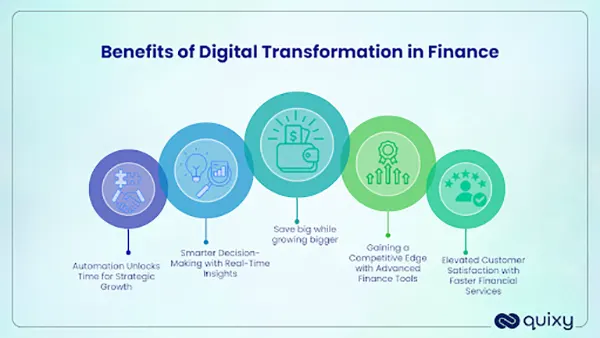
Integration of technology in the financial sector has reshaped the industry entirely by providing customers with personalized experiences, ease of access, and more, all the while improving efficiency and security of existing systems.
For businesses that want to stay ahead of the competition, will have to adopt AI and technology into their workflow to remain competitive. Whether it’s investing in AI, blockchain, or user-friendly platforms like stock trading tools, technology is the key to unlocking future growth in financial services.
Ans: Many of the tasks speed up, provide a better customer experience, enhance security, and provide real-time insights into the market and investment opportunities.
Ans: The following are the challenges that are faced when adopting these tools:
Ans: AI is responsible for automating and streamlining the workflow of many tasks so that the focus remains on more important tasks of the financial services.
Ans: With the usage of cybersecurity technology, sensitive and important documents and consumer databases are now protected with even tougher security systems.
