
In-house infrastructure and managed services are two unique technical setups with different types of risk, responsibility, and cost to the company in the long term.
Hardware, downtime, staffing, scalability, and compliance are all shaped by the decision of choosing which setup to go with for the organization.
In this guide, we have outlined some factors, challenges, key things, and how to deal with them for the long term for each model, to assist you in making the final choice for the firm.
Key Takeaways
- Financial projection and budget control
- Operational Flexibility and Scalability potential
- Risk Management and Security
- Long-term impact of both setups
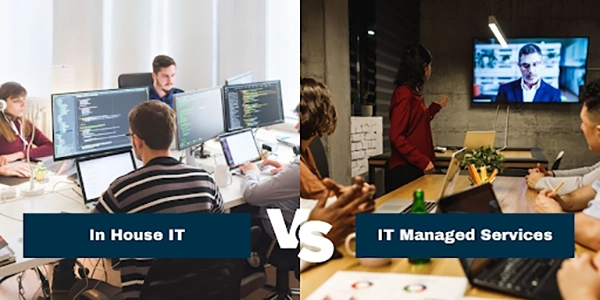
When you decide to build everything in-house, the first thing you notice is the upfront bill. Servers, storage arrays, networking gear, backup systems—it adds up quickly. You don’t just buy equipment; you invest in capacity you hope will last years. However, hardware ages fast, and performance expectations rarely stand still.
Beyond the purchase price, you deal with ongoing maintenance and refresh cycles. Components fail, firmware needs updates, and warranties expire. You schedule upgrades carefully, yet they still disrupt workflows. Moreover, every replacement restarts the spending cycle, which makes long-term planning more complex than it looks on paper.
Another major expense organizations have to deal with is staffing, as skilled individuals are expensive to hire. Specialists are needed for each department to improve the functioning of the firm.
Moreover, the benefits, salaries, and training programs all increase the expense, putting more burden on the company.
Downtime hurts more than most spreadsheets show. When systems crash, teams stop working, customers get frustrated, and leadership demands answers. You see the financial impact immediately, yet the reputational cost lingers longer. Even a few hours of disruption can undo weeks of productivity and strain internal confidence.
The in-house infrastructure needs upfront investment, which is a large amount, to function correctly because these funds of the organization get tied up in one place, which could have been used to support other fronts.
As a result, the flexibility of a firm is limited to a great extent, whereas subscription-based models help leadership plan better by distributing costs more evenly to various departments, providing confidence.
Hidden expenses quietly expand your budget. Power consumption, cooling systems, rack space, and physical security all cost money. You might not notice these items at first, yet they show up month after month. Over time, they inflate operational spending far beyond the original hardware purchase.
Growth creates another challenge. When your company scales quickly or experiences seasonal demand spikes, your infrastructure must keep up. That often means buying additional hardware before you fully utilize what you already own. Moreover, unused capacity sits idle, which translates into wasted capital.
When you compare the total cost of ownership over several years, the picture becomes clearer. It’s not just about purchase price; it’s about maintenance, staffing, energy, and risk. Many companies eventually explore managed infrastructure services to balance costs and gain more predictable monthly spending.
Did You Know?
Managed services provide around a 25-45% reduction in overall IT costs compared to in-house infrastructure management.
Hiring experienced infrastructure engineers takes time and money. The talent pool remains competitive, and strong candidates often weigh multiple offers. You compete not only on salary but also on flexibility, culture, and growth opportunities. That pressure raises recruitment costs significantly.
As technology is constantly changing and evolving, the employees need constant training and updation to their certifications, which adds another layer of investment in the mix.
Additionally, smaller teams end up facing heavier workloads. One security alert or a tight deadline can stretch everyone thin and lead to exhaustion and burnout.
As a result, morale drops, slow response,s and instability among teams become imminent and unavoidable.
Knowledge concentration poses a serious risk. If one key engineer leaves, they take critical system insights with them. Documentation rarely captures every nuance. However, rebuilding that expertise takes months, and during that period, your infrastructure remains more vulnerable.

Provisioning new users or launching applications often takes longer with fixed, in-house systems. You must check capacity, configure hardware, and sometimes order additional components. That delay slows down business initiatives. In contrast, more flexible models enable faster deployment and smoother onboarding.
Adaptable resource allocation benefits everyone; instead of demanding extra servers for high traffic times, the capacity automatically adjusts. This helps teams test ideas without heavy financial commitments, as there is less wastage of funds.
WFH (Work from home) and hybrid models demand flexible infrastructure, and secure access to the company’s utilities is expected at all times. This type of environment requires networking, access management, and close monitoring
Alignment between infrastructure and business strategy matters deeply. If your systems can’t scale alongside growth, you create bottlenecks. However, when IT adapts quickly, it becomes a growth driver instead of a constraint. That flexibility directly influences how confidently leadership pursues new opportunities.
Regulatory compliance requires continuous attention. You must document processes, track configurations, and prepare for audits regularly. This effort consumes time and resources. Moreover, failing to meet compliance standards exposes your organization to fines and reputational damage that far exceed operational costs.
Security investments go beyond installing a firewall. You need monitoring tools, intrusion detection, vulnerability scanning, and consistent patch management. Each layer strengthens protection, yet each layer also increases complexity. Without dedicated focus, small gaps can turn into serious breaches.
Moreover, preparation and discipline are needed during incident response. Roles are to be defined, potential attacks are simulated, etc., but handling real incidents requires immense experience, and without that, the response times suffer, and recovery takes longer.
Security breaches lead to sensitive data getting compromised, this created financial strain and issues. The legal costs, compensation, and other claims add up fast.
So, a single lapse in security breaks the trust of the customers and the relationship between them.
When IT operates purely as a cost center, leadership often minimizes investment. That mindset restricts innovation and slows progress. However, infrastructure can also serve as a strategic enabler when it supports rapid experimentation and reliable performance across all departments.
Executive attention carries real value. If leaders spend excessive time resolving infrastructure issues, they lose focus on growth initiatives. Moreover, constant firefighting drains energy that should fuel product development and market expansion efforts.
The speed of innovating things depends on our own system’s capabilities. If the deployment workflow functions smoothly, then everything speeds up, but delays in integration slow down that momentum.
The efficiency of conduction operations secures a competitive positioning as architecture, and trusted systems create a better foundation. This allows firms to respond to changing trends in the market, strengthening performance and resilience.
Check out this quick comparison between in-house infrastructure management and managed services, and decide for yourselves which serves your organization better:
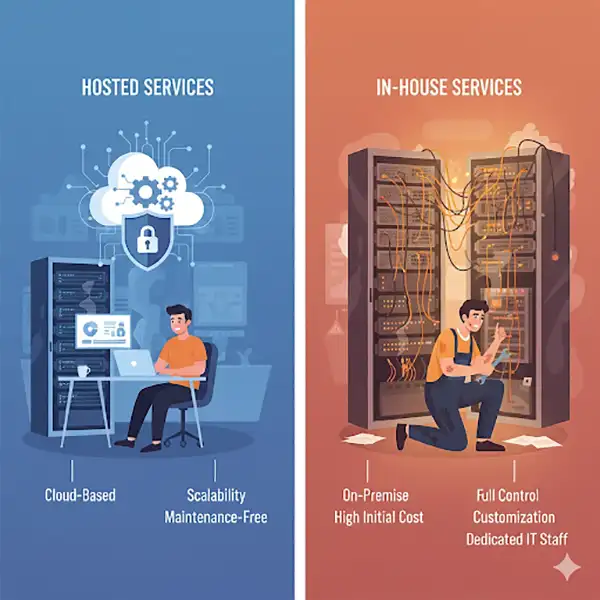
The choice of infrastructure strategy is vital for an organization as it affects all the departments and single-handedly influences cash flow and agility.
Although in-house management gives you control, it also depends on constant supervision and attention, whereas managed services excel in that space and shift that burden, improving predictability.
However, the right choice depends on the company’s risk tolerance, planning, and internal capacity. That is why knowing the full picture of each setup is essential to making a decision.
Ans: For most of the organizations, managed services provide better ROI, reduced downtime, and lower overall expenses.
Ans: Managed services provide better security and 24/7 monitoring, leading to reduced risk of breach of data.
Ans: The hybrid model combines internal staff for oversight with managed services for increased efficiency and skills.
Ans: Managed services allow scaling to match the business’s requirements, whereas in-house requires a slow and expensive hiring process.
